
Braden Hess focuses on judiciary in run for Senate District 7 seat
-
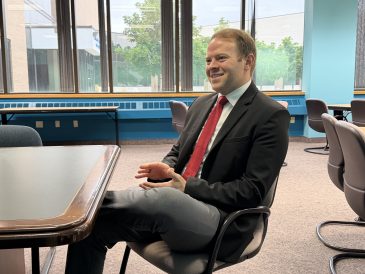
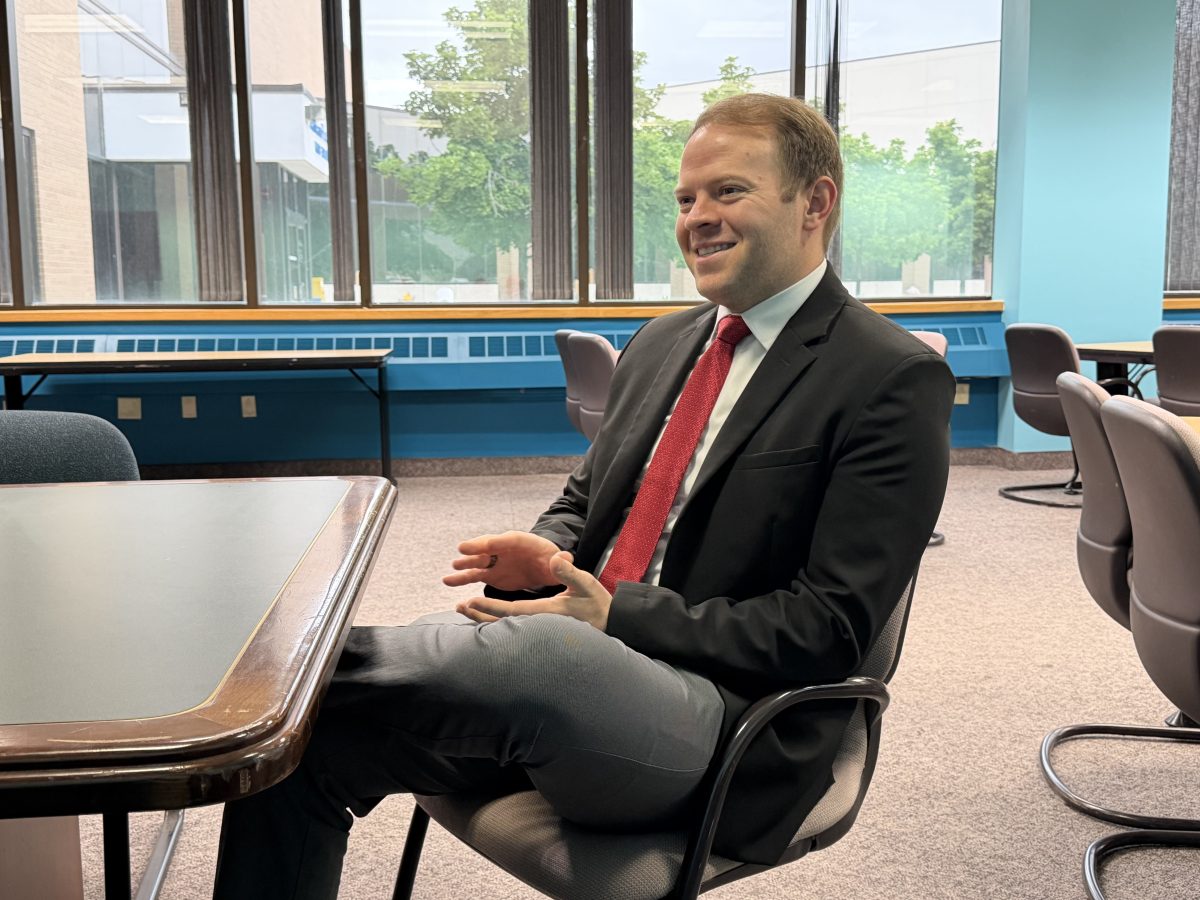
- Braden Hess, competing in the Republican primary for the Senate District 7 seat in Utah, participates in a candidate interview at the Standard-Examiner office on Monday, May 18, 2026. (Rob Nielsen, Standard-Examiner)
-
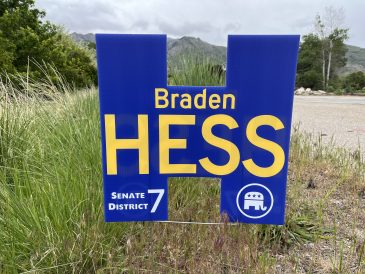
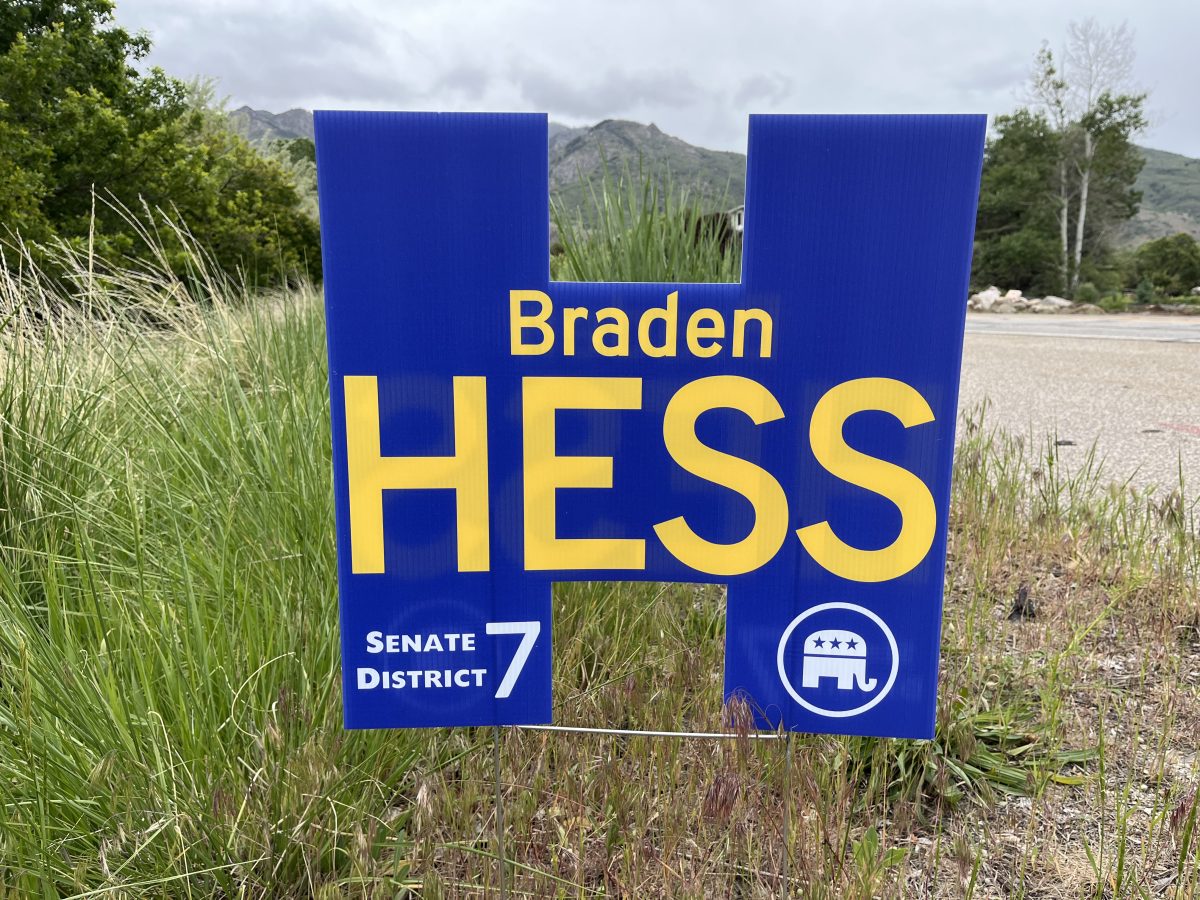
- A campaign sign for Braden Hess, competing in the Republican primary for the Senate District 7 seat in Utah, on Sunday, May 17, 2026. (Ryan Comer, Standard-Examiner)
Rob Nielsen, Standard-Examiner
Braden Hess, competing in the Republican primary for the Senate District 7 seat in Utah, participates in a candidate interview at the Standard-Examiner office on Monday, May 18, 2026. (Rob Nielsen, Standard-Examiner)
Braden Hess was an attorney drafting bills for the Utah Legislature and providing legal guidance on the Constitution.
There was a problem, though.
“It’s a nonpartisan position, and I’m a pretty partisan person, so I realized I was in the wrong place,” he said.
So, he quit his job and decided to start his own law firm with the intention of eventually running for elected office.
Now, he is, and he’s challenging the Senate president, Stuart Adams, as well as Stephanie Hollist in the Republican primary in Senate District 7.
Ryan Comer, Standard-Examiner
A campaign sign for Braden Hess, competing in the Republican primary for the Senate District 7 seat in Utah, on Sunday, May 17, 2026. (Ryan Comer, Standard-Examiner)
Political insider and outsider
Hess is not a political insider in the sense that he hasn’t held elected office before, but he’s not exactly an outsider given his history working with legislators.
His political journey, he said, started in about 2014 when he was on his mission for The Church of Jesus Christ of Latter-day Saints in England.
At the time, Brexit was a big deal. Hess said he didn’t really care about politics much at the time, but he realized it was an issue that mattered a lot.
He returned home and started doing some research and realized that his morals were tied with his political beliefs. He started taking political science and economics courses and graduated with a degree in both.
He went on to do internships for U.S. Rep. Chris Stewart and former Cache Valley representative Edward Redd.
He saw law as “a natural progression” of where he wanted to go and subsequently went to law school at the University of Maryland.
“Because I love politics, I wanted to be close to D.C.,” he said.
After law school, he got a job with the Legislative Research and General Council, or LRGC, drafting bills and providing guidance on the Constitution.
“But I saw, while I was drafting them, I had opinions about how I thought they should be drafted, about what the law should say, and so I thought I was on the wrong side of the desk,” he said.”
The judiciary
Hess said the number one reason he’s running is the judiciary.
He said that it has concerned him to see how the judiciary has been handled by the Legislature.
Prop 4 is a key issue for Hess. He said he’s a fan of repealing it. He said it’s not just the Utah Supreme Court that people should be worried about but that a lower court judge “had a significant impact in how that law was implemented.”
He also blamed current senators for their roles.
“They confirmed judges that I believe that they shouldn’t have,” he said. “It really boils down to the thoroughness of their questions during the confirmation hearings. In some instances, when I watched each of the confirmation hearings for the Supreme Court and several other lower court judges, they only asked one or two legal questions, which is not nearly enough to find out what someone’s judicial philosophy is.”
Hess said the most important factor in deciding a judge in Utah is how the Constitution is viewed – whether it’s viewed as “a living, breathing document that changes as our language evolves and as people’s understanding of the Constitution changes, or is it a concrete document that should be interpreted based off of the original intent of when the document was created.”
He said senators need to figure out a judge’s “particular positions on specific issues in the Constitution.”
He acknowledged that sometimes judges won’t answer those kinds of questions because it may impact a case they’re hearing or one they might hear, but he called them “vital questions” that help show how that judge will “interpret the Constitution and represent the values of Utah.”
Hess said if they aren’t willing to answer those questions, he’s willing to vote no on confirming them.
“We need to know what their philosophy is before they even sit on the bench, rather than confirming them, having them sit on the bench, and then bring these cases, or rule on these cases, and us just being absolutely astounded as to how they went about doing that,” he said.
Hess said the Senate aligns more with his judicial priorities.
“It’s the Senate that confirms judges, so I wanted to get in there and actually vet the judges, because I don’t think that was going on enough,” he said. “The last Supreme Court justice that was confirmed, John Nielsen, I think they did a better job of vetting him, but still, I’d like to see more of that.
“And President Adams being in charge of the entire Senate had a significant impact on whether these judges actually got confirmed or not. So even though he wasn’t a part of the confirmation hearings, he orchestrated a lot of the actual confirmation itself. So that’s why I wanted to run for the Senate in particular, why I wanted to challenge the president of the Senate. It’s either brave or foolish, but really, it boils down to providing that alternative for people.
“I don’t hate Stuart Adams. I think he’s done a lot of good, too. But there comes a point where you’ve been in office long enough and the district needs to be represented by the next generation.”
Prop 4’s importance
In explaining why the Prop 4 issue is so important to him, Hess said it boils down to the language of the Constitution.
“That’s what’s most important to me,” he said. “If a slim majority, like what happened with Prop 4 in 2018, is able to pass something that the Legislature can’t touch, it’s not following what the Constitution says, no matter what the Supreme Court thinks it says.
“To me, the Constitution is very clear that it’s the Legislature’s power to control redistricting. So if we want to change that, it shouldn’t be through statute. It needs to be a constitutional amendment. So when it comes to why it’s such an important thing for me, it really boils down to I want to protect the Constitution so that I can protect future generations and the legacy that we’ve inherited so that it can be passed on.”
Hess said, ultimately, he thinks districts should be drawn “directly by people who are directly elected by the citizenry.”
Background
Hess said 90% of his history comes from the district. He said he was born at Davis Hospital (when it was called Davis Hospital) and was raised in Kaysville. He went to Davis High School and Utah State University for his undergraduate degree. He said his roots come from Farmington.
“I’m a Hess and we’ve got some deep, deep roots in Farmington,” he said.
He said his family decided to buy a home in Kaysville to be close to family.
Box Elder County data center
Hess said he is neutral on the existence of data centers and he thinks the government should be as well.
“It shouldn’t be that because it’s so big and unfamiliar that we don’t allow it to come to fruition, but at the same time, we also shouldn’t be providing political favors, government subsidies, tax subsidies or energy or water incentives, or making those resources cheaper for them,” he said.
He said he has “a negative view” of The Military Installation Development Authority, or MIDA.
“I think MIDA is another government entity that shouldn’t even exist,” he said. “That was just an expansion of government I’m not in favor of.”
Taxes
Hess said his number two issue is reforming the tax system.
“President Adams and the Legislature have been cutting the income tax piece by piece, but we’ve got a governor who’s willing to directly address the income tax,” Hess said. “He’s talked about eliminating it, is what I’ve understood. So while we’ve got somebody that’s supportive of that, rather than slowly getting rid of the income tax, we should follow the lead of other states that have eliminated the income tax and just get rid of it.
“I think a cleaner cut would be better. Ultimately, it’s my belief that we need to have a tax system that doesn’t penalize people for doing the very things we want them to do, like earning income or owning property.”
He said Utah could shift away from those tax systems and more toward a sales and use tax.
Concluding statement
As part of his concluding statement, Hess emphasized his familiarity with the Legislature and said he could hit the ground running.
“I’m a native to Davis County, so I know exactly what the people are wanting, what they need out of a representative, as well as I’m a strong conservative, free-market candidate who loves limited government and wants to protect the Constitution so that we can pass it on to the next generation,” he said. “We need a fresh set of eyes, a fresh perspective from a senator, and I want to be that alternative to what we’ve had, not because (Adams) has done a terrible job, but because it’s time for turnover.”
For more information on Hess and his campaign, visit https://www.electbradenhess.com/
Contact Standard-Examiner editor Ryan Comer at rcomer@standard.net.
Local News

Weber County 4-H members assemble care kits for county correctional officers in observance of 9/11 Day of Service

Volunteer opportunities available at local organizations
