Senate President Stuart Adams: ‘I’m at the top of my game’
-
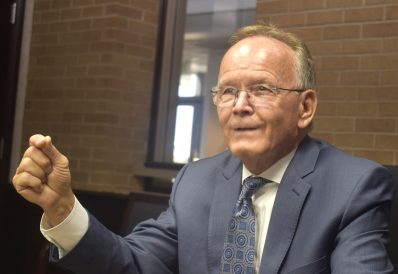
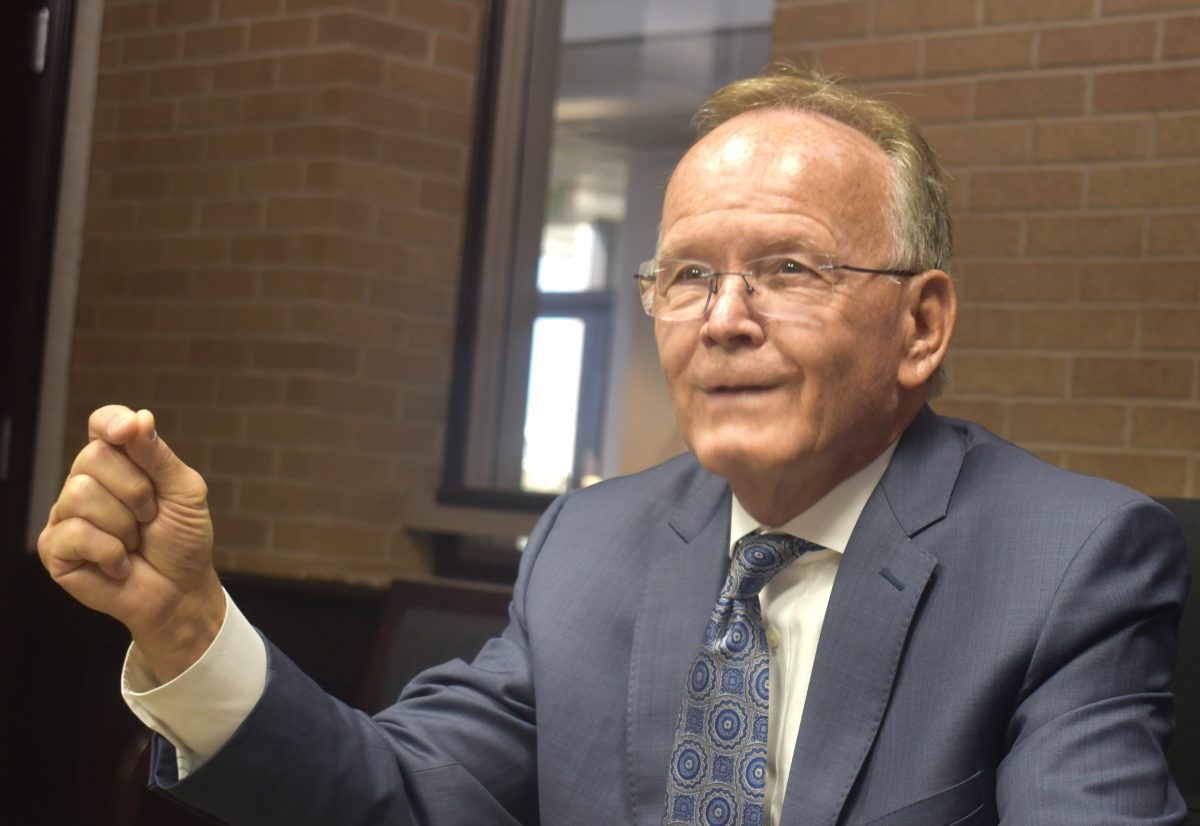
- Utah Senate President Stuart Adams, competing in the Republican primary for the District 7 seat, participates in a candidate interview at the Standard-Examiner office on Thursday, June 4, 2026. (Jared Lloyd, Standard-Examiner)
-
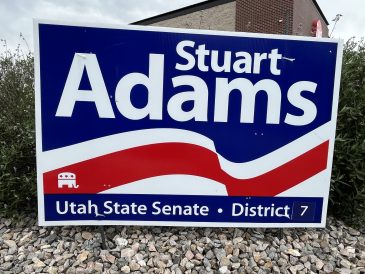
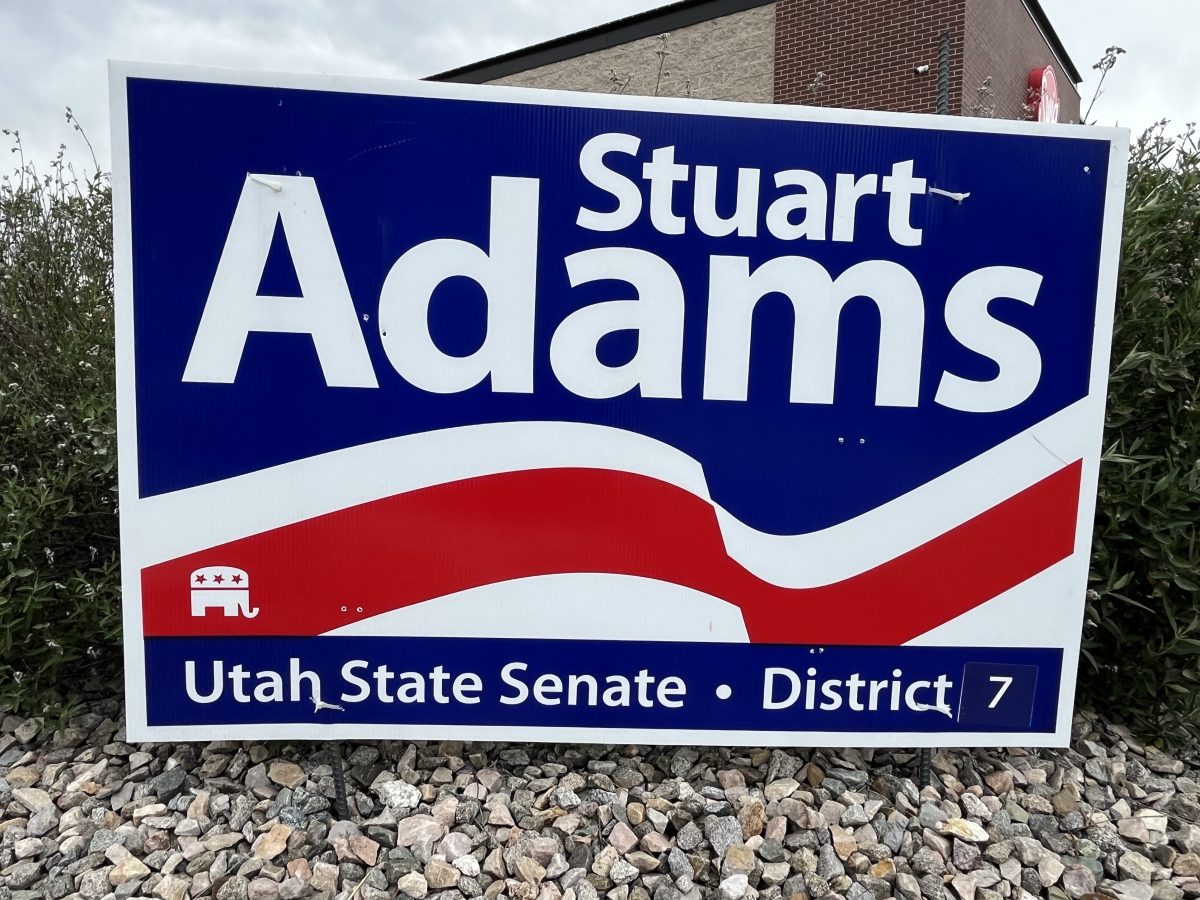
- A campaign sign for Utah Senate President Stuart Adams, competing in the Republican primary for the Senate District 7 seat, on Wednesday, May 13, 2026. (Ryan Comer, Standard-Examiner)
Jared Lloyd, Standard-Examiner
Utah Senate President Stuart Adams, competing in the Republican primary for the District 7 seat, participates in a candidate interview at the Standard-Examiner office on Thursday, June 4, 2026. (Jared Lloyd, Standard-Examiner)
Utah Senate President Stuart Adams was discussing with the Standard-Examiner editorial board his views on the Box Elder County data center when his campaign manager interjected with some breaking news.
Kevin O’Leary had just agreed to Adams’ demands and was going to comply with everything, he said.
“He what?” asked Adams, with seemingly a hint of surprise in his voice.
There was no attempt at a negotiation on size or anything and every demand was accepted, Adams was told.
Adams appeared to be somewhat at a loss for words.
Ryan Comer, Standard-Examiner
A campaign sign for Utah Senate President Stuart Adams, competing in the Republican primary for the Senate District 7 seat, on Wednesday, May 13, 2026. (Ryan Comer, Standard-Examiner)
“Does that surprise you?” Adams was asked by a member of the editorial board.
“It does,” he said. “We’ve been going the rounds.”
The Box Elder County data center has catapulted into arguably the biggest issue of the 2026 primary season.
O’Leary’s plan was for a 40,000-acre data center, and Adams wanted to reduce it by 75%.
“Why 75%?” Adams was asked by the editorial board.
“I figured that 10,000 acres was enough,” Adams said. “I mean, it’s enough.”
Pressed further, he said:
“I think his overall footprint is 2,500 acres, and that gives him four times his footprint. 10,000’s enough. It was a good number. It probably hasn’t been done scientifically, but it seems like a good number.”
Adams said if it needs to be 40,000 due to future growth because of AI’s importance, O’Leary can go through another permitting process.
Explaining the data center
In discussing the “big picture” of the data center, Adams referred to the nuclear arms race with the Soviet Union. He said he didn’t believe Mikhail Gorbachev would have taken down the Berlin Wall if the United States didn’t have superior military technology.
Adams said the arms race has moved to AI. He said he went to Ukraine as part of a 30-person group from Utah and met with President Volodymyr Zelenskyy and realized that warfare had changed to drones – AI-driven drones.
“So militarily, we know we have to have superior AI technology,” Adams said. “And then if you’re going to survive in the economy, AI is going to be part of that economic competitiveness. And if you want to be competitive in the world, you’re going to have to understand AI. So both economically and militarily, AI is going to be needed.”
That brought Adams to the importance of energy, space and data.
“We just permitted the first nuclear manufacturing plant in Box Elder County,” he said. “We have to find a way to solve our energy problem. Now, not only does AI need energy, it does need data centers. Kind of a tough word right now. But we knew that … been talked about for years.”
Fifteen months ago, during the 2025 legislative session, Adams said Rocky Mountain Power, data center users and members of the public – “the smartest minds we could find in the nation, in the world” – were consulted.
“And we started to say, ‘Let’s try to solve this problem,'” Adams said. “Scott Sandall ran the legislation, and what the legislation basically said is if you’re a data center, you want to come to Utah … you’ve got to do a couple of things. One is you’ve got to produce your own dang power. You’re not going to come onto our grid and raise our rates. We have the lowest electric rates. I hope somebody screams that from the rooftops. … And we’re going to protect those fiercely. … And then, if you’re going to come into Utah, and produce your own power, we don’t want you to be able to run out of power, tap onto the grid. You’ve got to produce more than your own power. And you’ve got to sell it back onto the grid to be able to give us the extra capacity. And you can’t mess up our water. … The old data centers were like swamp coolers. … But the new data centers are either closed loop system, like in a radiator in a car, or they’re all electric. And those … are the only we’re going to allow.
“And so we have a user right now that came in and said, ‘I will produce more power because I found a pipeline, a gas pipeline, and I will produce more power than I need. I will sell it back onto the grid.’ But it was unclear as to what he wanted to do. So … I sent him a letter, and I wanted to clarify where we were at. He had 40,000 acres. I said, ‘Reduce it by 75%.’ And we’d had our Division of Water Resources – they told me that there’s zero water from those 40,000 acres that make it to the Great Salt Lake currently. Not even the aquifer gets there. … And if we’re going to stay true to the criteria that we put in, I said, ‘You’ve got to build the most water-efficient plant, the best technology on the market today, and you’re going to have excess water because there’s water on the property that exists that’s not making it to the Great Salt Lake. You’re going to take that water that exists on that ground, and you’re going to deliver it to the Great Salt Lake.'”
Adams mentioned a list of other demands.
“One of the things I asked for is he has to set up a website with a public face to it … and there’s a whole bunch of things he has to do,” Adams said. “He’s going to have to build a building. He’s got to get a permit. He’s going to have to build a road. He’s going to have to get all the approvals. He’s going to have to get air quality approvals. He’s going to have to get water approvals. He’s going to have to get a whole boatload of approvals. … I want him to have a public-facing website where the citizens of Utah can act (so) we don’t go through this again – this public, horrible process that got misinformation spread everywhere. We need the public involved, but we need them involved so that they’re educated and understand the processes.”
Reelection bid
As he runs for reelection for District 7, Adams touted several reported statistics that are favorable to Utah. He cited the U.S. News and World Report ranking Utah as the top state in the country three years in a row. He cited Utah being named the No. 1 state in economic outlook for the 19th consecutive year, according to the Rich States, Poor States: ALEC-Laffer State Economic Competitive Index. He cited analysis from the Urban Institute that showed from 1970 to 2023, the median income in Utah rose 78%, or $40,280, the highest of any state during that period.
Adams said he credits the people in Utah first.
“I’d like to take credit for it,” he said. “I think I had a role. It doesn’t happen by chance. But there’s a lot of people that had a role in it. I believe it’s the people, and I believe the Legislature is a reflection of those people, hardworking.”
Among other accomplishments, Adams pointed out that Utah has cut its income tax six straight years. He said those who make under $90,000 a year don’t pay any Social Security income tax in Utah. He said he’s working to get rid of the Social Security tax completely. He cited a $1,000 child tax credit.
He said every state wants to cut taxes, but it’s hard to cut taxes and deliver services. Nevertheless, he said, Utah has the fifth highest starting teacher salaries in the country, according to the National Education Association.
He cited infrastructure improvements, saying Utah has built more infrastructure than any other state per capita.
“I want to try to continue the policies we’ve had in the past … and I am involved in some things that I want to finish, and I believe there’s good people that want to run, and I support that, but I believe I’ve got experience and talents, and right now, I’m at the top of my game, and I have relationships and everything else that I can use to actually help (to do) some of the things that are going on,” Adams said.
Housing
Adams said that he’s “lockstep” with Governor Spencer Cox on housing.
“We are not going to be a state of renters,” he said.
He said there has to be a way to get people into homes.
“And part of it is, increase the capacity, increase the product, increase the supply, and make sure we keep the supply ahead of the demand,” he said. “And we focus on getting kids into homes and not focus on apartments. And that’s kind of what I want to do.”
Other priorities
Adams said he has a bunch of things from specific to broad that he wants to accomplish with another term.
He said another freeway isn’t going to be built through Davis County, so to fix the gridlock, FrontRunner needs to be fixed.
“You ought to be able to get places faster,” he said. “And if you can get places as fast on FrontRunner as you can in a car, you’ll fill the train. And right now, we’re in the middle of it. We’re trying to double track it. We’re trying to get express trains. We’re trying to do those type of things. That’s a very specific thing that I’m in the middle of that I think my constituents would be very supportive of, and I don’t think other people really understand or have the background or experience that I do, and that’s what I bring to the table is I think I can help get that done.”
He said he wants to have air mobility taxis by the time the Olympics come to Utah in 2034.
He said he would like to do away with the income tax.
“People shudder when I say that because it funds education, and you can pay for education out of other funds,” he said. “And I probably ought to be saying instead of getting rid of the income tax, I want to replace the income tax. It’s probably a better way to say it. But there’s ways to do that.”
One big-picture issue Adams mentioned involved critical minerals. He cited a Wall Street Journal report on Ionic Mineral Technologies, a Utah County-based company that, according to the report, “said it discovered high grades of 16 different types of minerals, everything from lithium to alumina, germanium, rubidium, cesium, vanadium and niobium at the site in Utah’s Silicon Ridge.”
The report explained China’s dominance in the critical minerals market and said the minerals “are used in everything from semiconductors for electronics to defense.”
“I want to try to solve the problems of the world now,” Adams said. “There’s no bigger problem right now than critical minerals. You use them for F-35s, F-15s, all of the battery production – these critical minerals. And you’ve got to have them for the day-to-day life and your cell phones, everything else. So Utah, and I’ll say it one more time, America is the hope of the world. I believe it with a passion. … Utah is the hope of America and I believe Utah is the hope of the world, and I have a passion to try to finish some things that I’m involved in.
“I’m running again not because I enjoy this process because I am getting the crap kicked out of me. I’ll just tell you that much. The false media reports and the hit pieces on me are staggering. They’re just absolutely ridiculous. It’s not fun for my family. It’s not fun for my wife. It’s not a fun process. It’s become brutal, quite frankly. I don’t need this in my life. But I believe I have something to give, I believe I have something to offer, and … I have the type of background experience that can move these things forward I’m talking about.”
For more information on Adams and his campaign, visit https://votestuartadams.com/
Contact Standard-Examiner editor Ryan Comer at rcomer@standard.net.
Local News
Making a splash: GEHA, Ogden City Recreation expand no-cost swimming program

Duane Kearsley focuses on ‘smart growth,’ citing background, in Weber County Commission Seat A race