
Roy City Council sets 55.45% property tax increase cap after testy discussion; Saxton opposes
Ryan Comer, Standard-Examiner
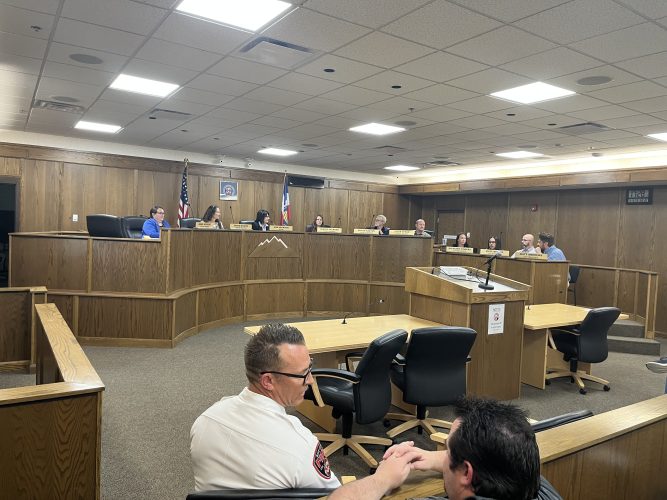
The Roy City Council members at the Roy Municipal Building City Council Chambers prior to meeting on Tuesday, May 5, 2026, in Roy. From left to right on the dais, Council member Janel Hulbert, Council member Diane Wilson, Mayor Ann Jackson, Council member Alexis Jackson, Council member Bryon Saxton and Council Member Jason Sphar.The following is part one in a three-part series on Tuesday’s Roy City Council meeting. Part two will focus on a presentation delivered during the meeting by Roy City Council woman Alexis Jackson. Part three will focus on reaction.
Bryon Saxton used the word “entrenched” to describe the Roy City Council members and the positions they’ve taken in the ongoing discussion of the city’s potential property tax increase after the City Council met Tuesday night.
During the three-plus hour meeting, Saxton vigorously defended his proposal to lower the proposed percentage increase while other council members – most notably Diane Wilson and Alexis Jackson – challenged him.
The main point of disagreement was related to Saxton’s proposal to only increase the property tax rate by about 18% this year.
According to Roy’s proposed 2026-27 budget, the general fund has a revenue shortage of $455,321, which would be made up with an 8.99% increase. That shortage comes from not passing a tax increase last year to align with the cost-of-living adjustment, or COLA. The COLA increase for Fiscal Year 2027 would require $481,523, or a 9.51% increase. Finally, but most importantly for the purposes of Tuesday’s discussion, was a wage correction amounting to $1,870,901, requiring a 36.95% increase.
The total property tax revenue addition would be $2,807,745, or 55.45%.
Saxton’s plan effectively accounted for the COLA adjustments but left questions about the wage corrections.
The conversation took an adversarial turn when it was Saxton’s turn to speak. Saxton was repeatedly interrupted by Wilson.
“When you talked, I listened,” Saxton told her.
“OK, if you want me to listen. I’m fine. I thought it was a discussion. Sorry about that.” Wilson responded.
Saxton said the council had a “two-year window to fix this tax increase.”
In a back-and-forth with Jackson, Jackson emphasized that her issue with it was that it didn’t account for wage corrections.
“That addresses COLAs alone,” she said. “It does not touch the wage correction, and that’s where I get the hang up because what that does is keep us where we’re at – below average, and it doesn’t get us any closer to the goal. So to me, I don’t see a way out with 18% because, otherwise, you just stay where we are, below average, and you don’t address the wage gaps.”
Council member Janel Hulbert also took issue with Saxton.
“First, I don’t think it’s fair to say we’re all against you, because I don’t think that’s true,” she said.
Saxton responded: “I didn’t say that.”
Hulbert replied: “Well, you always say, ‘You guys,’ I’m just saying that I don’t think that’s fair, because we’re all individuals and we all have different ideas, just like you.”
Hulbert said she thought it would have to be more than 18% because of the wage corrections. She added that she thought Saxton had “some good ideas” and she wasn’t against spreading the increase out. She said she wanted to see how it “would work exactly.”
Saxton then elaborated on his idea.
“I thought the goal was to get to a point where we can make smaller incremental increases, and the only way I can see that is we start it now, while we are a council, and start it this year,” he said. “Because if we start it next year, then on the second year, there’s no guarantee. With this, we have a two-year window to fix it.”
Saxton was referring to the fact that terms for three of the council members (he, Jackson and Jason Sphar) are up next year, which could result in three new council members.
Jackson continued to emphasize the need to address wage corrections.
“There’s got to be a better way than creating an historic high,” Saxton said.
Jackson agreed there were still a few weeks left to decide.
The adoption of the final Fiscal Year 2027 budget and the 2026 certified tax rate will take place on Aug. 11.
“Just so you collectively all understand, I’m not giving up and I’m probably voting nay to the (55%), and that’s fine,” Saxton said. “Just so we’re clear.”
Responded Jackson:
“But let’s keep working on it, please? You and I and Amber (Kelley)?” Jackson said. “Let’s sit down and let’s see what else. Then if this doesn’t get to the wage corrections, what can we settle on? What can we find that will make a dent? Is it possible the two-year thing? Because if it is, we’re going to have to address a part of that wage correction this year and then part of it next year. So let’s keep working on it?”
Ultimately, Resolution 26-17, which adopts the interim budget for Roy for the fiscal year from July 1, 2026, to June 30, 2027, passed 3-2. In addition to Saxton, Hulbert also voted nay, though that was the result of a differing opinion on cuts that were stipulated in the motion.
Three different motions were made.
Wilson made a motion to proceed with 55.45% as the cap while cutting Friday Roy Days events and also the Roy Days art show.
There was confusion about how to word the motion, and before a second was requested, Jackson interjected to ask how she could make a countermotion.
She was told what to say, and she proceeded to make a countermotion to proceed with 55.45% as the cap while cutting Roy Days fireworks from the budget.
A second was requested, but then Hulbert asked a question. After it was answered, a second was again requested, but none was given.
Hulbert then made a countermotion to proceed with the 55.45% as the cap but proposed to take out the Friday night movie at Roy Days. It also didn’t get a second.
It then reverted back to the initial motion, which was Wilson’s. Sphar seconded it and later broke a 2-2 tie in the roll-call vote.
Two more resolutions related to adopting a tentative property tax levy as well as a property tax impact schedule passed 4-1, with only Saxton dissenting.
Also earlier in the meeting, the City Council passed Resolution 26-16, “A Resolution of the Roy City Council Expressing Its Intent to Annex and Requesting Annexation into the Weber Fire District for Fire, Ems, and Related Services; and Establishing the Service Area to be Annexed.”
Contact Standard-Examiner editor Ryan Comer at rcomer@standard.net.