Roy City Council member Alexis Jackson addresses property tax increase concerns
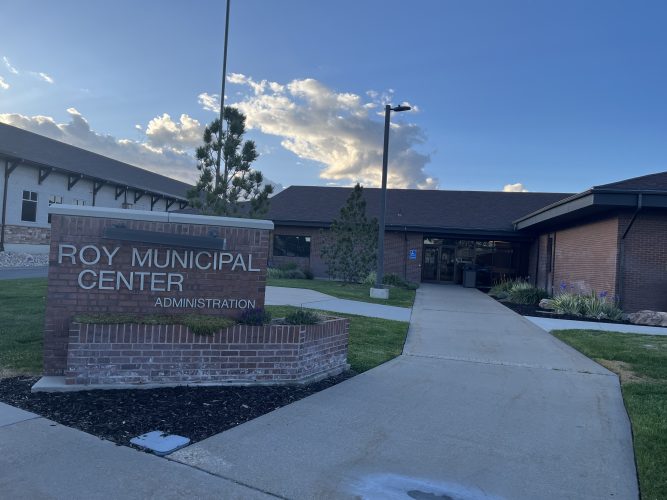
Ryan Comer, Standard-Examiner
The Roy Municipal Building on Tuesday, May 5, 2026.The following is part two in a three-part series on Tuesday’s Roy City Council meeting. Part one focused on a discussion during the meeting, while part three will focus on reaction to Council member Alexis Jackson’s presentation and the meeting.
Roy City Council member Alexis Jackson delivered a nearly hour-long presentation at the beginning of Tuesday’s City Council meeting to address the possible 55.45% property tax increase.
She said she wanted to present the options that she had looked at and be “very clear” that she was “as thorough” as she could have been.
“I have done hours and hours and hours of research to understand this from every angle, from the residents, to the staff, to the services, and the budget and the numbers,” she said.
Wage study results
In addressing where the budget shortfall was coming from, Jackson said that 100% of the tax increase “is intended to benefit full-time employee wages,” which she said includes fire, police, public works, parks and recreation, administrative, the court, human resources, and more.
She said 61.55% of the increase is for public safety.
In a follow-up email, Jackson explained that a professional wage study was done by TechNet for Roy in 2018 but not implemented at the time.
“This year, an internal wage committee consisting of two council members (not myself), the mayor, and fiscal staff consulted TechNet databases to analyze positions across several participating neighboring and comparable cities,” she said in the email. “Position analysis included parameters such as job title, salary, and job descriptions. Adjustments were made to accommodate positions that had no comparable match, and these processes were verified with an independent contractor who does salary surveys. I compared the methodology between Roy City’s wage study and the compensation study Baker Tilly did for Weber County in 2025 and found the processes to be comparable. (Weber County’s contract and wage study presentation can be found on their website, and the contract reflects a 7-month implementation timeline.) The extreme turnover we have faced required immediate information and action. I look forward to pushing for and implementing an updated independent wage study as we address the current staffing issues.”
Explaining the results of the wage study during the City Council meeting, Jackson said it was found that eight positions were less than 5% below average, nine positions were 5%-10% below, 26 were 10%-15% below, 24 were 15%-20% below, five were 20%-25% below and 10 were over 25% below. The low was 44.41% and the average percent below was 15.13%, she said. She said only three of the 83 positions were at or above average.
She had a slide that listed a number of positions that were shown to be underpaid, including the fire captain at 15.10% below, the chief of police at 12.31% below, the police captain at 15.56% below, the prosecutor at 19.18% below and the IT supervisor at 44.41% below.
Turnover
Jackson said underpaid employees is causing turnover and cited it as a factor in closing a fire station in December.
“And so that’s something that’s frightening to me,” she said. “I don’t feel like compromising on public safety, at least. And there are other things as well that I don’t want to compromise on, as far as interrupted services. This is something that we have to get to stop. With high turnover, you lose institutional knowledge. You have supervisors who are training people who may be … six months in the city, as is the case in the court clerk position. And that’s actually a particular position that’s high, high turnover, and … consistently about six months (in the city) are the people training the others.”
She said there are also applicant challenges.
“We are fortunate to have some who have been able to be hired on such low starting wages, but we have found that there have been some where they’re being hired, they’re accepting a lower rate, the qualifications of many of those individuals go down, and those people end up getting dismissed,” she said. “And so that’s another concern with high turnover. We also find there’s a very high cost with rehiring, especially in specialist departments such as public safety, when you have to rehire over and over and over again for a fireman or for a police officer or for someone specialized like in public works. It’s taking a lot of money to retrain them and reoutfit them and reonboard.”
She said turnover is happening at every level.
Budget cuts
In addressing the potential of “fat trimming,” Jackson said that two years ago, each department head was asked to cut 7.5% from their discretionary spending and did that.
She said she asked the department heads to report to her what they cut and outlined specific cuts that were reported in public works, parks and recreation, human resources, fire and police.
“What I found when I asked these department heads to report this is that it is possible for a budget to be fully cut of its fat,” she said. “When we see departments cutting into stuff like (what was reported), we’re no longer cutting into fat, we’re carving off steak. And I’m satisfied when I sat down with each of them and required them to justify every dollar that they spent.”
Additionally, Jackson said she found initiatives from each department that went beyond what they were asked for the purposes of frugality.
“So that for me tells me that fat trimming is not an option anymore,” she said. “That has been done, and I have been pleased with what I’ve heard from department heads and their attempts on that.”
Regarding the potential of dropping services, Jackson referenced an interactive app that she said she had built by a data scientist to determine the effect of cutting certain services.
She said cutting the arts council would save eight cents per month. She said selling Foxglen Park would save 10 cents a month and cutting fireworks would save 16 cents per month.
Moving to a bigger item, she said removing the complex would drop the monthly cost about $2.78 per month.
The biggest thing Jackson said could be done would be to sell every park and cut every rec program. She said that would drop the monthly rate to $7.84.
“It does bring it down, but now we start to have a conflict in my mind because we are also cutting into value,” she said.
She said the impact on the community “for our value is too hard for me to consider.”
Fund balance
Jackson said the potential to use fund balance is an “ongoing investigation” for her and that she talked to Council member Bryon Saxton about it. She said there is $5.5 million in the unassigned fund balance. She said that’s 21% of the general fund revenues, and that it has to be between 5% and 25%.
“So we’re at a pretty healthy fund balance,” she said.
She said in considering concerns with using the fund balance, she inquired of public works about costs associated with disaster recovery.
“A water line, a sewer line and a stormwater line … are each about $1 to $1.5 million per mile,” she said. “And if we had to rebuild a road, it would be about $1 million per mile. So that just kind of puts it in perspective for me, because … this is on a scale that’s not my own budget, so I want to know what things cost around the city, and that’s what I found.”
She said part of the proposed 55.45% increase addresses the COLA that was implemented for the last three months of Fiscal Year 26 because one-time funds were used. She said COLAs will continue to be paid and has created an expense in the budget and said the council will continue to discuss the use of fund balance for one-time expenses.
“That does remain an option open for August,” she said.
Cutting personnel
In talking about the idea of cutting personnel, Jackson highlighted public works, which she called “a critical department” because she said it provides “an essential service.”
She said 40% of what is paid for wages in public works comes from the general fund.
“That means if you were to cut positions from public works, you’d have to cut three of them in order to make up … the equivalent of one full-time position,” she said. “So if you’re going to cut, let’s say we’re going to trim down public works by two salaries, we have to cut six of them. … They’re already cross-training. Now you’re running into the problem where you don’t have enough staff to do the work that’s required.”
She added:
“The other personnel you could consider … we’ve got one city planner, we have one economic development director. Twenty percent of that is all that actually comes from the general fund. The other 80 is from the RDA fund. You’ve got one code enforcement officer, one building inspector, one community development office manager, two court clerks. They’re both part-time. … Receptionists are both part-time. And then you’ve got 14 parks and rec full-timers. So a lot of part-timers, but they don’t all come in at the same time. They’re part-time or seasonal.”
Multiyear approach
Jackson said the council would still talk about a multiyear approach and she wanted to go over it with the budget officer.
Contact Standard-Examiner editor Ryan Comer at rcomer@standard.net.