Ogden City Council meeting put into recess after descending into disorder
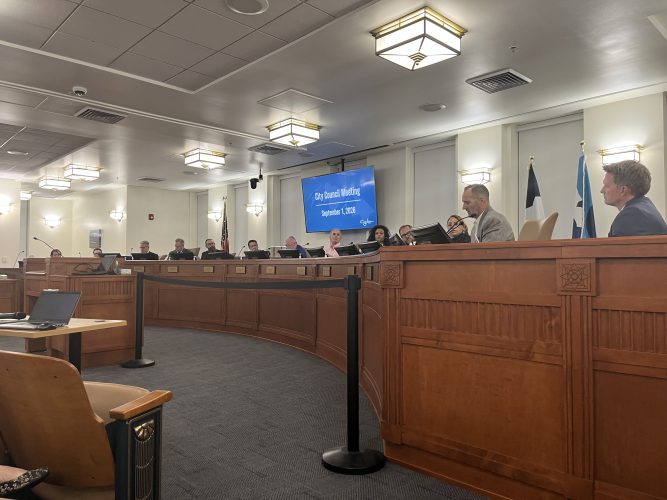
Ogden Mayor Ben Nadolski speaks during the Ogden City Council meeting Tuesday, Sept. 1, 2026. (Ryan Comer, Standard-Examiner)
OGDEN – After over an hour and a half of public comment, dominated by frustration expressed over an Ogden police officer’s recent handling of an Immigration and Customs Enforcement agent’s interaction with a person the ICE agent was following, Ogden Mayor Ben Nadolski was interrupted less than a minute and a half into his remarks to the public at Tuesday’s City Council meeting.
The interruption, which was led by Taylor Knuth, who lost to Nadolski in the 2023 election, persisted even after Ogden City Council Chair Richard Hyer told Knuth he was out of order, that he could speak to the mayor afterward and asked him to quit interrupting. Others in attendance joined Knuth.
“Please do not continue to disrupt the meeting,” Hyer said twice before those disrupting the meeting began chanting ‘shame.’
“Due to the disruption, we will be taking a recess,” Hyer said.
After about seven minutes, the council came back to order and the meeting continued for nearly another hour, including comments from council members.
“It’s hard because I know emotions are definitely high, and people have concerns and they want to speak their piece,” Ogden City Council member Ken Richey told the Standard-Examiner afterward. “I do think … the most productive dialogue is when we keep our heads and we can have a good dialogue and conversation. And so we sit and listen to people as long as it takes, and then if the mayor starts to talk and the people start shouting over him, it’s just like, this doesn’t feel respectful. And I just feel like we can do better as a community when that happens.”
In a follow-up email to the Standard-Examiner, Knuth provided the following statement:
“My question to the mayor was when that policy would be finished. An answer none of us have.”
The incident
Driving the emotions expressed during the public comment period was an incident last week where a man was taken into custody by an ICE agent following an interaction with an Ogden police officer.
According to an Ogden Police Department post on Facebook, the driver of a black SUV, who identified himself as an ICE agent, contacted the police officer, stated his intent to arrest the driver of a gold vehicle down the road and asked the police officer to conduct a traffic stop. The officer did not and the ICE agent drove away, the post continued, but shortly afterward, the driver of the gold vehicle made a U-turn, stopped near the officer and said he was being followed by the black SUV and didn’t know what was happening.
The police officer returned to the ICE agent, and body camera footage, which the Ogden Police Department released as part of its post, showed him telling the ICE agent, ‘I’ll just walk up and talk to him, if he’s stopped. If you want to just pull up behind him and make contact with him.'”
The police officer again approached the gold vehicle, the ICE agent followed and the man in the vehicle was subsequently taken into custody.
The body camera footage also captured a conversation between the police officer and a supervisor after the ICE agent had the situation with the driver seemingly under control.
“I just don’t know what the extent of what we’re allowed to do is,” the officer said.
Moments later, the officer said:
“I didn’t do any of that.”
The Ogden Police Department post continued:
“The Ogden Police Department did not initiate the stop, did not conduct the arrest, did not ask for or run any information, and did not assist with immigration enforcement. The officer’s involvement was limited to maintaining safety and attempting to de-escalate an unusual and potentially escalating interaction. Questions related to the arrest need to be directed to ICE.”
What could have been done differently?
Ogden City Council member Kevin Lundell posted a video on Facebook calling the incident “a breach of community trust,” specifically taking issue with the police officer’s interaction with the ICE agent, the officer’s comment of not knowing what he was allowed to do and ultimately not helping a citizen who had asked him for help.
“What we just saw there was an Ogden police officer making a plan with an ICE officer about how they were going to detain a person that had just reached out for help,” Lundell said. “You see, the person being detained had actually reached out to the police officer because he felt like he was being followed, which he was, by a man in a black SUV. He reached out to his neighborhood police officer for help, and instead, he got detained.”
Asked after the meeting Tuesday what the police officer should have done instead, Lundell told the Standard-Examiner the officer “certainly didn’t need to lead step-by-step directions to what he was about to do … tell the ICE officer to make contact after he made contact.”
Lundell suggested that the policy could be noninteraction with ICE.
“If ICE comes up and asks you anything, you say, ‘Listen, I’m not here to get involved with immigration. We’ll see you later,'” Lundell said.
Pressed on this particular situation, however, Lundell said the police officer could have told the person he was being followed by ICE.
“‘I’ve met with the person; it’s ICE. I’m not going to get involved in that. You have a nice day,'” Lundell suggested the officer could have replied.
“I don’t know the legalities of that,” he added. “I’m going to leave that up to the attorneys in that situation, but maybe we’ll find out as we learn more about it.”
The idea of telling a person who is being followed they are being followed by ICE was echoed by Daniel Martinez, a Clinton resident with Ogden ties who showed up to the meeting and spoke during public comment.
“What would (ICE) have done? That’s what I’m saying,” Martinez told the Standard-Examiner. “Let’s do that. Let’s do that and see where that goes. So the OPD officer goes back to the citizen and says ‘Hey, that’s ICE. You need to get out of here.'”
Asked if that constitutes obstruction, Martinez replied:
“I don’t know.”
Policy and trust
A core demand made by commenters Tuesday was that there should be clear, written policy.
Nadolski was interrupted after he said “a policy is something that we have been talking about for a while and have actually put work into already before this event took place.”
Knuth interrupted by repeatedly asking when the policy would be done, with the disruption persisting until Hyer said the council would recess.
The ability to trust the Ogden Police Department was also questioned.
“I’m so disappointed with our Ogden City police,” said Ogden School District Board of Education Vice President Arlene Anderson. “I did trust them, and I say past tense because with what is happening now, right now, I don’t know that anybody can trust.”
Darick Fisher, president of the Weber Fraternal Order of Police and speaking alongside TJ Scott, John Thomas and Chad Ledford, called for elected officials to speak with leadership before publicly drawing conclusions and said when people question if they can safely call police because of rhetoric and incomplete information, trust is damaged.
“You have direct access with the chief of police and information most members of the public do not,” he said. “Use that access. Ask what happened, why it happened, and what law and department policy require before public narrative is established. Our officers should be able to make lawful, responsible decisions based on the circumstances in front of them, not how those decisions may later be characterized politically. If another law enforcement agency needs assistance or a situation needs to be stabilized, officers should be able to protect the public without first wondering whether the decision will become the next political controversy.”
Contact Standard-Examiner editor Ryan Comer at rcomer@standard.net.