
‘Duty and responsibility’: Ogden police chief, mayor discuss ICE involvement
Ogden police chief, mayor discuss ICE involvement
Rob Nielsen, Standard-Examiner
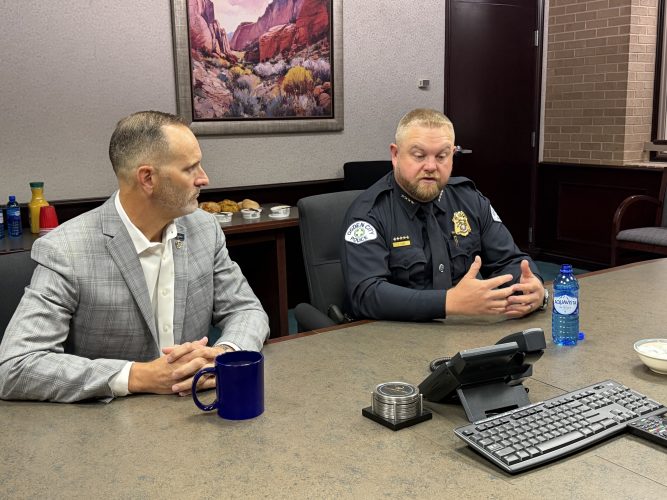
Ogden Mayor Ben Nadolski and Ogden Chief of Police Jake Sube speak with the Standard-Examiner editorial board on Thursday, Sept. 10, 2026.Editor’s note: This is the first of three stories following a Standard-Examiner editorial board interview with Ogden Mayor Ben Nadolski and Ogden Police Chief Jake Sube. Discussion topics included Immigration and Customs Enforcement and Automatic License Plate Recognition, or ALPR, technology.
OGDEN – Ogden Mayor Ben Nadolski told the Standard-Examiner the country and the community more than ever need long-form discussions, specifically, related to involvement with Immigration and Customs Enforcement, or ICE, and partisanship was a leading reason.
“We’ve got to view each other in a more human way and see the people and the person that we’re with,” he said. “Because when someone calls for help, when they dial 911, they don’t experience a political party. They experience an emergency in which they need our help, and that’s why we hire the best professionals in the business to answer the phone and to return and to respond to those calls.”
Nadolski and Ogden City Police Chief Jake Sube sat down with the Standard-Examiner last week to discuss the city’s role with ICE.
‘Duty and responsibility’
Sube said Ogden isn’t operating in a vacuum and that law enforcement understands the national topic related to ICE.
“But I do have a duty and responsibility in law enforcement to provide public safety and to prevent my department from becoming brought into a political spectrum in this issue,” he said. “I have to focus on what guides us and what leads us, and that’s the law.”
He said that duty and responsibility applies if assistance is requested from any law enforcement agency, whether it be immigration, a federal entity or a local county.
“And when we’re there, we’re going to act within the law,” he said. “What is our role and responsibility in that? That’s the guidance that I’ve been giving to our officers is how we respond in those situations, what do we do when we are asked to go and stand on a scene and provide security, in case it’s to prevent it from getting out of control or onlookers becoming involved. … And I think we’ve been successful in doing that. And I think the situations that have occurred in Ogden I think demonstrate that.”
He said he thinks the officers are doing the best they can within the confines of their role and responsibility and that the role when on scene following a request from ICE is not passive.
“It’s an active role,” he said. “We don’t just show up to passively watch things happen. We’re there to step in when things may go bad, and if they do – and that means resistive behavior, violent behavior, aggressive onlooker involvement or engagement – our officers know and have an understanding that it’s to bring that to under control as quick as possible.
“And I firmly believe that us being on those scenes oftentimes is going to result in a situation like that being taken under control quicker, safer, faster.”
Sube rejected that such involvement means an officer has become an immigration officer.
“It does not mean we begin to take on immigration’s responsibility,” he said. “We’re not following through with immigration charges. Once the scene is secure and safe, that’s our role. We’re done. We back out. And I want and hope the public understands that if ICE calls dispatch and says, ‘Hey, we need an Ogden officer. We’d love him to stand by while we do this because we worry about this risk,’ that our officers go there and that’s their sole purpose, that if something were to go bad that they’re going to be there to help take control of that scenario to help control it to prevent it from getting out of hand, getting worse than it could be.”
Sube said he understands “it’s a polarizing conversation” and “a difficult environment to operate in” but he believes what he’s conveyed to the officers has guided them and approves of how they’ve handled situations.
“I’ve looked at every one of these situations that we’ve been involved in, and I believe we’ve done everything right,” he said. “Can we learn from everything? Absolutely. We’ll always take an opportunity to grow and learn and provide additional information and resources to our officers to be the most successful. But I look at these scenarios that we’ve been involved in and I think our officers have done a fantastic job in an extremely difficult, complex environment, with the sole purpose of public safety being the main factor. That’s it. That’s what’s on their mind.”
Nadolski emphasized public safety being on officers’ minds.
“What we can’t have is that when an officer arrives at a call for politics to be on that officer’s mind,” he said. “It is critically important for the safety of our city and for the strength and well-being of our officers and of our department and the people they serve that our department remains apolitical.
“I’ve learned as mayor, and I learned this actually as a councilman as well, that officers don’t want to work somewhere where they feel like they’re going to be used as political pawns. And so every time we swear in an officer, I make them a promise, and they make me a promise back, and those promises are working because we’re keeping our promises to each other. I say that I promise not to politicize you, but you have to promise that you’ll follow the law and that you’ll follow the Constitution, because that shared responsibility to each other ensures that we are focused on fidelity to the law in our mission.
“And so, when these moments … happen, of which we’ve had so few, it’s so important in that moment that our officers are not worried about politics, and that’s my job to do everything I can not to politicize them. But I can’t control what others do, and so it’s our leadership role to make sure that they’ve got the guidance they need in those moments so that they can just disregard politics and focus on the moment.”
Both Sube and Nadolski said Ogden police is operating similarly to other police departments with its ICE involvement.
“And I think if people were to look at that, they would see that we’re not doing anything different from anybody else,” Sube said. “I will say, I think we’re doing a great job. I think our officers are taking difficult situations and doing the best they can in those circumstances.”
Nadolski emphasized the importance of everyone taking a deep breath and listening to each other.
“We’ve got a lot of listening to do, and we want to make sure that when we’re speaking, that people are hearing where we’re coming from too, because that’s how I think we build the strongest relationships with the public and with each other is being able to truly understand where each other is coming from,” he said.
Nadolski said if he doesn’t create an environment where people can take a deep breath, he’s not leading the department responsibly and that he would put the professionalism of the Ogden Police Department and its officers up against anyone.
“But I also think that Ogden right now is being politicized more than these other cities are, and so there’s a lot of eyes on us,” he said. “And I just want to really make the point that when you’re looking at what Ogden is doing, it’s no different than what everyone else is doing because we all fall under the same framework of laws and of order and of the constitution.”
Contact Standard-Examiner editor Ryan Comer at rcomer@standard.net.
Local News
‘Duty and responsibility’: Ogden police chief, mayor discuss ICE involvement
Competing for a cause: Annual American Red Cross Blood Battle between Utah State and Weber State returns to WSU for 23rd year
