
Guest opinion: Informational exhibit at Utah Cultural Celebration Center
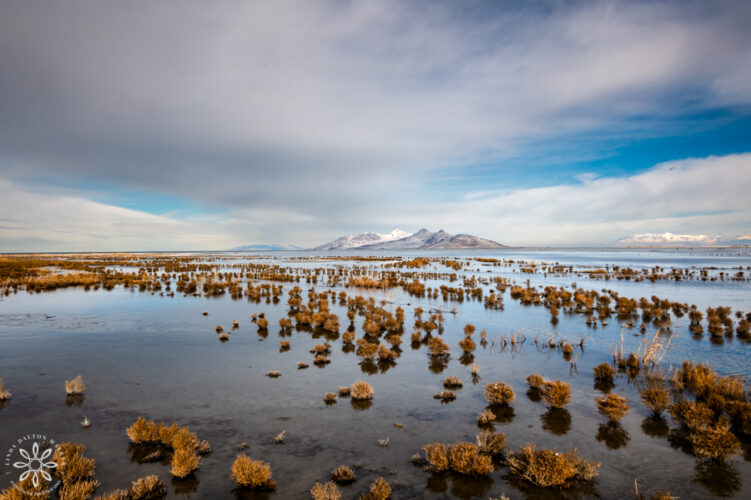
Photo supplied, Linda Dalton Walker
This photo taken Jan. 6, 2024, shows Antelope Island in the Great Salt Lake.As a young girl raised in Utah, I grew up in the arms of the Great Salt Lake. I floated in her salty waters, built sandcastles on her shores and could walk just a few feet from where my parents parked their vehicle to touch my toes in the cerulean blue water.
Now, as an adult, in order to reach Great Salt Lake’s shoreline, I need muck boots and a full day to walk the 4 to 7 miles to the water’s edge. In addition, I am reluctant to get into the water filled with metals such as copper, lead, arsenic, lithium, iron and manganese due to human activities like mining, smelting and industrial operations within its watershed. These toxic metals are carried to our beautiful valleys and mountains when the winds blow. Now my hometown of Salt Lake City is no longer a healthy place to live.
In addition, each year more than 10 million birds, both migratory and non-migratory, rely on Great Salt Lake for survival. These beautiful birds would not have a safe haven without the lake. When I read and hear that Great Salt Lake is “doing great” because we’ve had two years of above-average precipitation, I look to the lake to see if this is true. Despite the optimistic news, I cringe and am near tears as I look out over the dry lakebed from the Garr Ranch on Antelope Island. Most people who don’t visit our lake regularly lack the visual data to determine whether the lake is in trouble. But I have been visiting Great Salt Lake over two dozen times a year for the past 10 years, and I’ve seen the lake’s decline firsthand. Lake managers often blame this decline on the heat wave, which admittedly has some effect, but there are so many more complex issues at play. The optimistic view that our lake is “doing great” makes it difficult for people to understand and respond to the urgent call for action.
A couple of years ago, another artist and I, both concerned Utah citizens, joined forces to explore the three rivers that flow into Great Salt Lake. We wondered if the Jordan, Weber and Bear rivers were flowing into the lake like we envisioned. We documented these convergence points not only to educate ourselves but also to share our findings with other Utahns. We waded through mud and miles of shallow water, discovering complex deltas that were difficult to locate and nearly impossible to traverse. In some cases, the rivers had been so heavily diverted that there was no single point where the rivers met the lake.
The journey proved far more complex than either of us had imagined. To verify and document where the rivers “end,” we worked with several scientists and a longtime airboat owner who was deeply familiar with the lake and its waters. Most tellingly, throughout our research, no one could definitively tell us where all three rivers entered the lake.
Our pilgrimage brought us to all kinds of landscapes — some choked with non-native plant species, others spangled with garbage, one bursting with thousands of birds, another hosting a trigger-happy stranger and most covered in thick mud. As artists, we immersed ourselves in the landscape, trudging countless miles in boots filled with cold water, swarms of bugs gnawing at our temples and breath crystallizing on our hair — all to find the places where the rivers give themselves to the body of Great Salt Lake. Through our miles of observation, we slowly became pilgrims ourselves, laden with lenses, notebooks, found objects, mud and awe.
Our findings revealed that, unlike even 20 years ago, the rivers are hardly making it to the Great Salt Lake. They are being diverted upstream by industries, agriculture, overdevelopment, unsustainable water practices, and invasive plant species like Tamarisk and roughly 26,000 acres of Phragmites. Unchecked threats like these could cause Great Salt Lake to disappear within the next five years. Currently, the exposed shoreline covers roughly 800 square miles, about the size of the island of Maui. Prayers and hopes won’t eliminate these problems.
We will exhibit our research and findings in January and February 2025 at the Utah Cultural Celebration Center, Pilar Pobil Gallery.
Linda Dalton Walker, a native of Utah, has a Bachelor of Science degree from the University of Utah, a Master of Education from Utah State University and an art endorsement from the Utah State Office of Education. An international award-winning nature photographer, she grew up in the arms of the Great Salt Lake, building castles in the sand and floating in the salty water with her siblings.