Guest opinion: Looking at the realities of Roy’s proposed tax increase
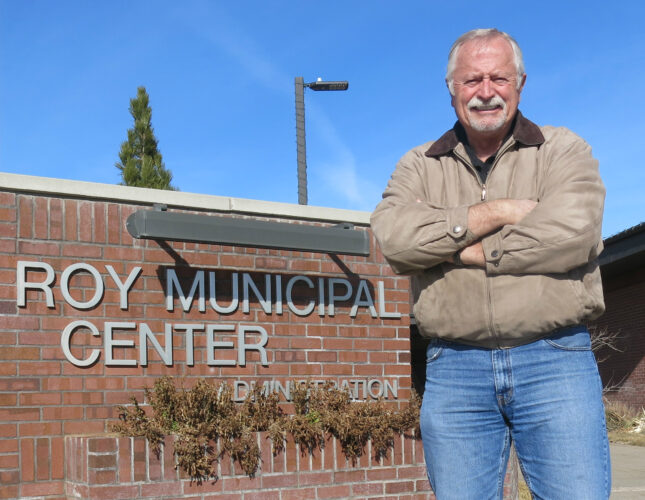
TIM VANDENACK/Standard-Examiner
Roy Mayor Bob Dandoy, photographed Monday, Jan. 15, 2017.Roy City recently announced an unprecedented proposed 55% property tax increase leaving many residents and business owners in shock. The reported purpose of this increase is to bring city employee compensation equality with other surrounding communities.
In January of 2022, the Roy City Council approved a $1.5M increase in employee compensation based on an internally conducted Salary Survey. One would think that providing combined Cost-of-Living Adjustments (COLA) and employee merit performance increases each year would have kept Roy City employees’ salaries competitive. Normally, it does in private and federal employment. The fact is it doesn’t happen in city government.
This is reflected nationally in the U.S. Department of Labor, Bureau of Labor Statistics (BLS), News Release March 20, 2026, Titled Employer Costs for Employee Compensation – December 2025 which states, total employer compensation costs for private industry workers averaged $46.15 per hour with state and local government employer compensation at $65.68 per hour. The numbers excluded US Armed Forces active-duty members and Federal Employees.
These are national averages, but they represent a significant variance between local / state government employee compensation costs from those in private industry. Clearly local and state government employees are realizing higher compensation in salary and benefits nationally and locally.
The main driving force behind local government employee compensation is what other cities, counties and state governments are offering. Employees often jump from one local government position to another for a little more pay, forcing cities like Roy to regularly conduct salary surveys to re-adjust employee salaries. It never stops. The unfortunate reality is that many local government positions are paid far beyond what state, federal or private businesses would pay for the same duties and responsibilities.
Cities and counties use Salary Surveys, commercially or internally developed, as a tool to determine whether a particular government position needs to be adjusted. For any Salary Survey to attempt to bring some level of accuracy, it should include enough samples. For most basic statistical analyses, a minimum sample size of 30 is a common rule of thumb. Last year’s Roy City draft Salary Survey clearly showed many government positions needed some further adjustments. But when you dig deeper into the data, it was clear that the Survey itself was plagued with problems.
Trying to locate 30 salary data samples from cities, county, state, federal governments and/or private business organizations for a specific job in the local area can be difficult. So, one needs to select as many as possible from every available source.
It was in this area that the problem existed. In last year’s survey there was no salary information from Weber or Davis County governments involving firefighters, paramedics, deputy sheriffs, clerks, public works, office administration, parks, or legal positions included. There were no local state or federal government positions included.
Several cities, many in both Weber and Davis Counties, were not in the survey. There were no private business positions in the Roy City Salary Survey.
As a result, the Roy City Salary Survey failed to include and assess numerous local and regional salaries opportunities that would have helped bring some level of accuracy to the survey. Since the data was incomplete, the proposed salary increases were questionable. If they were questionable last year, then there is a good chance they are questionable in the proposed FY27 budget.
All this supports the BLS position that local and state governments are outpacing the average private industry worker compensation costs. This is wrong and it needs to stop.
The employee compensation details in what is driving the need for a 55% property tax are not made public, leaving the Roy City residents and business owners with a $2.8M tax increase with little factual justification.
The public has a right for local government transparency, particularly when faced with the highest proposed property tax increase in Roy City’s history. Roy City would have been better served had they hired an independent unbiased contractor to perform the Salary Survey and make the results public.
There is no question that Roy City needs to provide fair compensation for the employees. However, what is also needed is a city administration that cuts spending and manages to the existing realities that Roy City is facing. Land-locked with little land left to capitalize, numerous vacant commercial buildings, population decreasing, all adds up to a city that now must rely on year-over-year property tax increases to exist with no end in sight.
The solution is simple, Roy City must cut government personnel, the single highest expense within the city. Unfortunately, the proposed FY27 budget adds more personnel to the organization, further stressing the financial burden on future property taxpayers.
Robert Dandoy was elected twice as Roy City Mayor (2017-2025) and is a former Roy City Councilmember (2015-2016), and a Roy City Planning Commissioner (2013-2014).