
WSU guest opinion: Industry and government must become a bigger partner in academia
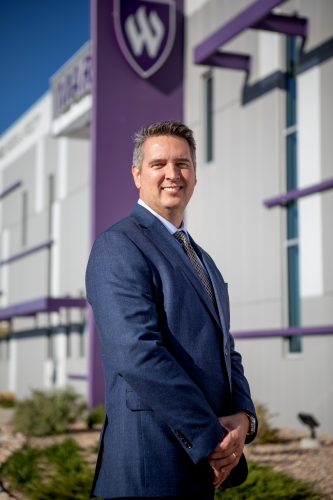
Courtesy photo
Ben Garcia is the Executive Director of Weber State University’s Miller Advanced Research and Solutions (MARS) Center.The future of higher education requires better collaboration among government, industry, and academia. Universities have the intellectual capital, research infrastructure, and talent. Industry has the market knowledge, practical challenges, and resources to turn discoveries into meaningful solutions. Combining these strengths enhances education value, meets workforce development needs, and strengthens national security.
American universities have long served as engines of innovation, but over the last 20 to 30 years, many have operated in isolation from industry and government. This disconnect makes educating the next generation of scientists and engineers more difficult. Providing meaningful and relevant project work at both the undergraduate and graduate level remains largely underdeveloped. How do universities establish sustained collaboration with industry? One solution to this challenge is Weber State University’s Miller Advanced Research & Solutions Center.
Located just outside the west gate of Hill Air Force Base, collaboration with personnel at Hill AFB comes easy. By directly identifying key challenges facing the base, the center works alongside industry partners to deliver targeted solutions–creating a win-win-win model for academia, government, and industry.
The United States faces increasing global competition in advanced manufacturing, aerospace, defense, energy, artificial intelligence, materials science, and other critical technology sectors. Maintaining leadership in these fields requires more than government investment and academic research. It requires stronger partnerships between institutions developing technologies and companies responsible for manufacturing, commercializing, and deploying them.
Prioritizing industry participation
The MARS Center was established to address a critical need for advanced manufacturing of aerospace and defense components that go into solid rocket motors, hypersonic vehicles, space reentry vehicles, nuclear energy, and propulsion technologies. The center has an extraordinary collection of assets that government and industry needs: specialized manufacturing equipment, experienced staff and faculty, technical expertise, and facilities that many companies cannot economically maintain themselves.
At the MARS Center, industry partners can evaluate new manufacturing technologies without the enormous expense of purchasing, installing, and maintaining the necessary equipment. This model has generated numerous industry- and government-funded projects that enhance student education. While most participating students attend Weber State, the center has hosted students from nearly every higher education institution in Utah.
Bringing together government, industry, and academia creates tremendous educational value while addressing the critical needs facing our nation.
Consider the advanced materials sector. A university laboratory may have the expertise and equipment to investigate new polymer systems, ceramic matrix composites, carbon-carbon materials, or high-temperature coatings. However, without meaningful industry participation, researchers lack insight into the processing challenges, production economics, qualification requirements, and performance specifications required for commercial application.
The same situation exists across nearly every technical discipline. Research can be scientifically impressive while remaining disconnected from the practical challenges facing manufacturers and technology developers.
Removing barriers to partnerships
One of the greatest obstacles to university-industry collaboration is not a lack of interest. It is often the difficulty of establishing and maintaining productive relationships.
Companies frequently encounter complicated contracting processes, lengthy intellectual property negotiations, restrictive publication requirements, and uncertainty surrounding project costs and timelines. Partners need clearly defined deliverables, realistic schedules, transparent budgets, and confidence that their intellectual property and proprietary information will be protected. They also need a single point of contact who understands both the company’s technical objectives and the university’s research capabilities.
The MARS Center directly addresses these concerns. First, intellectual property negotiations are easy. Our industry partners fully own all intellectual property discovered on the sponsored project. Government projects retain government purpose rights. Inventorship is shared, but complex licensing agreements are not required. Second, we operate contractually with purchase orders. Once a statement of work for the project and deliverables are determined, a cost estimate is generated, and the company sends the MARS Center a purchase order authorizing the work. The process can be completed in days, not months to years. Third, we maintain cybersecurity requirements. Industry needs to know that their intellectual property is secured, and the government needs to know that sensitive data and information will be protected. MARS has set up the necessary facility and information technology systems to ensure these needs are met.
The MARS Center breaks the traditional academic mold by focusing on applied manufacturing research. Although many faculty at WSU perform fundamental research, the primary focus of the university is on education and preparing our students for the workforce. The MARS Center accomplishes this goal by working with industry and government to improve outcomes for students, our regional and national economic development, and key national security initiatives.
Ben Garcia is the executive director of Weber State University’s Miller Advanced Research & Solutions Center, where teams develop solutions to real-world problems. Garcia helps government, industry, and higher education collaborate on projects in the aerospace and defense industries. This commentary is provided through a partnership with Weber State. The views expressed by the author do not necessarily represent the institutional values or positions of the university.
Guest Commentary

WSU guest opinion: Industry and government must become a bigger partner in academia

The Homefront: If you haven’t voted, get your body to the booth
Guest opinion: Voting for Amendment B would diminish your rights
During the summer, I drove with my family across a few states for a family church event. A sign I saw gave me hope: ...