
Guest opinion: United we stand – but we don’t have to agree
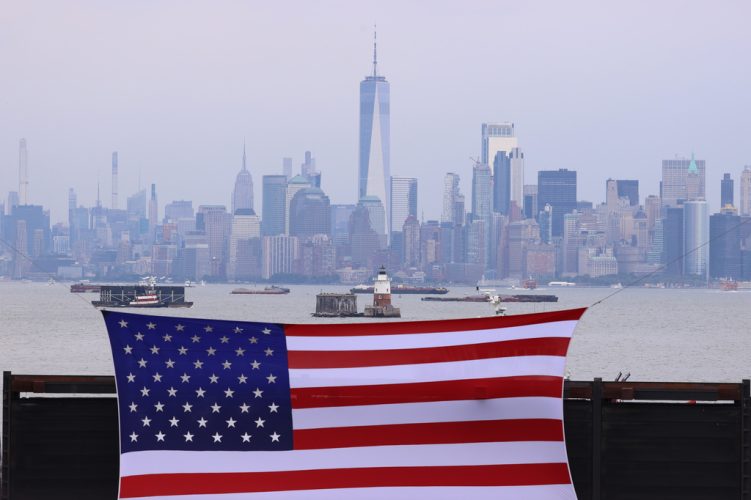
A general view of the New York skyline during an FDNY memorial to commemorate the 25th anniversary of the 9/11 attacks, Wednesday, Sept. 9, 2026, in the Staten Island borough of New York. (AP Photo/Pamela Smith)
Twenty-five years ago, many Americans woke up on September 12 to a country that felt different. The shock and grief were overwhelming, but so was the way people responded to one another. Strangers helped strangers, communities rallied around those who were hurting, and displays of American flags seemed to appear everywhere. For a brief time, our differences seemed less important than the fact that we were Americans.
Twenty-five years later, that sense of unity can feel like a distant memory. Research from the Pew Research Center shows how widespread Americans’ response to 9/11 was: 94% of Americans took at least one personal action, including displaying flags, contributing to relief efforts, attending religious services, or trying to donate blood.
But patriotism and unity are not the same thing as agreement, and I’m not arguing that Americans should stop having different opinions. In fact, I believe we need more debate, not less. Arguments and debates are how we challenge ideas, express our passions, identify problems, and develop solutions. What concerns me is that our differences too often seem to turn into hostility. Instead of listening to understand another person’s perspective, people seem more interested in convincing others that they are wrong.
I don’t believe America needs to eliminate disagreement to become more united. We need to disagree without turning our differences into hatred. Twenty-five years after 9/11, I think we should remember that being American can give us something in common even when our political beliefs, backgrounds, and opinions are very different.
I have seen this kind of healthy disagreement firsthand during my years working with my city’s youth commission. Our city council members do not always agree with one another. They have different opinions, backgrounds, and experiences, but they still sit down together, discuss difficult issues, and work through their disagreements.
What I have learned from watching them is that understanding someone does not require agreeing with them. They do not have to change each other’s minds to find a way to work together.
I have experienced the same thing in my legislative work. I have worked with Representative Steve Handy on legislation even though we did not always share the same views.
He listened to my perspective, and I listened to his. Sometimes we still walked away with different opinions, but we understood each other better because we were willing to listen. Neither of us had to convince the other to think exactly the way we did. We needed to understand where the other person was coming from and then figure out what we could accomplish together. I think that is one of the things we are missing in America today.
Too often, we seem to believe that the goal of a disagreement is to change the other person’s mind instead of understanding them. Healthy disagreement takes effort, especially when the issues are deeply personal or political. It’s what we do with that disagreement that can either divide us or unite us. And the divide is not just something we feel when we argue with our neighbors or scroll through social media. Americans are becoming less trusting of one another.
According to a 2025 Pew Research Center survey, only 34% of Americans said most people can be trusted, compared with 46% in 1972. When we stop seeing the person behind the opinion, our differences become easier to turn into hostility. We forget that the person on the other side of an issue is still a person with their own experiences, beliefs, and reasons for seeing the world differently.
So how do we change that? I don’t think the answer is to avoid difficult conversations or pretend our differences don’t exist. I think we need to learn how to have those conversations differently.
I am not calling for less debate. I am calling for healthy debate.
We can feel passionately about important issues without attacking the character, intelligence, or worth of a person who sees things differently. Healthy debate means being willing to listen as much as we are willing to speak. It means asking questions and trying to understand why someone holds their beliefs.
This does not mean we have to agree on every issue or even find a compromise every time. Sometimes there may be no middle ground. But we can still choose to respect one another, listen to different perspectives, and look for what we can accomplish together. Sometimes conceding one point can make room for us to accomplish something bigger together. Meeting in the middle may not win every battle, but it can sometimes move us closer to a common resolution.
If we want to strengthen our communities, it has to start with how we treat the people around us. Twenty-five years ago, many Americans found ways to come together because the shared experience of 9/11 reminded us that, despite our differences, we belonged to the same community. We do not need another tragedy to remind us of that.
Maybe the first step toward rebuilding our sense of community is finding compassion for one another again. We have become so focused on being right that we sometimes forget to consider what another person may be going through or why they see the world differently.
Compassion does not require agreement. It simply asks us to remember that there is a person on the other side of the argument.
Get involved in the things you are passionate about, whether that means politics, community service, or even baking cupcakes for your neighborhood. Be passionate, but be civil.
Talk to people who see things differently, and listen to understand rather than simply listening for your turn to respond. Most importantly, bring compassion to the conversation. Twenty-five years after 9/11, perhaps patriotism is not something we lost after all. Perhaps we simply forgot that loving our country also means caring about the people who live in it-even when we disagree with one another.
Jenna Nelson is a student at Weber State University in the Bachelors of Criminal Justice program.
Guest Commentary
Guest opinion: United we stand – but we don’t have to agree

The Homefront: Dealing with the details of a grandparent’s role
Guest opinion: The rise of the self-serve patient
Patients aren't waiting for permission anymore. Medicine's job is to make sure they don't get hurt along the ...