Weber State football: Increased skill, continuity may finally put offense into high gear
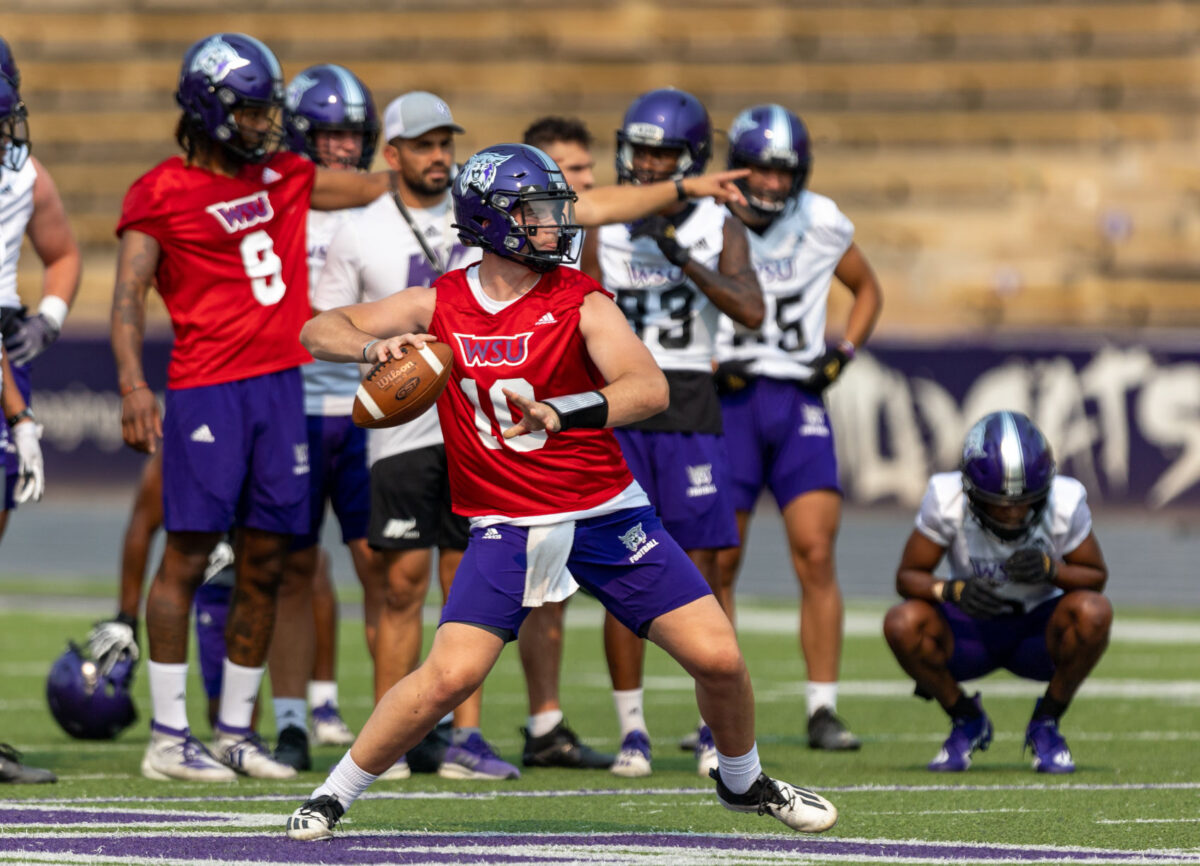
Weber State quarterback Bronson Barron (10) rears back to throwing during the first practice of fall camp Wednesday, Aug. 4, 2021, at Stewart Stadium in Ogden.

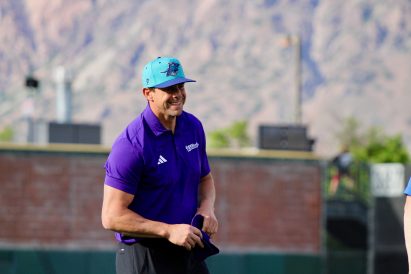
In this Aug. 31, 2019, photo, Weber State assistant coach Matt Hammer oversees warmups before a game against San Diego State in San Diego.
OGDEN — Since Weber State’s football breakthrough 2017 season, it’s been a perpetual effort to get the offense to fully support WSU’s elite defensive efforts as the Wildcats push to convert mere national prominence into ultimate national glory.
After a 49-21 romp in Pocatello to open the short spring season in February, Weber State again struggled to score points. It didn’t help that freshman and emerging star quarterback Bronson Barron broke his left wrist in Game 2, either.
Following the opening win, the Wildcats averaged just 23 points per game over the final five contests.
The problem was starkly obvious: Weber State simply could not finish consistently once the ball got inside the opponent’s 20.
In 22 red-zone trips, WSU only scored 12 touchdowns and three field goals, a scoring rate of 68% and a touchdown rate of just 54%. The Wildcats turned the ball over four times and missed three field goals in only six games.
“We know we weren’t great in the red zone,” offensive coordinator and quarterbacks coach Matt Hammer said Thursday after a fall camp practice. “We just have to do better than that.”
Hammer and the Wildcats feel like it’s a fixable problem, mostly because everything else looked much better offensively. WSU got better in yards per game (from 339 yards per game in 2019 to 415 yards per game in the spring) and on third downs (a 35% conversion rate in 2019 improved to 43% in the spring).
The offense also became more explosive. In 2019’s 15-game campaign, WSU totaled 24 plays of 30 or more yards, or 1.6 per game. In 2021’s spring season of six games, the Wildcats totaled 17 such plays, or 2.8 per game.
Receiver Ty MacPherson and running back Dontae McMillan emerged as new big-play threats to give WSU’s offense some punch, something more than trying to consistently grind out long scoring drives. MacPherson averaged 20.8 yards per reception.
There’s enough reason that WSU’s belief in itself may not be faithless — that, perhaps, if any season is the one to finally bring an offensive breakthrough, it’s this one.
Barron is no longer hurt, and optimism abounds on the hill about his potential now that he has real games under his belt. Weber’s decision to participate in the spring season should pay dividends that way.
Between Barron and backup Randall Johnson, neither had played in any football game for at least two years before the spring season, and neither had thrown a pass in Division I. Still, Barron was 72 of 130 (55.4%) for 1,071 yards and seven touchdowns in five games, throwing two interceptions, as a true freshman.
Senior receiver Rashid Shaheed began to look like his dynamic self after being shelved multiple times with injuries in 2019.
Plus, the marked improvement came without 2019’s leading receiver Devon Cooley, who caught one ball in the spring and got beat out for reps. Reports from Hammer, head coach Jay Hill and receivers coach Jared Ursua are all positive about Cooley’s return to action this season.
Offensive success is an interplay between scheme, playcalling and execution. Hammer, who was in his first year back as offensive coordinator after calling plays for the Wildcats about 10 years ago, said he never felt uncertainty during games.
While the reps Barron got under his belt are important, so too is the film from those six spring games. Now that they’re done and the Wildcats fell short, Hammer can revisit those games as a testing ground for the unit because the personnel will be almost exactly the same.
“As you go back through and rip it apart, you do that scout of yourself — what we did, how we did it, what was good, what wasn’t, what we thought we were good at, what we invested reps in — for me, it taught me some good lessons about what we need to do to move forward,” Hammer said. “I think it gives us better clarity of who we are.
“The other part is, we’ve got to do a better job of just getting our best guys the right amount of touches in a football game.”
Early in camp, Hammer and Barron have both characterized WSU’s red-zone woes as execution- and mental-based problems, things that happen when less than all 11 players are on the same page.
“Because when we did that, all 11 guys, it was a good rhythm, good flow, and we got it in the end zone,” Hammer said.
He said the glaring obviousness of the red-zone scoring problem is ultimately good for players, coaches, everyone.
“I think we’ll be much, much better because of it. I’m excited for the challenge that’s in front of us that way,” he said.
The offense returns everyone but starting offensive lineman Hyrum Tapusoa.
“What’s exciting is I’ve never been a part of anything where you turn around from one season to the next and you have every single guy who played back. It’s almost bizarre,” Hammer said. “In the first two days, we’ve installed more than, this would have been install seven or eight for us in a normal camp. So from a mental standpoint, they’ve been able to pick up and go.
“I think our guys are in a great spot in their belief of one another and how they care. They know they just need to do their part, the other guys are going to do their part. That part has been good.”
And, the unit adds two more dynamic pieces which should make the offense tougher to defend, especially in the red zone.
Randal Grimes, a transfer from UNLV who started his career at USC, is a 6-foot-4, big-bodied receiver with range. Jordan Allen joins the group as powerful, relatively quick, 6-foot-4 tight end from Tennessee. Both have been with the team since before the spring season but were not eligible to play due to their transfers.
The offense also adds skilled senior fullback Clay Moss back into the mix, who was not a factor in the spring due to injury.
“Clay is back to being Clay, looks like he’s in a great spot,” Hammer said.
Weber State opens the 2021 fall season at Utah on Thursday, Sept. 2.