‘Falling’ versus ‘Nightcrawler’ — a critic’s take
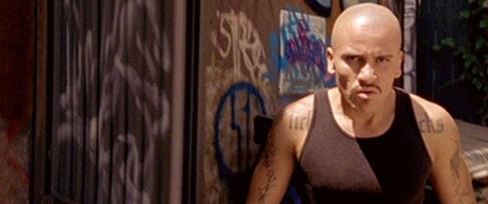
Gang leader Ruiz (Cesar Garcia) in Richard Dutcher's "Falling." file photo
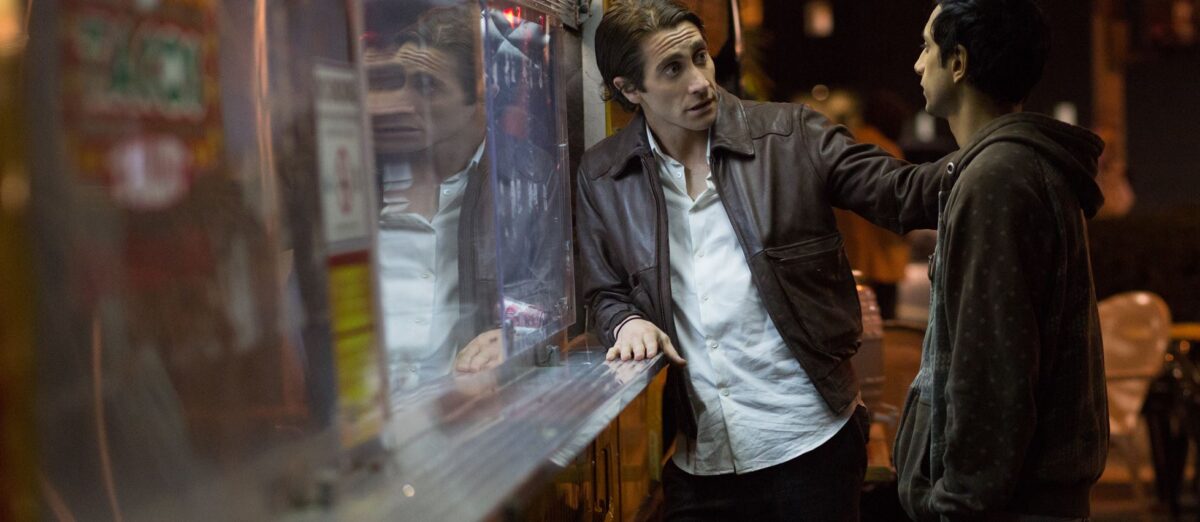
A scene from the film, Nightcrawler. File
–“Falling” and “Nightcrawler”
Spoilers, obviously!
As we reported on Feb. 20, Utah filmmaker Richard Dutcher is suing the makers of the 2014 Jake Gyllenhaal movie “Nightcrawler,” accusing them of violating the copyright on his own 2008 movie, “Falling.”
Dutcher is suing Bold Films Productions, Open Road Films and NBC Universal Media.
Both films are about freelance video journalists in Los Angeles who make a living filming crimes for resale to local news outlets. Dutcher says he screened “Falling” in both Salt Lake City and Los Angeles and distributed some DVDs. His lawyers say the movies are similar, with turning points about a murder caught on tape.
If being similar was grounds for a lawsuit, every action movie could sue the other (and the same may be said for nearly every movie of any genre). But Dutcher does not just claim that writer/director Dan Gilroy unknowingly created something similar to his film.
At a screening of “Falling” at Broadway Centre Cinemas on February, Dutcher said that he believes Gilroy got a hold of one of those DVD copies he distributed years ago, watched it, liked it, and decided to remake it with a bigger budget and big-name actor. When Dutcher finally saw “Nightcrawler,” he said, “Those bastards ripped me off.”
Officially, the storyline for “Falling” on IMDB (“Drama chronicling the tragic mental and spiritual collapse of a Hollywood videographer.”), bears little resemblance to the one for “Nightcrawler:” “NIGHTCRAWLER is a thriller set in the nocturnal underbelly of contemporary Los Angeles. Jake Gyllenhaal stars as Lou Bloom, a driven young man desperate for work who discovers the high-speed world of L.A. crime journalism. Finding a group of freelance camera crews who film crashes, fires, murder and other mayhem, Lou muscles into the cutthroat, dangerous realm of nightcrawling – where each police siren wail equals a possible windfall and victims are converted into dollars and cents. Aided by Rene Russo as Nina, a veteran of the blood-sport that is local TV news, Lou blurs the line between observer and participant to become the star of his own story.”
But Dutcher claims this is explained by an observance from a friend of his, whom he said sat with a notebook watching “Nightcrawler” and writing down other similarities (on which he did not elaborate). Dutcher says his friend said that the “Nightcrawler” filmmakers basically used his movie as a template, and instead of a good man falling, it was a bad man rising.
So how similar are they?
“Falling” is rated R and set in Los Angeles, circa 2008. “Nightcrawler” is also rated R and set in Los Angeles, circa 2014. In fact, Dutcher said that Lou from “Nightcrawler” lives is right down the street from where Eric lived in his film, “Falling.”
During the title sequence for “Nightcrawler,” at the 2 minute 25 second mark, the LA LDS temple shows up, one of many buildings and landmarks featured in the opening minutes of the film. After 6 seconds onscreen, it is not seen again. Although no additional LDS imagery is shown, as reported in The Salt Lake Tribune, one of Dutcher’s lawyers, Stephen Silverman, of Scottsdale, Ariz., said that in the DVD commentary of “Nightcrawler,’ writer/director Gilroy explains that Lou is in a white shirt to make him look more professional: ‘It makes him look like a Mormon.’
In “Falling,” Eric Boyle (played by writer/director Dutcher) is a married, 30-something white male, a lapsed/struggling returned Mormon missionary in a crisis of faith. Eric now lives in Los Angeles with his wife Davey, an aspiring actress, having moved there from Utah to take Hollywood by storm. Since that hasn’t panned out, he now works as a stringer, perusing police scanners and making money by filming and selling news footage to local outlets via a middleman named Hector. It’s dangerous work, and one of his fellow stringers was recently killed in a bad neighborhood, but it pays. On the side, he still tries to sell his screenplays to interested parties.
In “Nightcrawler,” Louis Bloom (played by Gyllenhaal) is an unmarried 30-something white male, an outsider living alone in Los Angeles. When we meet him he is a petty thief, stealing watches for personal use, and chain link fences and manhole covers for resale to recycling facilities. He shows no guilt or remorse for his actions. On a chance encounter one evening, Louis witnesses a car accident that is being filmed by “nightcrawlers” who use police scanners in their cars to find trouble, and then film and sell news footage. Lou sells more stolen goods to a pawnshop in exchange for a police scanner and camera, intent on making a go of nightcrawling.
Dutcher pointed out the stringer team of Eric and Luis in “Fallen” is changed to Louis and Rick in “Nightcrawler,” but it should be noted that as of this writing there is no listing of a Luis character under Cast on the “Falling” IMDB page. It is possible that Luis is the stringer friend of Eric’s who was already dead before the movie begins. The stringers in “Fallen” seem to work alone, whereas in “Nightcrawler” they work in at least pairs.
If names are different, Dutcher claims the characters are similar. He says in “Falling” the humiliation of Davey as an actress is counterpoint to the humiliation of Nina played by Rene Russo, Lou’s local news producer connection. Further, he asserts that Bill Paxton’s character Joe in “Nightcrawler” is a counterpoint to Hector in “Falling.” Finally, Richard Dutcher said that the “Nightcrawler” filmmakers also named a character Richard — whom they kill and leave on the street.
In “Falling,” rescue workers pull a woman from a car, while in “Nightcrawler,” Lou pulls a man from a car accident, staging his shot. Both lead characters catch a crime being committed, and film a man who is dying instead of helping him.
But possibly the most damning piece of evidence is in the third act of “Nightcrawler.” Gyllenhaal’s character Lou is being interrogated by police; he basically recounts the third act of “Falling” as an explanation for his questionable actions: the thugs he filmed earlier discovered his identity, and followed him to his house.
In “Falling,” Eric has many social attachments, such as his wife Davey Boyle (Virginia Reece), and various work friendships most notably Lorena (Maria Eberline), the wife of a fellow stringer who was killed (possibly named Luis). Not having children of his own, Eric becomes somewhat of a surrogate for her now fatherless son, taking him to the Los Angeles LDS Temple to play on its grounds.
Meanwhile in “Nightcrawler,” Lou has no attachments whatsoever. He develops some loose work relationships via his new chosen profession (“loose” because associating with him normally results in physical and emotional abuse/blackmail, or death). His other working relationships are purely superficial, solely meant to gain advantage.
Given the “If it bleeds it leads” maxim, the more graphic the footage, the more money it fetches. Eric is despondent over having to acquire more and more distasteful video — a building fire, a car accident (complete with victims), and finally he witnesses a murder. But instead of reaching for his cell phone to dial 911, he grabs his camera and records the beating a man is taking from three gang bangers. When they leave the man for dead, Eric approaches and gets a close up as the man dies on camera. Eric is disgusted by his own actions, but that doesn’t keep him from selling his footage for 20 thousand dollars. An APB is put out on the gang bangers, which motivates the bangers to find the man who shot the footage that identifies them.
Meanwhile, Eric’s struggle is only intensified when he finds that his wife has had an abortion so as to not disrupt her fledgling acting career. She recently landed a part in a film, but only after stripping naked in an audition and possibly sleeping with the director, neither of which Eric knows. But he gets wind of it when she says the aborted child may not have been his anyway, which sends him into a rage, nearly choking her to death. Realizing how far he’s fallen, he leaves their house abruptly; heading to Hector’s possibly to tell him he’s out of the stringer business.
But the bad guys are closing in, as the gang bangers attack and assault Linda (Tennison Hightower), the reporter who did the stand up for Eric’s news package, in an attempt to find out who shot the footage that betrays them. Strangely they do not kill Linda, a reporter who has easy access to the news, who now knows what they look like and can easily identify them. Instead they kill Hector, the middleman Linda gave them, but not before Hector gives up Eric. They arrive at Eric’s house while he is on his way to see Hector, and kill Davey.
When Eric arrives at Hector’s to find him dead and his own name exposed on a rolodex, he easily puts two and two together and races home, frantically calling ahead on his cell to warn his wife, but there’s no answer.
In a brilliant bit of misdirection foreshadowed at the beginning of the movie, Eric arrives home only to find his wife murdered, hanging from a ceiling fan. Eric calls the police and a fellow stringer arrives as well, and Eric feels what it’s like to be on the other side of the camera during a traumatic experience. After the police leave, a dismayed Eric contemplates suicide, but instead runs to his vehicle and proceeds to destroy his camera equipment. So involved is he that he doesn’t notice the return of the three gang bangers, who surprise and stab him. Eric fires off a few of rounds from a gun procured from Hector, killing two of the bangers and wounding the third. A protracted fight ensues, resulting in the death of the third banger, with Eric on the brink of death. He drags himself to the grounds of the Los Angeles LDS Temple, his life flashing before his eyes along with visions of young child – possibly himself as a boy, possibly an angel – leading him to the Christus on the Temple grounds, where he finally succumbs to his wounds and collapses.
“Nightcrawler” Lou also knows where the money is, and crosses every journalistic line possible to get some, starting with essentially breaking into a crime scene for better footage, and staging his shots in order to make them more graphic. But he needs help, so he “hires” homeless Rick as an intern for assistance. Eventually, he buys an extra camera for Rick, and a very fast car for himself, determined to arrive at the scene of a crime even before the police. He’s doing well enough that rival nightcrawler Joe approaches him to partner up and become a two-truck team, rather than be in constant competition. Lou declines, not only earning Joe’s ire, but his promise that he’ll find someone else to partner with and shut Lou down. Joe makes good on his threat, as his new team can be at two places at once and they begin to beat Lou to all the great scoops.
This doesn’t sit well with Nina, the local news producer Lou regularly sells his footage to for top dollar. He’s also begun a sexual relationship with her, blackmailing her with the footage he knows she needs to make a name for herself at the station. She’s resistant at first, but her success from his footage makes her an all too-willing accomplice to his misdeeds, and through their parasitic relationship she goads him on to ever more graphic material.
So Lou sabotages the brake lines on one of Joe’s news trucks, and when Joe eventually crashes into a pole, severely injuring himself, Lou is there to film his anguish and sell his story, and Joe feels what it’s like to be on the other side of the camera during a traumatic experience.
With Joe out of the picture, Lou begins to take over the business, and often arrives before the police just as he intended. During one such situation, he not only films a crime in process but also the death of a victim and the faces of the perpetrators. Instead of notifying the police, he arranges their confrontation in full view of his camera and in a public place, hoping for carnage.
He gets his wish as the thugs fire their weapons and the police retaliate, resulting in multiple deaths. A high-speed car chase ensues, which culminates in Rick’s death. Rick had been pestering Lou recently only over his share of the spoils, and how Lou conducts himself. Rick knew too much and Lou saw a chance to be rid of him, so he lured Rick into the line of fire. Lou also makes sure to film Rick’s death too, all for the late night news.
In the end, Lou lies to the police just well enough to get away with it all, and even steals Joe’s business model — complete with two brand-new trucks and a fresh pack of interns.
CONCLUSION
You be the judge, or let the judge be the judge.
Or let me be the judge!
Personally, I think there is enough there for Mr. Dutcher to believe that there’s more than enough there.
But there are also striking differences and whole subplots in “Falling” that have little to no correlation in “Nightcrawler.”
And do I believe that successful screenwriter Dan Gilroy, with nine screenplays under his belt thus far, somehow acquired a DVD of “Falling,” bothered to watch it, thought it was amazing enough to remake but changed just enough to claim it was his original idea, but not enough to not get caught?
Further, do I believe that Gilmore is not creative enough to come up with names completely dissimilar from some of Dutcher’s characters, but vindictive enough to name a character after the writer/director he is supposedly ripping off, only to murder him onscreen? Do I believe that Gilroy decided to steal from a man he has never met for his directorial debut?
Not without evidence I don’t. Without proof, it’s hard to believe in anything more than coincidence, and harder still to prove what Dutcher is claiming.
Bonaduce is the Standard-Examiner’s film critic.