Utah plans to buy, preserve more land on the south side of the Great Salt Lake
Ashley Detrick, Salt Lake City Mayor’s Office
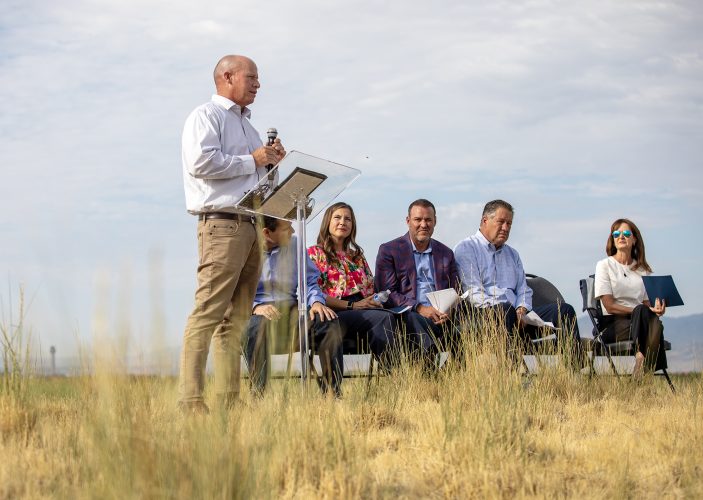
Utah Department of Natural Resources Executive Director Joel Ferry speaks at a podium on the shoreline of the Great Salt Lake along with other state and local leaders about the Inland Port Authority’s investment in Great Salt Lake shoreline and wetland conservation.State leaders say they’re moving closer toward a goal of snapping up more land on the southeast side of the Great Salt Lake to help protect it from any further encroaching development.
They announced a new $2.5 million contribution from the Utah Inland Port Authority toward the effort on Wednesday, holding a news conference on the marshland property of a duck hunting club just a few miles from warehouses in the authority’s northwest quadrant in Salt Lake City.
“This funding gives the Department of Natural Resources another tool to support shoreline preservation,” Joel Ferry, commissioner for the Utah Department of Natural Resources, told reporters.
House Speaker Mike Schultz noted the state, using other sorts of funding, has already purchased nearby land from the former Blackhawk Duck Club near the Salt Lake City International Airport. But Schultz, R-Hooper, said there’s more to be done.
In 2022, Schultz carried a new state law requiring the authority to set aside funds for environmental and community mitigation. In January of this year, the authority announced it would direct $5 million toward wetland improvements, along with public safety services in Salt Lake City. In total, it’s set aside $7.5 million for shoreline conservation, a spokesperson said.
At Wednesday’s news conference, Salt Lake City Mayor Erin Mendenhall praised the new contribution, saying the city’s communities “are inextricably connected to the well-being of this lake, our namesake.”
Planes leaving the Salt Lake City International Airport soared overhead as the officials spoke, sometimes drowning out their voices, and warehouses could be seen in the distance. White-faced ibises also flew around and waded in shallow water.
The shrinking Great Salt Lake remains more than seven feet below its minimum healthy level of 4,198 feet above sea level. Its decline threatens the food supply for millions of migratory birds and has raised public health concerns about heavy metals from its dry lake bed blowing into northern Utah neighborhoods.
The Inland Port Authority was created with an act of the Legislature in 2018 and brought a large shipping hub to the area over the objections of environmental groups and residents who warned of air pollution and damage to the lake and its ecosystem.
Asked Wednesday about criticism from those who say it should never have moved in, Ben Hart, the port authority’s executive director, told Utah News Dispatch, “Well, I think there’s a lot of people who would say that, and I think there’s probably a lot of justification for saying that as well.”
Hart said he and his colleagues want to be good stewards as the state negotiates with landowners, a process that he said could take some time and additional funding.
“The best way to protect land is just to be able to purchase it, put land conservation easements over the top of it, and make sure that no matter who owns it, or what the future zoning laws are, that land is going to be protected,” Hart said.
Local News
Rob Bishop points to listening, water issues in campaign for House District 6 seat

James Rich focuses on being a voice, housing affordability in campaign for House District 6 seat