
Changing the plan: O’Leary concedes to Utah Senate President Sen. Stuart Adams’ demands on data center
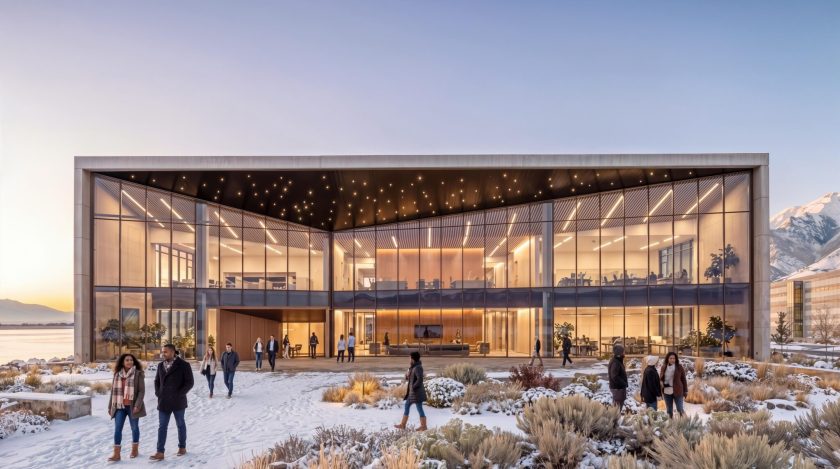
Courtesy of O’Leary Digital
A rendering shows an initial vision of a building in the Stratos Project, a proposed data center campus project proposed in Utah. (Courtesy of O’Leary Digital)BOX ELDER COUNTY — A controversial data center plan in Northern Utah is going to see some major changes.
On Thursday, Utah Senate President Sen. Stuart Adams announced that Stratos Hyperscale Data Center backer Kevin O’Leary agreed to a list of conditions for the building of the data center in rural Box Elder County.
Earlier this week, Adams sent O’Leary a letter with a list of conditions in response to public outcry about the center’s size and potential environmental impact, asking for additional transparency and a significant reduction in the data center’s size.
“I’ve sent a letter directly to Kevin O’Leary calling for a 75% reduction in the proposed data center project area, from 40,000 acres to approximately 10,000 acres,” Adams said in a press release about the letter this week. “I am also requiring that any excess water be treated and dedicated to the Great Salt Lake, even though none of the water currently used in that area flows to the lake. In addition, I am demanding greater transparency, stronger conservation commitments and enhanced protections for Utah’s natural resources as this project moves through the review process. Utah can pursue economic opportunity while protecting our water, air, wildlife and communities. We can and must do both.”
On Thursday, O’Leary responded with a letter of his own provided to the Standard-Examiner by Adams’ office.
“On project footprint, I want to give you a concrete response now,” he wrote. “We will agree to remove 19,430 acres in and around the Locomotive Springs area in recognition of the Locomotive Springs Waterfowl Management Area immediately to the south — a Utah Division of Wildlife Resources-managed migratory bird habitat critical to the north shore of the Great Salt Lake, whose spring flows have declined significantly over recent decades. We will likewise remove the 620-acre parcel in the northeast portion of the area near the highway. On the balance, we will preserve a majority of the remaining acreage as open space. The practical effect is that the project’s built industrial and data-center footprint is brought in line with the scale your letter contemplates, while the broader expansion area remains available to anchor advanced manufacturing and defense-industrial uses over a 30-year horizon – the kind of cluster that builds on Northrop Grumman, Nucor, and Utah’s industrial base. Any future adjustments would be subject to the same regulatory process as the project itself.”
He added that he hopes this offers a model for future projects while also claiming that the project has been misconstrued in the public.
“I hope this dialogue can serve as a model for how complex projects are best addressed — through direct, good-faith engagement between developers and elected officials rather than through public narratives that outpace the facts.,” he said. “Much of the alarm surrounding this project has been based on incorrect assumpitons [sic] and facts about land use, water use, heat dispursion [sic], air quality, and project timeline that does not reflect reality. O’Leary Digital has not broken ground, has not received permits, and the development plan is still being engineered and refined. We welcome the chance to work with your office and all relevant state agencies and elected officials to ensure the public has access to accurate information, which is the most effective antidote to misinformation. Serious partners hold each other to high standards, and I take your letter in that spirit. I welcome the chance to discuss any of the above with you directly.”
In a statement from Adams following the letter, he said that he’s happy to see a path forward.
“O’Leary’s concessions in response to the demand letter I sent are a positive step forward,” he said. “The concerns raised by Utahns are valid, which is why I have pushed for meaningful changes to ensure those issues are addressed before any project can move forward.
“The good news for Utahns is that this process is still in its earliest stages — no approvals or permits have been applied for, let alone issued. There must be written commitments in place, and the proposal must undergo a full permitting and environmental review process, just like any other development project in Utah.”
He added that protecting the states resources are paramount to any project moving forward.
“Protecting Utah’s water, especially the future of the Great Salt Lake, remains one of my highest priorities,” he said. “As a result of the letter, the project now includes a commitment of water that did not previously exist for the Great Salt Lake — while also reducing the overall effective size of the proposed project area by 75%.
“O’Leary also committed thousands of acres to be set aside for open space, wildlife protections, and continued agricultural use under an agreement with the Utah Department of Natural Resources. Additional commitments include heat-capture technology and independent scientific and engineering reviews of environmental impacts, water use, infrastructure demands and long-term sustainability.”
Adams added that he also sees the process as being more transparent going forward.
“To ensure transparency and public accountability, a centralized public-facing website will be created in coordination with state agencies, so Utahns have access to project information, review materials, environmental analyses and updates as policymakers do throughout the process,” he said. “The response to the demand letter I sent demonstrates that public engagement matters and that Utahns’ concerns are being heard. I will continue working to ensure those concerns lead to meaningful changes, stronger safeguards and greater accountability. My responsibility is to safeguard Utah’s water, protect our communities and put the long-term interests of Utah families and future generations first.”
Local News
Bob Stevenson highlights mayoral, county-level governing history in House District 16 campaign

Julie Powell highlights ‘high level of expertise’ and ‘years of time and effort’ in campaign for Davis School Board District 3 seat