Ogden City enters Phase II of Water Shortage Management Plan as dry conditions persist
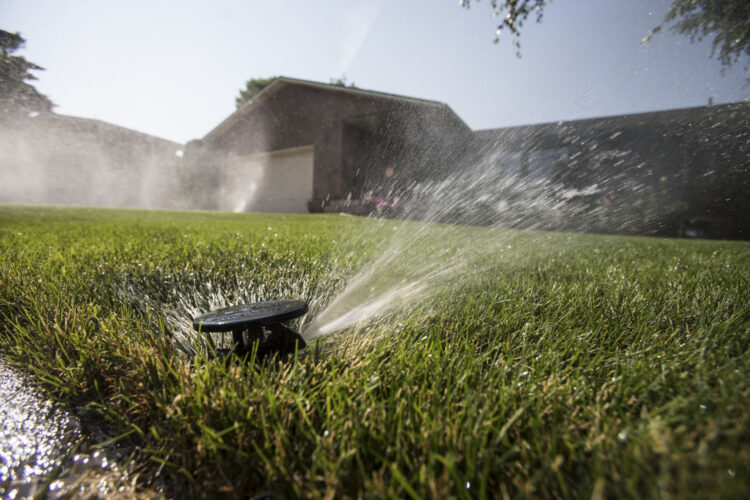
Matt Herp, Standard-Examiner file photo
Sprinklers water the front lawn of an Ogden home in July 2018.OGDEN — A winter that yielded little snow is giving way to a spring that highlights the delicate position the state’s water resources are in.
This was further driven home late Wednesday afternoon when Ogden City sent out a press release announcing the transition into Phase II of its Water Shortage Management Plan, calling for residents and businesses to increase water conservation efforts as drought conditions persist.
“Recent data shows seasonal accumulation of precipitation is near normal levels at about 90 percent of average, while snowpack, which is critical for long-term supply, is significantly below normal at 19 percent,” the release said. “Reservoir storage across the basin is at 68 percent of capacity, with Pineview Reservoir at about 88 percent.”
According to the release, infrastructure updates have significantly helped the city in saving water resources.
“The city has made measurable progress in reducing water use over the past decade, largely due to supply line and system repair,” the release said. “Peak summer demand has dropped from nearly 35 million gallons per day in 2008 to about 28 million gallons per day in recent years.”
The release continues that, under Phase II, the city is asking for a voluntary 10% reduction in water use citywide.
Ogden City Communications Director Mike McBride told the Standard-Examiner in an email that Phase II is the second of four stages of water conservation:
- “Phase I – Normal to Moderate: Ongoing conservation education and awareness
- Phase II – Severe: Voluntary conservation with a 10% reduction target
- Phase III – Extreme: Stronger restrictions and a 20% reduction target
- Phase IV – Exceptional: Emergency conditions with potential service limitations and up to a 30% reduction target”
“As conditions worsen, measures shift from voluntary conservation to mandatory restrictions, including limits on lawn watering, reduced irrigation days, restrictions on non-essential uses, and in extreme cases, prioritizing water for essential services like hospitals and public safety,” McBride said.
McBride also laid out what the current state of conservation might look like to businesses and residents alike.
For a typical resident, it might look like:
- “Watering lawns less frequently or for shorter durations
- Fixing small leaks (which can waste significant water over time)
- Running dishwashers and laundry only with full loads
- Adjusting irrigation systems for efficiency”
For businesses, the city is asking for a 15% reduction that could include:
- “Reducing outdoor irrigation or adjusting landscaping schedules
- Identifying and fixing inefficiencies in plumbing or operations
- Implementing basic water management practices, especially for higher-use industries”
The release notes that there are two types of systems in Ogden with different oversight.
“Ogden’s water system includes both culinary drinking water which the city manages and secondary irrigation water which are managed by other agencies, each with different supply conditions,” the release said. “Officials said conservation measures may vary depending on the source and availability. Residents with secondary water should consult with either Pineview Water or Weber Basin Water for current restrictions.”
As summer approaches, McBride said the city has taken several measures to build on its water savings, including:
- “Upgrading irrigation systems in parks and public spaces with smart, weather-based controls
- Detecting and repairing leaks in the water system more aggressively
- Replacing aging infrastructure, such as pipelines, to reduce water loss
- Expanding metering and monitoring systems to better track usage and identify waste”
He also said that the city’s pools are built to help reduce water waste.
“Considering that water loss due to poor conditions is the biggest culprit for pools, the Lorin Farr pool received major renovations over the past year to reinforce the membrane that contains water, minimizing loss,” he said. “The Marshall White Center pool is state of the art design that does not lose water but rather recaptures and reuses water. The climate controlled environment adds to the efficiency.”
McBride said these efforts are about being proactive rather than reactive.
“The city’s long-term goal is to reduce overall water use to 175 gallons per person per day by 2065, which allows for continued growth while protecting our water supply,” he said. “What’s important right now is that early, voluntary conservation helps avoid stricter restrictions later. When the community makes small adjustments early, it gives the city more flexibility and helps maintain service levels and quality of life even during dry years.”