Outsider Robert Wanlass representing ‘something new’ in Senate bid
-

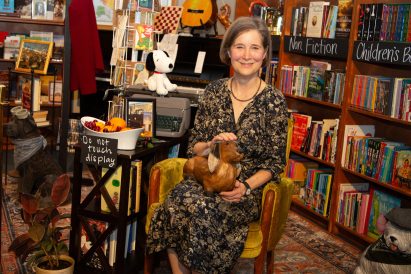
- Robert Wanlass, competing in the Republican primary for the Senate District 6 seat in Utah, participates in a candidate interview at the Standard-Examiner office on Thursday, May 21, 2026. (Grace Watters, Standard-Examiner)
-

- A campaign sign for Robert Wanlass, competing in the Republican primary for the Senate District 6 seat in Utah, on Sunday, May 24, 2026. (Ryan Comer, Standard-Examiner)

Grace Watters, Standard-Examiner
Robert Wanlass, competing in the Republican primary for the Senate District 6 seat in Utah, participates in a candidate interview at the Standard-Examiner office on Thursday, May 21, 2026. (Grace Watters, Standard-Examiner)
Name recognition was already a challenge for Robert Wanlass, a complete political outsider.
But now he’s on the ballot trying to become the next representative of Senate District 6 under a name he never goes by.
The name he really goes by is Denny, short for Dennis, his middle name.
He has a candidate named Lucifer to thank.
“I’ve gone by Denny my entire life, but because a few years ago somebody was running for office and put down that they wanted to be on the ballot as Lucifer, the Legislature did not like that,” he said. “And so they won’t allow you to use a nickname or anything other than your legal given name unless you go get five signed affidavits from people saying that’s how they know you.”

Ryan Comer, Standard-Examiner
A campaign sign for Robert Wanlass, competing in the Republican primary for the Senate District 6 seat in Utah, on Sunday, May 24, 2026. (Ryan Comer, Standard-Examiner)
It was the last day to file and there was only an hour and a half left when Wanlass found out.
“And I said, ‘Well, I’m in Farmington. I’d have to go to Layton and find five people that aren’t at work,’ which I could get 100 in the evening or yesterday, but in the next hour and a half and be back here? Like, there’s no way I’m going to get five of them right now and be back in time,” he said. “So, Robert it is on the ballot.”
Why he’s running
Wanlass used to own Red Dot Firearms in Layton. From there, he got to know House Reps. Trevor Lee and Karianne Lisonbee, who he said patronized his business.
He sold his store about two years ago, but he kept their phone numbers.
When the last day to file to run came, Wanlass said a friend of his sent him a YouTube video about some bill that was being proposed in the Utah Legislature that was “going to limit some gun stuff.”
Wanlass said he forwarded it to Lee and said he hoped it would be dead on arrival.
“And about two hours later, I got a text back from him,” Wanlass said. “He’s like, ‘Hey, do you want to run for the Senate? Me and Karianne think you would do really well.’
“So I thought about it for about an hour and I was like, ‘What do I need to do?’ … And so I spent the whole day trying to figure out how to get registered to run.”
Political experience
Wanlass said he doesn’t have a political background.
“Just been a conservative my whole life and just a normal, everyday average Joe citizen with no political history at all,” he said.
He thinks that’s a selling point.
“I’m a political outsider,” he said. “I don’t have connections to people on the MIDA board. I don’t have connections to other politicians or organizations that want something from me. I am literally beholden to my values and the people that vote for me and the Constitution. That’s it. I don’t owe anybody anything. I’m just a citizen that’s concerned and wants to make Utah better.”
Wanlass said he doesn’t know that being a senator really requires anything other than being a citizen who is concerned about the direction the state is headed.
“I mean, that’s how our government was founded – by everyday people deciding to get involved and trying to make things better,” he said. “So, yeah, do I have the city council background and the mayor background like some people do? No, I don’t. But I’m a smart guy. Got a master’s degree in business administration. Ran my own business for 10 and a half years. I mean, I’m sure I can pick it up and make good decisions.”
Government accountability
Wanlass said unelected control is a concern of his.
“People are really up in arms about the data center in Brigham City, and rightly so,” he said. “Not that I’m necessarily against the data center per se. I’m more against the way it came about, this whole MIDA board thing. … I don’t believe that the ability to tax and to allocate taxes belongs with unaccountable, unelected people. And there are unaccountable and unelected people on the MIDA board that are doing that kind of thing. And I don’t think that’s right. And that needs to be fixed.”
Public infrastructure districts were another concern.
“Once again, another taxing authority that has unelected people that you can’t vote out, you can’t do anything about, and you might not even know about when you buy a house that you’re in a PID, and all of a sudden, you have another payment you got to make for however long,” he said. “And I think you get that from having developers in power that look for ways to pad their own pockets and figure out ways to make things easier on them. Does that help with our housing problem? No. Why do they do it? Because it saves them money.”
Related to government spending, He said he liked Lee’s bill this year meant to withhold public money from those in the country illegally but mentioned that nobody in the Senate would sponsor it.
“And I think portions of it were kind of adopted into another bill, but I just don’t understand how putting Utah people first before other people is controversial or a bad thing,” he said.
Housing
Wanlass called the housing situation “probably one of the most complex problems we have” because of how many factors go into it. He said Utah is a great place to live and people are figuring that out, which means they want to move into the state. He said housing is no different from any other commodity in that it’s about supply and demand.
“And the supply of housing moves very slowly,” he said. “It takes time to build a house. The demand can change very quickly as people move in. And … if the demand keeps coming in, and the housing still takes eight months to build a house or whatever … it can get worse and worse and worse.”
He said he doesn’t necessarily believe high-density housing is the answer because people don’t necessarily want to live in an apartment.
“They want to own a house,” he said. “They want the American dream.”
Wanlass acknowledged he doesn’t necessarily know the solutions, but he’s happy to sit down with people and brainstorm and see what can be done.
Working with others
In working to find solutions, Wanlass said collaboration was about the only thing that could be done.
“I’ve always been a pretty big believer that government’s generally not the solution to a problem,” he said. “They’re generally the creators of the problems, and asking government to solve problems that they create is kind of not good, because I believe government is the problem. And the less government, smaller government we have, the free markets will handle things. And government interference never really makes anything turn out better.”
Wanlass said when it comes to negotiations and building relationships, there are a few lines he wouldn’t cross.
“I’m not going to raise taxes,” he said. “That’s a line I won’t cross. I’m always going to err on the side of more freedom, not less freedom. And as long as we don’t cross those two lines, I can work with people.”
Role of government
Wanlass has a simple definition for the role of government.
“The actual proper role of government is to protect our rights,” he said. “That is the role of government.”
What it’s been like running
Wanlass called the political world “a dog eat dog kind of business,” which he said he didn’t realize before he filed.
“Even my wife will say this. She says it is very eye-opening all this stuff that happens in the back deals and all the things that’s going on,” he said. “Most people don’t realize it.”
Wanlass said he isn’t sure any experience he’s had could prepare him for running for office.
“This is a whole different world than anything I’ve ever been in in my life,” he said. “So I’m not sure about that other than I’ve ran my own business. I know how business works. I know the needs of it. I know what government can do when they get in the way and start demanding and requiring things. And it’s a lot on business owners. It makes costs go up. It makes everything more expensive.”
Wanlass said that his run isn’t a political stepping stone.
“Like, for me, I’m just willing to serve in a capacity that I was asked to serve,” he said. “If I win, I will go in there and I will bust my butt and I will do the best I can to help out. If I don’t win, then I go back to living my life and doing what I do. I’m cool. I want to win, but if I don’t, it’s not like an embarrassment for me or anything like that. It’s not like my political bona fides are damaged or anything. Because I don’t have any political bona fides to damage.”
Concluding statement
Wanlass said his candidacy represents trying something new.
“I would say, if you’re tired of voting for people and nothing ever changes, then try something new,” he said. “If you’re tired of voting for the people with political experience and the people that are part of the club, nothing’s ever going to change. Nothing’s ever going to change if you keep voting for those people. You’ve got to vote for outsiders if you want something to change. And I’m that guy.”
For more on Wanlass and his campaign, visit https://www.wanlassforsenate.com/.
Contact Standard-Examiner editor Ryan Comer at rcomer@standard.net.