
Trevor Lee’s focus on making a difference, representing constituents in re-election bid
-
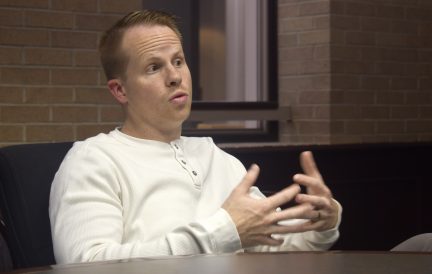
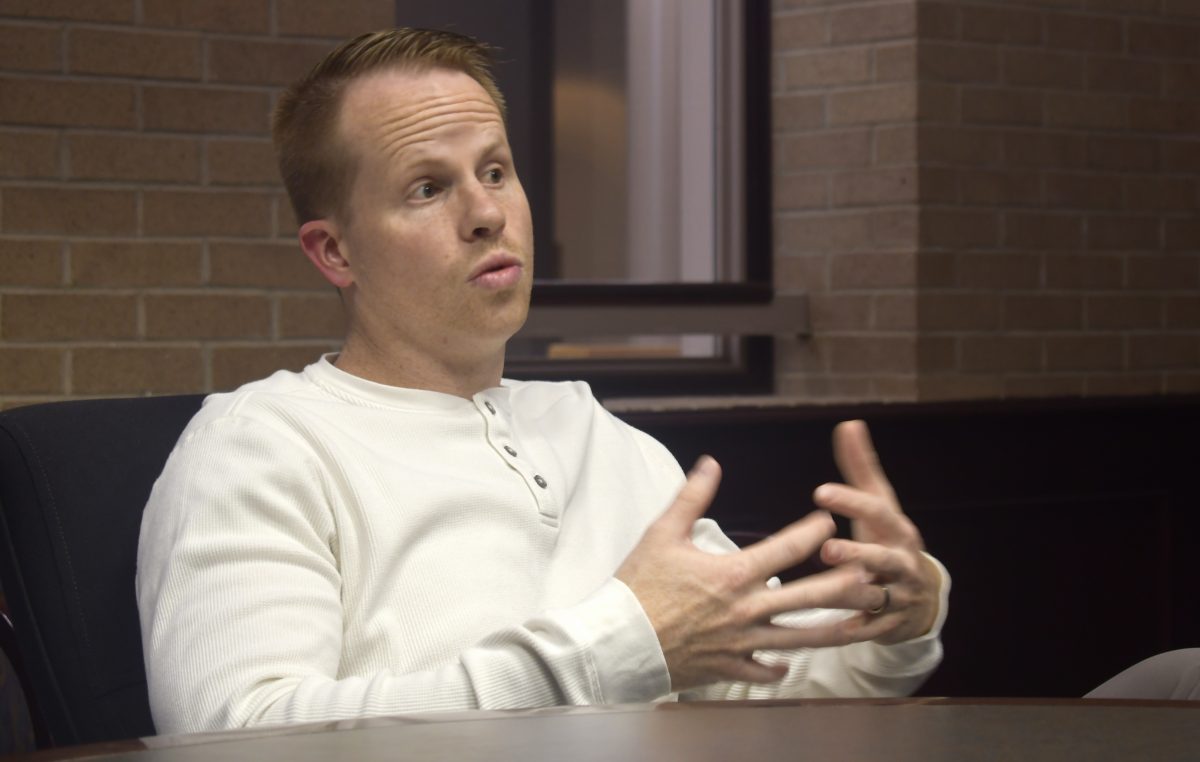
- Trevor Lee, competing in the Republican primary for the House District 16 seat in Utah, participates in a candidate interview at the Standard-Examiner office on Wednesday, April 29, 2026 (Jared Lloyd, Standard-Examiner)
-
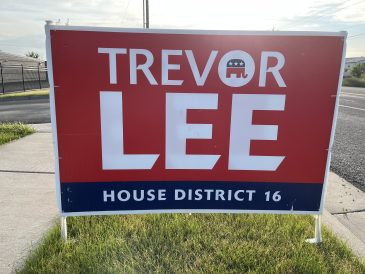
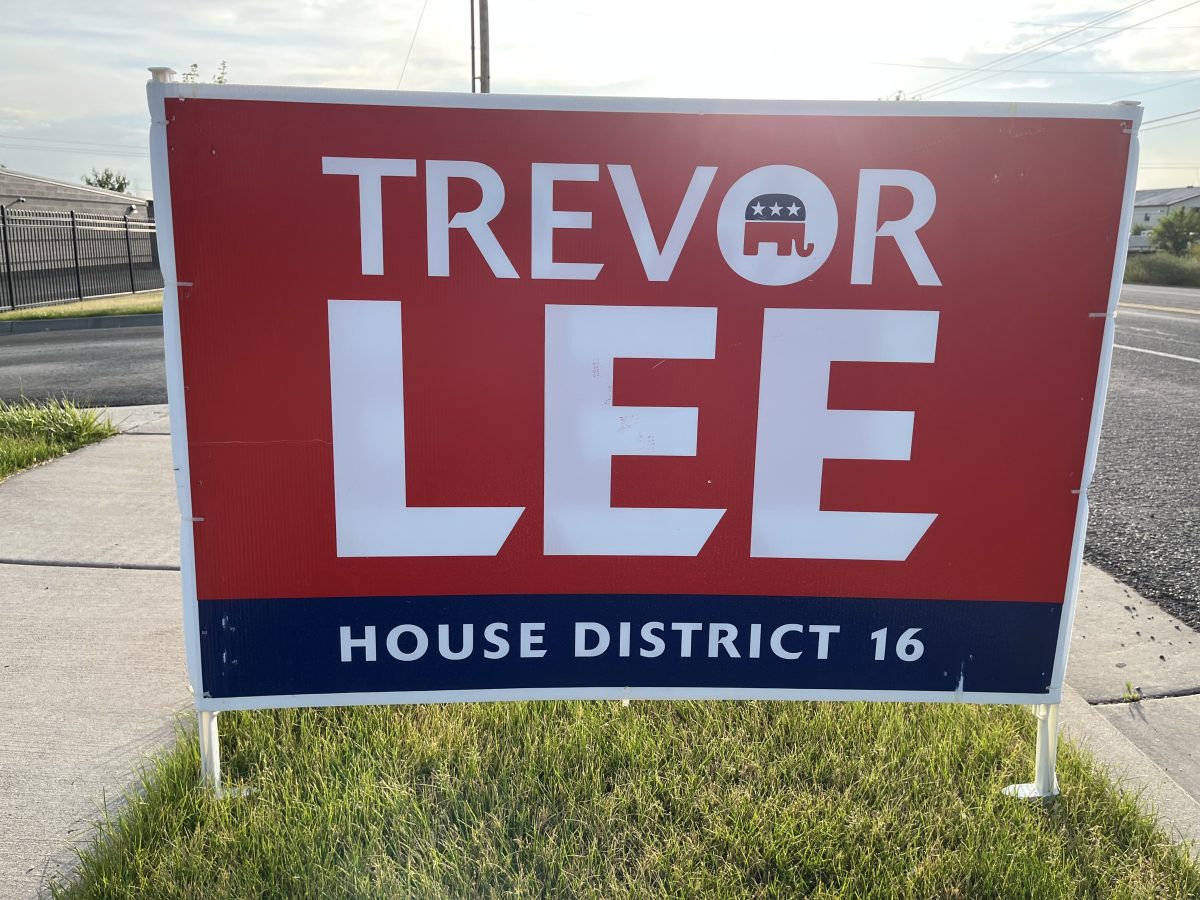
- A campaign sign for Trevor Lee, competing in the Republican primary for the House District 16 seat in Utah, on Monday, May 25, 2026. (Ryan Comer, Standard-Examiner)
Jared Lloyd, Standard-Examiner
Trevor Lee, competing in the Republican primary for the House District 16 seat in Utah, participates in a candidate interview at the Standard-Examiner office on Wednesday, April 29, 2026 (Jared Lloyd, Standard-Examiner)
Trevor Lee’s political story started with a visit to the Capitol in 2021.
Phil Lyman was proposing a bill targeting mail-in ballots.
“And I watched as the entire committee essentially just said, ‘No. We’re fine,'” he said. “And the room is packed full of people. Everyone was upset. We left, and it was that night that I decided … I’m going to go ahead and run for office.
“No clue what I was doing at all. I filed last second in the 2022 primary race against the incumbent Steve Handy, who’d been in for quite a while.”
Lee won at convention and then defeated Handy during the general election when Handy ran a write-in campaign against him.
Ryan Comer, Standard-Examiner
A campaign sign for Trevor Lee, competing in the Republican primary for the House District 16 seat in Utah, on Monday, May 25, 2026. (Ryan Comer, Standard-Examiner)
Lee was re-elected in 2024
Now, he’s involved in another reelection battle, this time against current Davis County Commissioner Bob Stevenson in the Republican primary for the House District 16 seat.
Impactful legislation
Lee said one thing he doesn’t want to do is waste his time.
“So, there’s a lot of politicians who go up there and they’re in office for decades,” he said. “And they can be in for decades if you’re quiet, if you go along to get along, if you’re able to stay with the establishment, what I would call it, and just not go around the way that they do things. And sometimes, if you try to propose or say something that might go outside of what the status quo is, you get branded as an extremist or a radical.
“And in my opinion, I believe this country was founded on people who were radicals. That’s who our founding fathers were. It was pushing back against tyranny. It was new ideas, new ways of thinking, trying to create the greatest country on this planet, which was thinking outside the box, something that had never been done before. And I want to do stuff similarly while I’m in office. I want to propose policies that actually make a difference, that actually move the needle.”
Lee said he has never been one to shy away from speaking his mind and pushing policies he thinks are good for his family and the state of Utah, even if they offend people. He said he looked up to Charlie Kirk in that regard.
“I thought he pushed a lot of truths and was unapologetically willing to speak out against things that may have gone against the status quo,” he said. “And … I’m not going to compare myself to Charlie, but I would like to assume that I fight for the things that are true, even if it’s going to upset people. And so now that I’ve been in office for four years, I’m running for another term because I understand how things work. I know how to get things done.
“I’ve passed over 20 bills in my time in the Legislature, some of them being some pretty big ones. And now my new priority has aligned a lot more with a lot of my friends and close associates with the Trump administration, which is putting Utahns and putting Americans first. I mean, we have sold out our country. We’ve sold our jobs out. We’ve sold our children out to people who aren’t even citizens of this country, and Utah is completely complicit in this. We have done this on multiple levels, and I want to make sure that my kids have a good future. And if I don’t stand up and push back against specifically these types of issues, I don’t see anyone else who is.”
Legislative focus
Lee said his legislative focus is based on his constituents.
“So, every bill that I run comes from a constituent,” he said. “I have people all around the state who ask me to run bills, but I only have so much of a capacity to actually run so many bills in a session.”
Lee singled out two bills in particular as achievements: one which he said was a big one, and the other he said was a simple, small one.
The big one was House Bill 77, which he described as being intended “to ban any flag that had any political leaning or ability to say you’re aligning with something that’s not either the American flag or the state flag.”
The goal of the bill, he said, was to get those flags “off of government property, out of schools” in order to “prioritize unity and uniting around one flag” instead of identity politics.
“That was a big bill, and we were the first state in the country to do something like that,” he said. “Other states had proposed it, but they couldn’t get it passed. And the bill initially started with just schools, but we had expanded it to governmental buildings and any taxpayer-funded entity by the time it got passed. So it went from kind of a small idea of just schools to, ‘OK, let’s just hit everything.’ And we did it.”
Lee said it was a big deal that every Republican in the Senate voted for it except for one, particularly because when he was whipping votes, he thought he only had 15 Republicans who would support it. He ended up getting 21.
Lee cited a Deseret News poll after the bill was signed into law, which showed a majority of Utahns, including 81% of Republicans, supported the legislation.
“So it was overwhelmingly popular amongst people, because it wasn’t necessarily, let’s say, a pride ban, which is what it was coined,” he said. “Ban MAGA flags, too.”
The second bill Lee cited was House Bill 114, a smaller bill, but one he said made a big difference.
“Not many people know or knew that in the state of Utah – in fact, in most states – there are certain organizations that have monopolies on words,” he said. “I had a home designer company approach me from my district who said, ‘Hey, we keep getting fined … because our website has the word architecture in it. We have architects that we contract with, but we’re not architects. We are home designers. We do interior design. We build homes. But we’re not architects. And there’s a law in the books in the state of Utah that says if the word architecture, or any form of that word, is used, you can get fined $200 a day for having that anywhere within your company, your social media, your website.’
“And there was an architect company who saw that and saw them as competition and just kept reporting them and getting them fine after fine after fine after fine. and then went back years, everywhere on their website or social media, and found the word architecture and was giving them a $200 fine. And when they complained … (the company) said, ‘The law’s the law. If you guys want to change this, you’ve got to change the law and talk to your legislator.’
“Well, they did. And they came to me, and we looked at the bill … and we found a good middle ground on this bill that was going to allow anyone to be able to use the word architecture without being an architect and getting fined but still maintaining the integrity of what an architect is in their trade. And so there was a distinction there.”
The bill passed unanimously.
“My constituent was happy; a lot of the businesses in the area were happy,” Lee said. “This was just clear government red tape. And at first, the architects fought it. They liked their law. And then after that bill had passed, we had a bunch of home builders, home designers come to me from around the country saying, ‘Hey, we’ve got the same problem in our state as well.'”
Accessibility
Lee believes what he’s doing is what the people want because of the public outreach he engages in.
“I’ve said it before and I’ll say it again. I’m very, very accessible,” he said. “I take all the calls. I take a lot of weekends, time away from my family to go out. I knock a ton of doors. I argue I’ll knock more doors than most legislators in this whole state. Luckily, my area is … small enough that I can do that, but I talk to a lot of people all over the place — the grocery store, in town halls, coming up to the Capitol, the phone calls, the emails, and I take all of them. And that’s what helps me understand what people really want and what’s important to them.”
He said he listens to people and that sets him apart from most politicians.
“I get so many people who reach out to me, not in my district, who are like, ‘Oh, I can’t ever get a hold of my representative,'” he said. “I email them. I don’t ever get a hold of them. Or I call them, I get a secretary. I never am able to get a hold of my representative. I hear that so much, and I’m never going to throw one of my colleagues under the bus who do that, and there’s a lot, but that is not me.
“And I really wish that people, if they had questions or concerns, would know and understand that. For all the people that I have talked to, there are still thousands and thousands who I haven’t. And I really wish that if they hear or they see something or they have a concern that they would know that they can just one phone call and I’ll pick up. If I don’t pick up, I will always call them back.”
Controversies
Just before the Davis County Republican Convention in April, two stories came out that challenged Lee’s integrity.
KSL reported that Jason Walton, who said Lee worked for his pest control company in 2013, accused Lee of altering “multiple checks by increasing the paid amounts, totaling at least $3,100.”
The second allegation came from Trent Spafford, according to the KSL report, who said he advanced Lee $93,000 to assist with a personal matter, and in exchange, Lee promised to help Spafford’s company, Enevive, obtain a government contract.
“I would say that this is exactly why people don’t run for politics now,” Lee said. “I mean, if you’ve ever done something wrong in your life, it will get brought up. It’s just inevitable.”
Lee said he believes in repentance and that people can change.
“I made a stupid mistake back in my early 20s – a really, really dumb mistake,” he said. “And I made right what I did wrong and I moved on. I have a completely different life now, and I don’t think that disqualifies someone from wanting to go be a public servant. I really don’t.”
Lee said a lot of people don’t know he made right what he did wrong, and he said that he and Walton became close friends when Walton ran for senator. At the time of this interview, Lee said he didn’t know why Walton was pushing this story and that Walton wasn’t taking his calls or texts.
Lee said if this was his first time running, it would be a different story, but having served four years and “in my opinion, being a very good representative for my area, my people, being transparent, being open with discussions on things and working hard to serve them, especially with the policies that I push,” the mistake has not been an indication of how he’s represented the people.
Regarding the second accusation, Lee said he didn’t think it should even be brought up because the case was completely dismissed.
“It’s a nonissue,” Lee said. “It was a disgruntled former employer. He was having financial issues with his business and he’s accusing me of doing things that obviously didn’t happen. And when they could have been brought up in court, they were not, because there’s nothing there and there’s no evidence for it. …”
Closing statement
In his closing statement, Lee said that in this race, he is the clear conservative who listens to people. He said he fights for people.
“And I want to make sure people also understand that I have moved our area to the right, and I believe that’s what they want,” he said. “I’ve won two elections. I’m hoping to win a third to show that what I’m doing and the policies I’m pushing is what they would like to see enacted.
“And if there’s things that they want, I would always hope that they understand that they can come and approach me with their concerns. Contrary to what people may say, I am very approachable and I have the ability to change if I’m wrong on issues. If I’m wrong on my stances, I will be one of the first to admit it. And I’m not that prideful that I can’t change on certain subjects and issues, and so if people want to have someone who will continually fight for them and what they have, that’s me. I mean, that’s why you get elected. That’s why I do what I do. I enjoy helping people, and being a state legislator has given me that ability to help a lot of people, and I would like to continue to do so as long as I’m effective and I’m able to make stuff happen.”
For more on Lee and his campaign, visit https://votetrevorlee.com.
Contact Standard-Examiner editor Ryan Comer at rcomer@standard.net.
Local News
Antelope Island State Park celebrates expanded visitor center
Utah House speaker ‘extremely disappointed’ in how JCC handled Hagen investigation