
New Weber State president discusses embrace of technology, new degree structures on campus
Rob Nielsen, Standard-Examiner
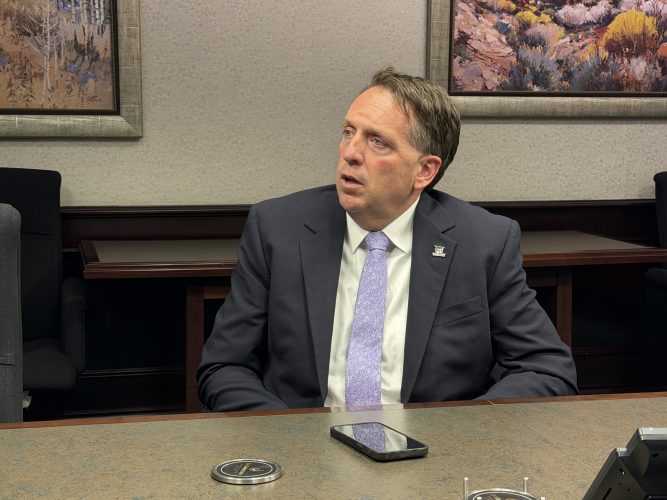
Weber State University President Chris Mallett speaks with the Standard-Examiner editorial board on Wednesday, Sept. 2, 2026. (Rob Nielsen, Standard-Examiner)Editor’s note: This is the second of three stories following a Standard-Examiner editorial board interview with Weber State University President Chris Mallett. Discussion topics included Mallett’s vision for WSU, partnerships with other higher education institutions and the local business community, evolutions in higher education and what artificial intelligence’s place is on campus.
OGDEN — A constant in higher education — as with many other facets of life — has been change.
Weber State University is hardly immune to this — a point driven home by WSU having welcomed alum Chris Mallett as its 14th president on August 1.
But some of the greatest changes were already beginning to manifest on campus ahead of Mallett’s arrival.
Artificial intelligence. Accelerated degree programs. Digital Learning.
Now, Mallett will have a role in WSU’s embrace of these concepts and how they’ll fit in to the university for years to come.
Digital Learning
It was Mallett’s time as a Weber State student that once helped introduce him to another globe-shifting concept.
“When I was a student in the late 1990s at Weber State, I used the Internet for the first time at Weber State’s library,” he said. “The first time I had launched Netscape and opened an Internet browser and saw a webpage, that was in the library at Weber State.”
He said he was also among the first students to take online courses through the university.
“Weber State was early to online and digital education,” he said.
Ever since then, Mallett said he has seen what an asset digital learning can be to schools.
“When I graduated from Weber State, I was part of the founding team that designed and scaled Western Governors University, which is 100% online,” he said. “And when I left WGU after 13 years, we had served 50,000 graduates and had an active enrollment of 50,000 students, so online education is something that I know well.”
He said that it remains popular at WSU, noting that around 25% of students take digital courses to complement their in-person coursework.
Mallett said that it shouldn’t be either-or when it comes to digital versus in-person learning.
“We’re not necessarily looking to choose one or the other, because I think our mission is to meet every student where she or he is,” he said. “That means providing access and flexibility. And just like me 30 years ago and today’s students, sometimes for some semesters, that might mean leaning into an online course. For other semesters, especially if I have the flexibility with part-time employment or other means, that might mean leaning into exclusively full-time and instructor-led and on-campus courses. So we’re designing the education experience so students can navigate between each of those things, and I think that’s one of the reasons that people prefer the flexibility and access and opportunity that we provide.”
He made note of one area that online education has seen a large shift over the last couple of decades.
“There’s opportunity with online education to think anew about the role of faculty,” he said. “In the past 25 years, let’s say, online education went from, ‘put it on the internet’ to some real sophisticated cohort and sometimes faculty-led approaches to then an era where sort of multimedia took hold, and often a lot of online education these days is driven through a video-based experience and digital discussion boards.”
Mallett said that this reintroduction of the human element is also manifesting back in the classroom.
“Just like other parts of society, what’s coming back in vogue is the real life, is the human element,” he said. “We’re finding that a good number of our students are actually opting — even though they could prefer for online education — to do on-ground and in-person because it gives them a different interaction with the faculty who teach the course in a different way when they’re teaching on-ground.”
He said that the university will continue to meet students where they’re at, no matter which way the pendulum swings.
“We’re not going to force the choice upon the learners that we serve,” he said. “We want to be a university that can meet learners where they are and give them choices, but I think personally in the next five or six years, I think you’ll see more and more students opting, again, for in-person, instructor-led class discussion formats because so much of our digital world is just that — it’s exclusively digital — and it’s refreshing to find more opportunities to experience each other in real life, for lack of a better word. And we’ll be well-positioned however that plays out.”
Artificial Intelligence
The conversation about AI’s impact on several facets of life, from public safety to art, has been inescapable.
Academics is no different.
Mallett likened the advent of AI to what he saw with the Internet as a WSU student in the late 1990s.
“The conversation was very similar, ‘What is the internet gonna mean for X or Y or Z?'” he said. “And all the unknowns, all the ethical risks, the moral risks, the uncertainty of it all, the fear sometimes. And what I recall — and maybe I have revisionist memory — is that we answered all those questions through trial and error and by being unafraid and optimistic about it and experimenting with it.”
He said that the best way to answer the AI question is to do what was done with the Internet — encourage experimentation.
“I just think the answer is to encourage our faculty and our students to be unafraid of AI and to experiment with it and then to put appropriate safeguards in place, obviously, to make sure that we’re not sacrificing the substance or the quality of it,” he said. “But if we over-index on trying to have all the answers, we won’t get started.”
Mallett spoke of a recent meeting with the WSU Faculty Senate where AI was discussed at length during which an ongoing example of this experimental spirit arose.
“At the end of it, a colleague raised her hand and she said, ‘Well, we’ve been doing that in the nursing program for a year and a half,'” he said. “What greater stakes than getting human health wrong? But they chose to be unafraid. They chose to recognize that AI is inevitable in their field, so we better get started with our industry partners figuring out how to implement AI appropriately in nursing education so that our graduates know how to appropriately use it in the workforce. They’re leading by example.”
He said he doesn’t necessarily see AI replacing human skills and capabilities.
“The technology of AI is going to evolve in the way that it’s going to evolve,” he said. “One thing’s for sure, that the human skills — the uniquely human abilities — are essential. The creativity, the critical thinking, the reasoning, the problem solving — you can program a computer to do some of those things some of the time, but I believe there are uniquely human capabilities and competencies that are going to come back in vogue and back into the foreground.”
Mallett said that this is becoming clear in the hiring practices of AI companies, and institutions like Weber State can play a critical role in preparing future employees.
“The AI giants themselves are preferring people with a liberal arts background to help complement the development of the AI,” he said. “The next wave of hiring is not going to be about just engineers, but rather engineers who have a humanics background or a strong liberal arts foundation. People who have interdisciplinary skills in the age of AI are going to be really important and in demand, and it’s great because universities like Weber State produce graduates like that in every field.
He said, ultimately, technologies that were hard to grasp at the time of introduction eventually become a part of everyday life and that AI will be the same.
“The story of the internet ended really well,” he said. “It brought along some other challenges too, but it literally became integrated in every aspect of life and changed the world. I just think AI has that kind of transformative power and, especially at a university, we should be unafraid of experimenting and assessing.”
Accelerated Degrees
The standard timeframe to obtain a degree at a liberal arts university has traditionally been four years.
However, in 2025, Weber State began rolling out degree programs that would allow students to finish in three years. With this, WSU became the first public university in the state to offer bachelor’s degree programs requiring less than 120 credit hours.
Mallett said he has his own experience with learning on an unorthodox timetable.
“At WGU, we did away with the notion of time to degree from the jump,” he said. “It was all about, ‘Are you competent?’ If you can demonstrate that competency, then you can progress to the next competency.”
He said a greater emphasis needs to be put on a set of questions about a student’s demonstrated ability rather than time in higher education.
“Can our graduates compete? Are the skills that they’re developing assessed properly? Are we confident that they have those abilities? I don’t think time is the variable that we should organize around,” he said. “Higher ed’s organized around time and credit hour for centuries because it was the easiest way to figure out how to pay faculty. That’s not the right reason to require 120 credits. The right thing to do is to design a degree program specific to the needs and the learning objectives and the needs of the workforce and then allow students to accelerate if it’s appropriate for them to do so.”
Mallett said he’s still learning about the accelerated degree programming at WSU, but he favors the concept where it’s appropriate.
“If (students) want a different choice with longer time to degree because of the outcomes and the courses and the objectives in that latter option, then that’s great too,” he said. “But not every learner has the luxury to take that extra 30 credits, nor does every learner need to take it if they have prior competencies or other skills that could allow them to demonstrate that and move ahead. I think it’s a really exciting innovation, and I haven’t learned enough about how we actually executed at Weber State in just six weeks, but the concept is appropriate and consistent with what I’ve learned over 26 years about what universities should be doing.”