Layin’ It on the Line: The birthday the IRS has been waiting 40 years to celebrate

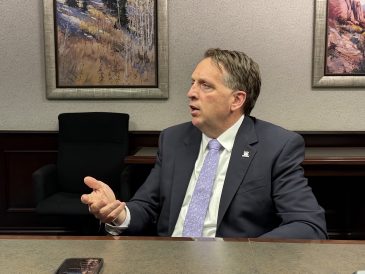
Photo supplied
Lyle BossIf you blew out 73 candles at some point in 2026, congratulations twice over. Once for the birthday, and once because you’ve officially reached the age the IRS has been circling on its calendar since your first 401(k) contribution back in the Reagan years.
This is the year required minimum distributions begin. The four decades of “save now, we’ll settle up later” are over. Later is now, and the paperwork has a deadline that’s closer than it looks.
The April 1 Head Fake
For your first RMD only, the government offers what sounds like a gift: you can wait until April 1 of the year after you turn 73. Turn 73 in 2026, and your first withdrawal can technically wait until April 1, 2027.
Be careful with that gift. It has a hook in it. Delay the first RMD into 2027 and you’ll still owe the second RMD by December 31, 2027. Two required distributions, stacked into a single tax year, on top of Social Security and everything else. That pile-up can shove you into a higher bracket, tax more of your Social Security, and, because Medicare looks back two years, hand you an IRMAA surcharge on your 2029 premiums as a souvenir.
For most people, taking the first RMD in the calendar year they turn 73, meaning by this December 31, is the cleaner play. Run both scenarios before you decide. But don’t let “technically allowed to wait” turn into “accidentally doubled my taxable income.”
What Happens If You Simply Don’t
The penalty for missing an RMD used to be a brutal 50 percent of the amount you failed to take. It’s now 25 percent, and it drops to 10 percent if you fix the mistake promptly and file the correction. Better, but still the most expensive form of forgetfulness in the tax code.
And know the aggregation rules, because they trip up organized people. If you have several IRAs, you calculate the RMD for each but can take the total from any one of them. Old 401(k)s don’t play by that rule. Each workplace plan generally requires its own separate distribution. I’ve seen a retiree take a large, correct withdrawal from her IRA and still get penalized on the forgotten $60,000 401(k) from a job she left in 2009.
One housekeeping note: don’t wait until the week between Christmas and New Year’s to call the custodian. Every financial firm in America is buried in December distribution requests, and a processing delay doesn’t excuse a missed deadline. Mid-November is your friend.
The Tithing Settlement Strategy
Now for the strategy I’d guess half of Ogden could use and a tenth of it does.
If you’re 70½ or older, you can send money directly from your IRA to a qualified charity, up to $111,000 per person in 2026, and it counts toward your RMD while never appearing in your adjusted gross income. It’s called a qualified charitable distribution, and for people who give anyway, it’s close to free money.
Utahns are among the most charitable people in the country. If you’re already writing checks to your church, the food bank in Ogden, a grandchild’s mission, or the university, routing that giving through the IRA instead of the checking account means the RMD does its duty without inflating the income that Utah’s $4,545 retirement credit, the senior deduction, and IRMAA are all measured against. Same generosity. Smaller tax return. The money must go straight from the custodian to the charity, so it takes a phone call, not just a checkbook.
The RMD You Don’t Need Still Has Options
Plenty of retirees tell me the RMD is money they don’t actually need that month, which is a fine problem to have. Taking the distribution doesn’t mean spending it. Pay the tax and the remainder can be repositioned, into the taxable bucket, into funding insurance, or into an income plan for the surviving spouse, who will someday file single on brackets built for one.
And a straight word about annuities here, since it’s my business: a Fixed Index Annuity inside an IRA does not escape RMDs. Nothing does. What a lifetime income rider does provide is a payment that can satisfy the requirement automatically, year after year, without you deciding what to sell or when. For an 85-year-old, or the spouse handling things alone later, that kind of autopilot has a value no illustration quite captures.
Forty Years Was the Deal
Nobody loves RMDs, but let’s be fair about what happened. You made a bargain in 1986: deduct it now, defer it for decades, settle up in your seventies. The deferral was real, the compounding was real, and now the bill arrives on schedule.
The retirees who resent this season are the ones who let the IRS pick the amounts and the timing by default. The ones who don’t are the ones who spent a November afternoon with a calculator, a charity list, and a plan. December 31 is coming either way. Whose plan it follows is still up to you.
Lyle Boss, The REAL BOSS Financial, a native Utahn and retirement specialist who has spent decades helping families across Utah and the Mountain West build secure, income-focused retirement plans. Boss Financial, 955 Chambers St. Suite 250, Ogden, UT 84403. Telephone: 801-475-9400. https://www.safemoneylyleboss.com