Pineview Reservoir study proposes dramatic long-term changes to keep pace with use
HUNTSVILLE — Pineview Reservoir is one of the key tourist draws in Weber County, attracting around a million visitors a year, federal officials estimate.
But more could be done to enhance its features, to make it more user-friendly, according to an ambitious study conducted by students and staff at Utah State University. And with the area population on the rise, such change — unifying the varied recreational attributes of Pineview, broadly speaking — is imperative to guard against deterioration of the resource.

Image supplied, Weber County
A map from a study looking at the future of Pineview Reservoir shows the recreational body of water. The study was conducted by Utah State University students and staff.
“Proactive measures in the planning and design of the reservoir’s assets are needed as quickly as possible to accommodate the increased demand before these assets are degraded further,” reads the study. It was carried out in conjunction with Weber County and the U.S. Forest Service, owner and overseer of the land where the reservoir sits.
Public release of the study to the Standard-Examiner comes in the wake of news late last month that the feds have allocated funding to help with plans to upgrade Pineview Reservoir. But the expected money, initially some $600,000, according to Weber County Commissioner Gage Froerer, will likely only cover the cost of improvements to perhaps three of the many recreational areas around Pineview.
The study, meant to serve as a preliminary blueprint for possible change over the long haul, proposes more ambitious change, including better connections between the recreational sites around Pineview, better signage to guide visitors and even ferry and shuttle systems, among other things.
“Students were asked to think big and be visionary in their designs. They were asked to push the boundaries of what uses, elements and designs exist in the area and envision what possibilities could exist in the near- and long-term future of the reservoir,” reads the study, titled Pineview Forward.
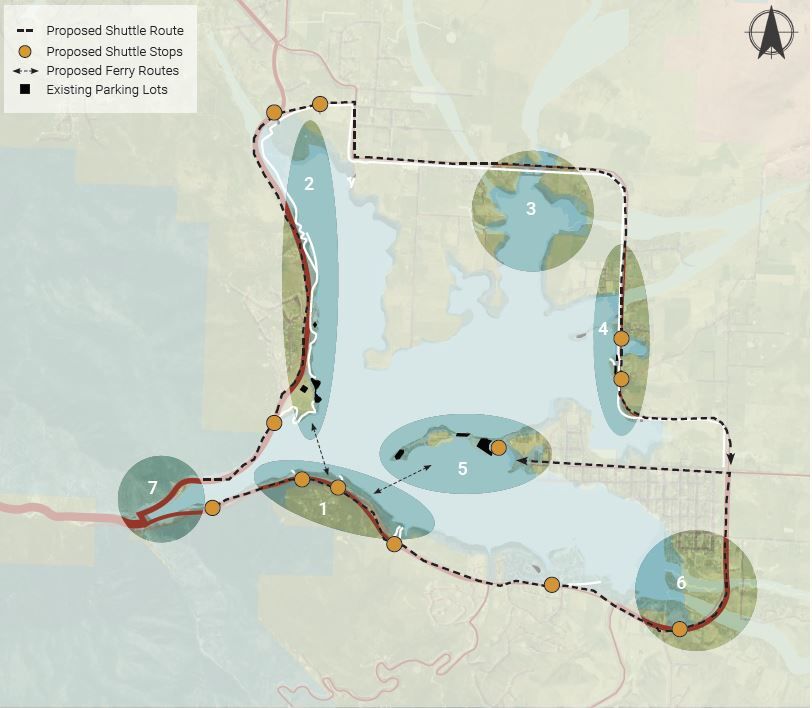
Image supplied, Weber County
A map from a study looking at the future of Pineview Reservoir shows the recreational body of water. The study was conducted by Utah State University students and staff.
The study, handled by staff and students in USU’s Landscape, Architecture and Environmental Planning program, looks at each of the varied beaches and other draws around Pineview, suggesting micro-level changes. Here are a few of the broader takeaways:
Take a unified vision: Those involved in developing Pineview Reservoir in the years to come should take a unified approach in assessing its resources and attributes, including the varied beaches, overlooks, boat ramps and other areas scattered around it.
“In order to address future demand on the recreational amenities and improve visitors’ experience, the recreational sites, the reservoir, the canyon entrance and the community of Huntsville must be considered an interconnected recreational system and should be planned and managed as such. A single site alone cannot be modified to accommodate the projected future growth in visitors or desired amenities,” the study states. The varied proposals in the study, it goes on, “were designed to facilitate a connected system.”
Perhaps Pineview could be divvied into districts to orient visitors to all it has to offer and to make it easier for visitors to pick the sites that most appeal to their tastes.
Signage: As is, signage guiding motorists and other visitors to Pineview’s varied recreational stops “is essentially non-existent.” The study proposes installation of a system of signs to make it easier to navigate the area and create a sense of place.
“Way-finding signs at Pineview would acquaint visitors to the spatial orientation of amenities and help with day planning,” it reads.
Connectivity: Trails could be improved to link up with one another and connect Pineview’s beaches and other resources, creating a loop all the way around the reservoir. “By including these trails, a loop of about 13.5 miles is created, perfect for half-marathons or full marathons if run twice,” says the study.
It further proposes creation of a shuttle system that would haul visitors from site to site, alleviating crowding at congested sites like Windsurfer Beach on the western side of the reservoir. The study noted the shuttle system used at Zion National Park as an example. “A shuttle at Pineview would alleviate satellite parking lots by facilitating the function of a main entrance park-and-ride,” it reads.
The study also suggests creation of a ferry system on the reservoir itself to haul pedestrians and cyclists from a lookout at the southwest corner of the body of water to Cemetery Point, the popular beach near Huntsville, and Windsurfer Beach, almost directly to the north. Furthermore, it proposes creation of a bridge over the narrow western portion of the reservoir between State Road 39 and S.R. 158 as a safety precaution so the nearby dam structure doesn’t have to be used to haul autos.
The entry: The study suggests creation of a visible gateway to Pineview Reservoir to “better notify visitors of their arrival to a distinct regional destination.” It puts forward several concepts, including inclusion of a park-and-ride area to be integrated with a shuttle system.
Implementation of any of the changes suggested in the study hinges on funding, according to Froerer, and for now the key funds available for immediate changes come from the Great American Outdoors Act, per an announcement late last month.
According to Froerer some $600,000 in funding from the act will be used to survey the reservoir and plan and prioritize upgrades. Froerer suspects enough money will be available for improvements to three to five areas of the reservoir. Among the sectors needing most immediate attention, in his view, are Port Ramp Marina to the west and the Spring Creek and Pelican beach areas north of Huntsville, which draw large crowds.
Looking to the future, more improvements will be needed. As the number of visitors increases, Froerer even envisions the possibility of having to implement a parking reservation system for visitors.
For now, though, big change is more in the conversation stage, with the Utah State University study meant as a catalyst for debate.
“There’s a lot of stuff in there and and a lot of it is really lofty. But there are also a lot of really good ideas,” said Sean Harwood, head of the U.S. Forest Service’s Ogden Ranger District. “The question that we’ve all asked ourselves is what do we want Pineview Reservoir to look like in 20 years?”