Democratic convention result triggers anger; some leave party




-

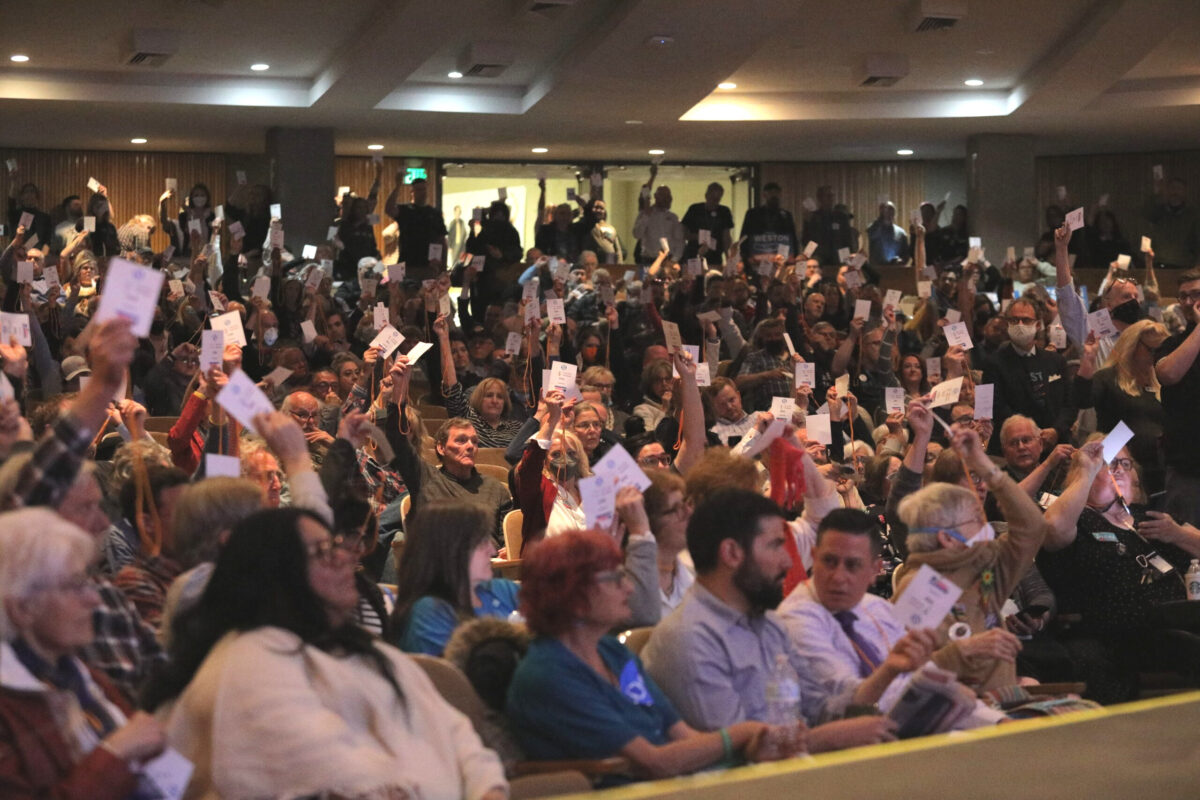
- Former Rep. Ben McAdams, left, and Salt Lake County Mayor Jenny Wilson, wearing stickers supporting independent U.S. Senate candidate Evan McMullin, talk to each other during the Utah Democratic Convention at Cottonwood High School on Saturday, April 23, 2022.
-

- Representatives for Evan McMullin and Kael Weston’s Senate campaigns discuss speaking procedures behind a curtain during the Utah Democratic Convention at Cottonwood High School on Saturday, April 23, 2022.
-
- Supporters of Kael Weston raise signs during the Utah Democratic Convention at Cottonwood High School on Saturday, April 23, 2022.
-

- Evan McMullin listens to speakers during the Utah Democratic Convention at Cottonwood High School on Saturday, April 23, 2022.
-

- Democrat Kael Weston addresses delegates during the Utah Democratic Convention at Cottonwood High School on Saturday, April 23, 2022.
When the Utah Democratic Party announced Saturday at the state convention that it would support independent candidate Evan McMullin’s bid for the U.S. Senate, it was a tale of two rooms.
On the auditorium’s stage left, elation. McMullin and his supporters erupted into cheers, hugged one another and began to mentally plan the next six-plus months until the general election.
Just across the room, it was the worst-case scenario. Supporters of Democrat Kael Weston were disheartened and disillusioned — so much so that people have begun leaving the party and the Utah County Democratic Party put out a statement to assuage members.
In a message shared on social media, party chair Katie Adams-Anderton wrote, “I understand that there are a lot of strong emotions right now, and please know that I am right there with you. However, I urge you to stay (a part) of the Democratic Party. Whether you are a delegate, volunteer, or a member; we want you to stay with us.”
The statement came after several members of the party resigned in the wake of the delegates’ decision. Others across the state have had similar reactions, including candidates and party executives.
Sophia Hawes-Tingey, a Utah House candidate in Salt Lake County, shared online that she could not support an unspoken “win at all costs” mantra reflected in the democratic party’s decisions made over the past decade.
“The boldness of standing up for principles has been watered down. I would love to see the restoration of the audacity to stand for universal principles, truth, and hope,” she wrote.
While Hawes-Tingey said that she withdrew from the party two weeks ago, her post was made public Saturday evening.
Also stepping away from the party is Sheila Srivastava, the now-former treasurer for the Utah Democratic Party. In her letter of resignation, Srivastava wrote about the financial standing of the state party, both when she started and today. She went on to say that it is her personal ethics that inform her work, and that she supports the mission of Utah Democrats — to elect Democrats. She wrote that her identity as a Democrat was “assaulted” by the decision to back an independent instead of a candidate from the party.
According to Ben Anderson, communications director for the Utah Democratic Party, there are not official membership rolls and, therefore, no information as to how many people may have resigned.
Due to Utah’s status as a deeply conservative state, Democrats have historically been in a precarious position, but every person who leaves the party makes the future possibility of electing representatives of the party more difficult. In the 2020 presidential election, Joe Biden received 37.65% of the vote — higher than Chris Peterson, the Democratic candidate for governor in Utah, who finished with 30.4% of the vote. Both of these figures were marked improvements for Democrats in the state. In 2018, Jenny Wilson took 30.9% of the vote in the U.S. Senate election against Mitt Romney. In 2016, gubernatorial candidate Mike Weinholtz finished with 28.7% of votes against Gary Herbert compared to the U.S. Senate race in which Mike Lee was reelected and Democrat Misty Snow finished with 27.1% of the vote.
In the 2016 presidential election, Democratic candidate Hillary Clinton finished with 27.46% of the vote, the closest a Democrat had come to winning Utah since 1964. But even that outcome was likely diluted because of McMullin. He finished with 21.54%, while former President Donald Trump received 45.54% of votes, and McMullin has used these figures to show his viability.
However, the independent pledged to delegates that he can beat Lee in November, saying his candidacy is based around him being the person with the best chance of unseating the senior senator by building a coalition of reasonable Republicans, independents and Democrats.
The McMullin for Senate campaign did not respond to multiple requests for comment.
Local News
Making a splash: GEHA, Ogden City Recreation expand no-cost swimming program
Duane Kearsley focuses on ‘smart growth,’ citing background, in Weber County Commission Seat A race