Rep. Moore says he puts policy over ‘toxic’ politics; Crosby calls himself a chance for change
Pool photo by Eli Lucero/The Herald Journal
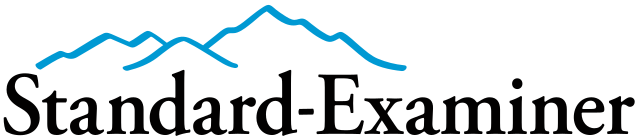
Candidates for Utah’s 2nd Congressional District, Democrat Peter Crosby, left, and Republican Blake Moore shake hands following a debate at Utah State University, Tuesday, Oct.13, 2026, in Logan, Utah.In the race for Utah’s newly-drawn 2nd Congressional District, Republican incumbent Rep. Blake Moore squared off with one of his challengers, Democrat Peter Crosby, on the debate stage at Utah State University on Tuesday, three weeks before the Nov. 3 election.
The debate — hosted by the Utah Debate Commission, moderated by KUTV news anchor Heidi Hatch and broadcast live by PBS Utah — put Moore and Crosby through their paces on a wide range of issues, including data centers, water, energy, the shrinking Great Salt Lake, the national debt, tariffs, the Iran War and more.
Moore defended his record and painted himself as a “productive” member of Congress that’s focused on solutions rather than “toxic” politics.
“I’ve been able to pass more legislation than anybody else in my cohort, from Great Salt Lake to Hill Air Force Base, to pro-growth and family policy with regards to tax, and it’s something that I’m going to continue to do,” Moore said.
Crosby, an adjunct professor for the Center for Anticipatory Intelligence at USU, argued he’s the right candidate to fix a “broken system” and “build a future for every generation to come.”
“The distinct difference between (Moore) and myself really is down to Blake Moore is fine with the path that we’re on. I’m not,” Crosby said. “And if we’re going to have something different happen, we need different representation.”
The debate
The two candidates shared common ground on several topics. They both expressed support for local control over data center development, both called for the creation of a fiscal commission to tackle the national debt, and both credited Utah state leaders for the way they’ve tried to handle artificial intelligence regulation.
During the debate, Moore and Crosby stayed focused on policy and there were no fiery back-and-forths between the two.
However, Crosby took some shots at Moore when discussing tariffs, fuel prices and the Iran War, arguing Moore has stood by while his own party, as President Donald Trump’s administration, has enacted policies that have hurt Utahns, especially farmers.
“You have to end a broad tariff regime. Tariffs are fine when they’re used for strategic purposes, but this isn’t strategic. This is now an effective tax on the American people that disproportionately hurts our agricultural community,” Crosby said.
He then pointed to the U.S.-Israel war in Iran, saying “when the executive decides to attack the two of the largest oil producers in the world, close a strait that’s necessary for the transportation of goods and energy, and then we buy more diesel from the country that’s funding the country that we’re being attacked by? Like, all of that is going to directly contribute to challenges in the ag sector.”
Moore said he “did not expect” fuel prices to rise like they have while Republicans have been in power, and he acknowledged that the war in Iran is “becoming a major, major problem.”
“I’ve encouraged a ceasefire. I was hopeful for the MOU to be able to play out, and simply … fell to the wayside, unfortunately. And there is a strong motivation to be able to get this figured out, so we can move past this. This is way too difficult, particularly on those important industries.”
On gas prices, Moore said there’s a permitting bill “that is likely going to pass here in the coming months” with a goal of increasing “our domestic supply so we don’t have to rely so much on foreign sources.”
“If we can accomplish that, you could see some relief that’s actually substantive,” Moore said.
Crosby said “we don’t need hope” to fix gas prices and inflation. “We need votes.” He also argued it would only take a few Republican votes in the House to end the war in Iran.
“It only takes one or two Republicans to cross the aisle and say, ‘I’m going to put the needs of my district before my political party or loyalty to an executive that seems to be maybe a little bit strategically challenged when it comes to putting the needs of Americans first,” Crosby said. “That doesn’t require committee work; it just requires courage.”
Crosby also attacked Moore over energy development, saying Congress and the Trump administration through the “big, beautiful” budget and tax bill passed year, “stripped subsidies for residential solar,” which he said “deliberately and directly targeted the northern Utah solar industry” and is going result in a loss of up to $1.8 billion in economic revenue.
“So not only do we have a failure to invest in a green energy solution that’s proven to be viable, but we are destroying Utah jobs and Utah economic outcomes. I’m against that,” Crosby said. He added: “That was a bill that was co-authored by my challenger.”
Moore pushed back, saying a bipartisan group in Congress is working on energy permitting reform that’s aimed at an “all-of-the-above energy approach.” He also argued “you can talk to every solar company in the entire state (about) how I went to bat for them.”
“What we’re trying to do is get an all-of-the-above energy approach where there’s a level playing field,” Moore said. “You go talk to every single solar company in Utah, they’ll know that I was somebody that was willing to go and create tough conversations and push back heavily in support of those organizations.”
Could the race for CD2 be closer than expected?
Utah’s new court-ordered map has widely been expected to have created a single Democratic-leaning district concentrated around northern Salt Lake County and three other sprawling, heavily Republican districts.
However, some recent polling suggests that Moore in the new 2nd Congressional District could be in a tighter race than expected. And he’s facing not just one challenger, but four.
Three other candidates are also competing in the general election — Libertarian Daniel Cottam, Independent American Carlton Bowen and unaffiliated candidate Robert Moesinger — but they didn’t qualify for the debate based on polling commissioned by the Utah Debate Commission, which hosted the debate.
In that poll conducted Sept. 10-24 of 515 registered voters, Moore got 39% and Crosby got 34%. Moesinger and Cottam each got 4.9%, and Bowen received 4.1%. The poll’s margin of error was plus or minus 4.32%. About 10.7% of voters were undecided at the time the poll was conducted.
Earlier this month, the Utah Democratic Party said those poll results showed Crosby “within striking distance” of Moore “in a competitive race with weeks to go before Election Day.”
Asked about those poll results during a scrum with reporters after the debate, Moore said he’s confident in his campaign, though he acknowledged third-party candidates and undecided voters can create some wild cards in polling.
“Some elements of that could definitely play out in this election,” Moore said. “But we’re confident where we are. We’re going to continue to drive the message home, and I look forward to an opportunity to kind of continue on a lot of the things that I’ve been working on.”
Crosby said his message to undecided voters is they have a choice between a change with him or the status quo with Moore.
“The conversation (with voters) really boils down to, ‘What do you need help with, and how can we fix that?'” Crosby said.
Tuesday’s debate took place the same day clerks began mailing ballots to eligible registered voters across the state. Once they have their ballots in hand, Utahns don’t need to wait until Election Day. They can cast their votes and send their ballots back through the mail, drop boxes at their convenience, or vote early at a polling place.
For those who want to wait until Election Day, polls close on Nov. 3 at 8 p.m.
Utah News Dispatch is part of States Newsroom, the nation’s largest state-focused nonprofit news organization.
Government
Scott Parke emphasizes experience, sustainable budget in campaign for Davis County controller
Stephanie Wayment focuses on outside perspective, regaining trust in campaign for Davis County controller