Ogden karate master looks back on a lifetime of learning

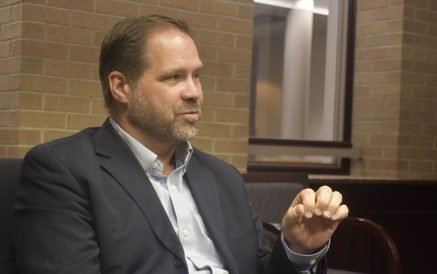
Wayne Wickizer poses for a photo in his Ogden home on February 22, 2016. Wickizer has been practicing karate since 1958 when he was stationed in Japan, and was recently promoted to a 7th degree black belt.
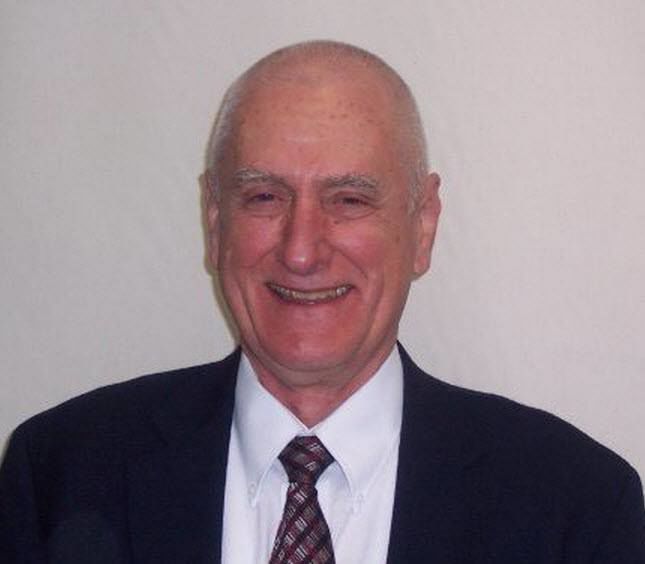
Ogden resident Wayne Wickizer.
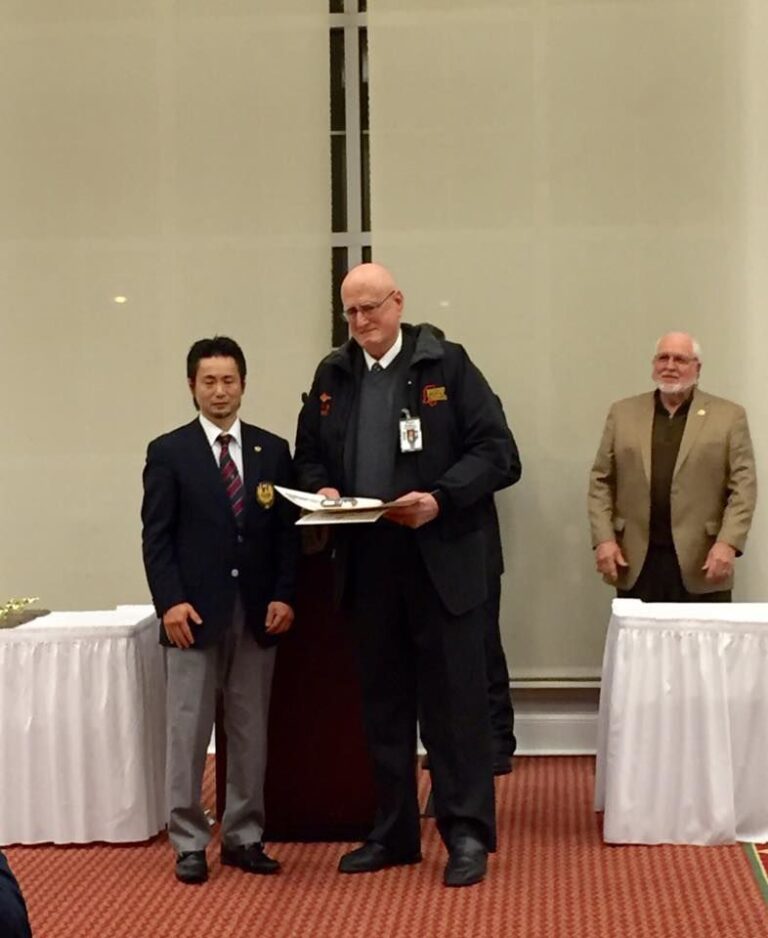
Wayne Wickizer (center) is promoted to 7th-degree black belt by Tomokatsu Okano (left) in a ceremony at the Mississippi Karate Association awards banquet and seminar.

Wayne Wickizer poses for a photo in his Ogden home on February 22, 2016. Wickizer has been practicing karate since 1958 when he was stationed in Japan, and was recently promoted to a 7th degree black belt.
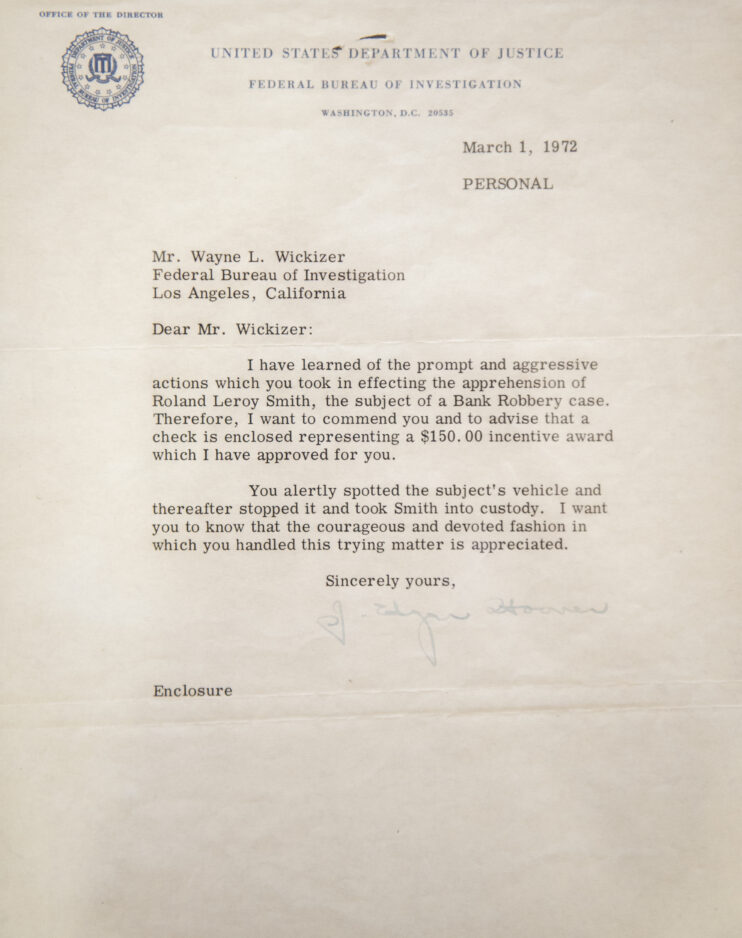
Pictured is a letter from J. Edgar Hoover to Wayne Wickizer that hangs on Wickizer’s office wall in Ogden on February 22, 2016. Wickizer has been practicing karate since 1958 when he was stationed in Japan, served in the FBI for 6 years, and was recently promoted to a 7th degree black belt.
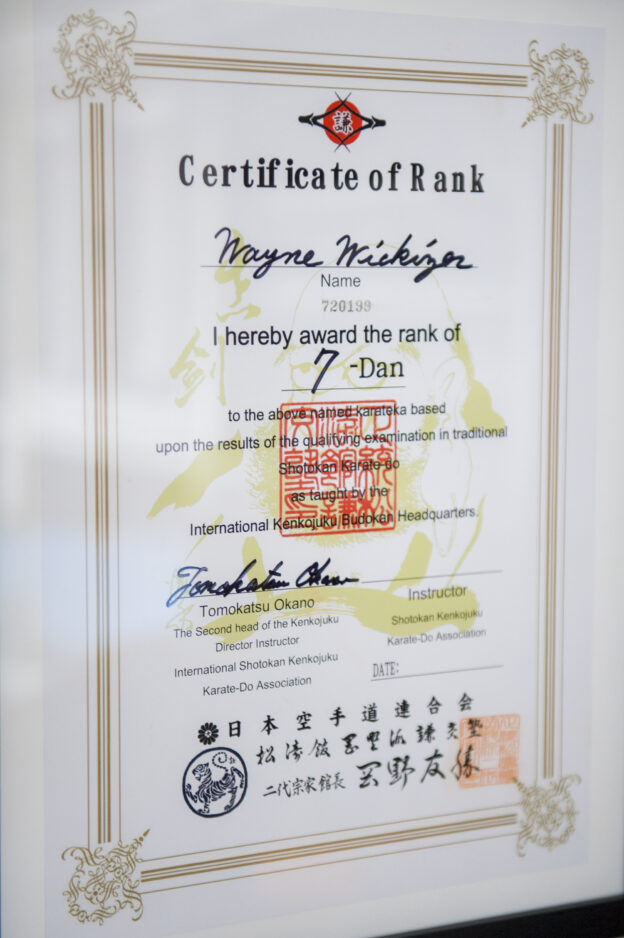
Pictured is a certificate showing that Wayne Wickizer is a 7th degree black belt that hangs on his office wall in Ogden on February 22, 2016.
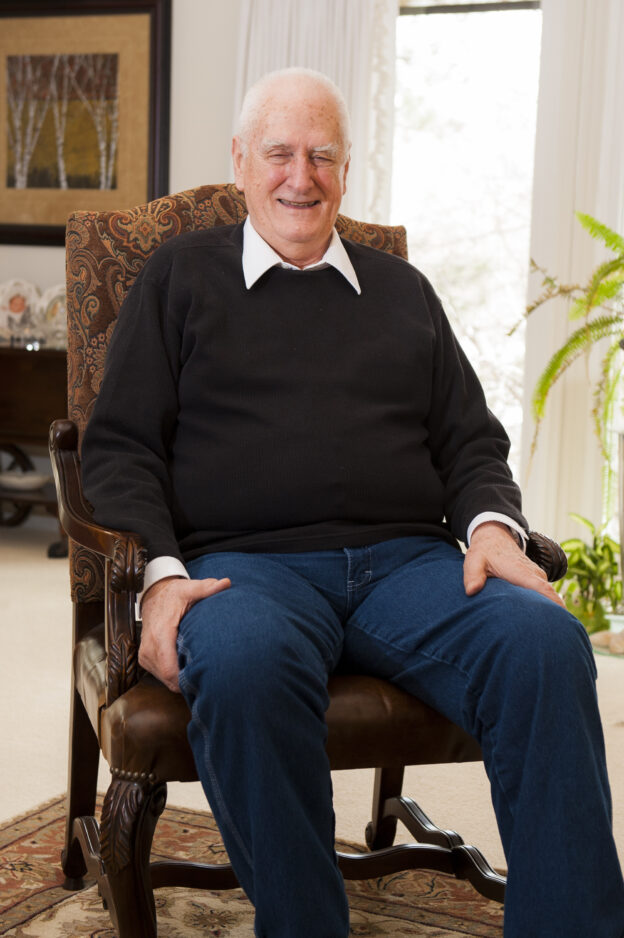
Wayne Wickizer poses for a photo in his Ogden home on February 22, 2016. Wickizer has been practicing karate since 1958 when he was stationed in Japan, and was recently promoted to a 7th degree black belt.
OGDEN — When it comes to karate, Wayne Wickizer freely admits his best days are behind him.
“I have a new hip and a new knee,” he said. “I’m basically worthless in a dojo.”
Despite this, the 78-year-old Ogden man, who has long been a student, teacher and advocate of karate, was recently promoted to 7th-degree black belt, one of the highest ranks attainable in the martial art.
“Theoretically, there are 10 degrees of black belt,” Wickizer explained. “Our current master is an 8th-degree; I don’t know anyone who is a 10th-degree.”
Terrell Bird, who for 20 years was a karate student of Wickizer’s, says becoming a 7th-degree black belt is a pretty big deal.
“It’s the equivalent of having three Ph.Ds in a field.”
Bird and his wife, of Woods Cross, are serving as employment missionaries for The Church of Jesus Christ of Latter-day Saints in Orlando, Fla., and Bird says much of what he learned in life came from his early association with Wickizer’s classes.
“It was a great turning point in my life as far as learning control and how I wanted to focus things,” Bird said. “When you look at pure martial arts, it’s more than self-defense. It’s a way of governing yourself. It allows you to learn control and eliminate things like temper problems.”
And while he hasn’t practiced karate in a few years now, Bird says he still uses the principles he learned.
“Martial arts is a lifestyle,” Bird said.
FATHER OF MODERN KARATE
Wickizer has ties to some fairly impressive karate royalty. He studied the art under Tomosaburo Okano while serving with the Air Force in Japan during the late 1950s and early ’60s.
Wickizer calls Okano the “single most-important person in my life.”
Okano was a student of Gichin Funakoshi, the founder of shotokan karate — the most widely practiced style of the martial art. Funakoshi has been referred to as the “father of modern karate,” and is generally credited with both introducing and popularizing it on the main island of Japan. Okano took after Funakoshi and became a well-known karate master as well. Prior to his death in 2003, Okano was declared a “living national treasure” by the government of Japan.
It was Okano’s son, Tomokatsu Okano, who presented Wickizer with his recent karate rank promotion. The ceremony took place in January, at the Mississippi Karate Association’s annual awards banquet and seminar.
Wickizer says he had no idea the rank advancement was coming.
“If I’d known, I wouldn’t have gone,” said Wickizer, who describes himself as an “ojiisan” in karate — a grandpa, or old guy. “I’d have refused it. I never want to see the effectiveness of rank advancements minimized.”
Nevertheless, it was clearly an emotional moment for Wickizer.
“It brought tears to his eyes,” said Bountiful’s Alan Cleverly, one of Wickizer’s first students. “He couldn’t say anything. He choked up to the point where he couldn’t talk.”
DEFENDERS KARATE CLUB
After leaving Japan in 1961, Wickizer was initially stationed at Hill Air Force Base before being transferred to Scott Air Force Base, in Illinois. In 1965, he left the service to attend the University of Utah and it was then Wickizer began teaching karate classes.
Cleverly remembers how it all started. At the time, he and his cousin, Gregg Cleverly, were a couple of 15-year-olds living in Woods Cross. They met Wickizer when he married into the family
“Wayne was working out in the backyard one day, practicing his katas — his karate moves — when me and Greg saw him,” Alan Cleverly recalled. “We said, ‘Could you teach us that?’ “
- RELATED: Tai Chi classes spark seniors
Wickizer told them to get four more guys to work out with, and from those initial six students, the class eventually built up to 35, according to Cleverly. For the next few years, the Cleverlys and others learned from Wickizer and they called themselves the Defenders Karate Club of Woods Cross.
“We were well-known in the area,” Alan Cleverly said. “At that time, there was an awakening to karate throughout the area.”
The name of the club reflected their training.
“One of the main things we’ll always remember him for, he never taught an offensive karate,” said Alan Cleverly. “That’s why Wayne called it ‘the Defenders,’ because he didn’t want it used for anything but defense.”
Wickizer didn’t want money for teaching, either. The club did ask nominal monthly dues. Some of it went to purchase equipment but most of it was used to occasionally take the group out to eat at a Japanese restaurant or another eatery.
”When I left Japan, I didn’t want to get involved in commercial karate,” he said.
Wickizer turned the karate club over to students in 1970, after he was appointed an FBI agent by Bureau Director J. Edgar Hoover. He worked bank robbery, kidnapping and hijacking cases before his family returned to Utah in 1976. He spent the rest of his career working alternately as a high school teacher and with the Utah Attorney General’s Office, combating white-collar and organized crime.
He again taught karate, this time at Viewmont High School and to law enforcement groups, and he was also involved with Army Special Forces for a time.
Eventually, Wickizer says he was no longer able to “efficiently participate” in karate, and he hung it up.
Wickizer hopes for another awakening in 2016. He and some of his former students are hoping to re-establish the Defenders Karate Club sometime in the next six months. The new club, he said, will be a private, not-for-profit venture and they’ll start by teaching their own family members, like grandchildren, or those children referred by friends.
“The only charge will be good behavior,” Wickizer says. “We will have to have dues for a dojo rental and liability insurance. But none of the money will go to anybody’s pocket.”
Wickizer and other enthusiasts from the American Shotokan Karate-do Kenkojuku Alliance are also hoping to establish a scholarship or perhaps a visiting residency program for a black belt to travel from Japan to the U.S. to train students.
“We want to ensure the style is kept pure,” Wickizer said.
Current Woods Cross Mayor Rick Earnshaw is a former student of Wickizer’s.
“Wayne has been a real inspiration in my life,” Earnshaw said.
Earnshaw started taking karate from Wickizer when he was 12 years old.
“He taught us a lot of lessons,” Earnshaw said. “He’s been a mentor of mine all my life.”
Earnshaw says Wickizer instilled in him the confidence to overcome things in life. And he had a blue-collar approach to karate, without emphasis on fancy patches on their basic white gi, or uniform.
“He said karate isn’t for show, it’s a discipline for life,” Earnshaw said of Wickizer. “He really was a great teacher.”
Steve Derbyshire, of Herriman, was the first student of Wickizer’s to earn a black belt. He called the time under Wickizer’s tutelage “one of the great, memorable things I did in my life.”
Derbyshire recalls him as a man who paid attention to the details.
“He was really quite a perfectionist,” Derbyshire says. “He wasn’t the kind of person to let things slide by — He’d let you know in a firm but gentle, kind way if you did it wrong.”
Mike Lallis, of West Jordan, calls his karate training “well-rounded.” Whereas some karate instructors just taught fighting, Wickizer provided the foundational basics, like principles of breathing, according to Lallis.
And Gregg Cleverly, of Centerville, says Wickizer’s simple and basic approach to karate was its beauty.
“I know that he always taught us to do karate the right way,” he said. “I know the karate he was doing wasn’t the most flashy. It was basic, but it was getting the job done.”
Contact Mark Saal at 801-625-4272, or msaal@standard.net. Follow him on Twitter at @Saalman. Like him on Facebook at facebook.com/SEMarkSaal.
Local News
Gov. Cox says his Utah Supreme Court picks were the most qualified. Critics disagree

Changing the plan: O’Leary concedes to President Adams’ demands on data center