Group forms to promote memory of accomplished but little-known Ogdenite Bernard DeVoto
OGDEN — As one of the oldest settlements in the West and onetime epicenter of American passenger railroad service, Ogden is a city steeped in history, with a host of famous names long associated with it.
Prominent mountain men like Peter Skene Ogden and Miles Goodyear have strong ties to the city. As does Brigham Young, second president of The Church of Jesus Christ of Latter-day Saints.
Ogden was home to one of the world’s most successful firearms designers in John Browning. Mariner Eccles was chairman of the Federal Reserve under President Franklin D. Roosevelt. In more recent years, famous American family music group the Osmonds lived in Ogden. Legendary Jazz musician Joe McQueen called the city home from the 1940s until his death in late 2019.
But as contradictory as it sounds, one of Junction City’s most accomplished native sons also remains relatively anonymous. A group of local history buffs is on a mission to change that.
Unless your deeply involved in the literary world, odds are you’ve never heard of Bernard DeVoto.
Born in Ogden in 1897, DeVoto was Utah’s first Pulitzer Prize winner. He won the prestigious literary award in 1948 for the second book (“Across the Wide Missouri”) in a historical trilogy on the American West. He graduated from Ogden High School and later attended the University of Utah. Growing disillusioned with his home town and state, he later transferred to Harvard, graduating in 1920 after a pause in his education to serve in the military during World War I.
For several years, he wrote a popular column in Harper’s Magazine called The Easy Chair. The New York City-based monthly magazine covers topics of politics, literature, finance, and arts and culture, and the magazine is the second-oldest continuously published monthly magazine in the U.S. DeVoto also wrote several acclaimed novels, was a historical authority on Mark Twain and served as a speech writer for 1950s presidential candidate Adlai Stevenson, a Democrat who ran and lost twice against President Dwight D. Eisenhower.
According to DeVoto biographer and fellow Pulitzer winning Utahn Wallace Stegner, DeVoto was “one of the most visible and most controversial literary figures in America, and had been for 30 years” by the time he died on Nov. 13, 1955. In a piece published in the journal Western American Literature, Stegner said while DeVoto started his career as a novelist, the public knew him mostly as a historian, essayist, a “custodian of the Bill of Rights” and an outspoken advocate for public lands. Stegner said DeVoto was never one to back away from a fight or be afraid to loudly voice his opinion, no matter how unpopular it may have been.
“When the public weathervane veered Left, he veered Right,” Stegner says in the WAL piece. “When it veered Right, he veered Left.”
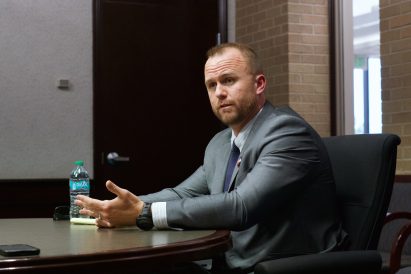
But despite his decorated literary career and high-profile commentaries, DeVoto doesn’t get the recognition he deserves from his own hometown. That’s according to Scott Greenwell, a former Davis and Weber school district administrator and longtime adjunct history professor at Weber State University.
Some cursory internet research shows that Greenwell’s theory checks out. DeVoto is conspicuously absent from a Google search of “Ogden Utah’s most famous residents.” A Wikipedia page titled, “People from Ogden, Utah” lists 74 important or otherwise well-known Ogdenites, but DeVoto is nowhere to be found.
Greenwell said when DeVoto left for Harvard, it wasn’t on the best of terms. He said DeVoto had become disenchanted with his hometown and his home state and was publicly critical of parts of Utah’s culture and of leadership within the LDS Church. Greenwell thinks this cast DeVoto in a negative light among many Utahns, diminishing his renown here.
“But he’s by far Ogden’s most distinguished writer,” Greenwell said. “He was born and raised here, grew up in a house near where Madison Elementary stands now. But he doesn’t have a street named after him, not a park, not a plaque. There’s nothing in Ogden that recognizes him. The closest monument for DeVoto is more than 500 miles away at the Clearwater National Forest in Idaho.”
According to a history from the National Parks Service, DeVoto camped in the Clearwater area while studying the journals of Lewis and Clark and requested his ashes be scattered there when he died.
Greenwell is part of a committee, made up of a dozen or so history and literature devotees, including professors at WSU, that has formed to celebrate the 125th anniversary of DeVoto’s birth, which will be next year. Greenwell said the group is working on a series of events, starting this fall and continuing through much of 2022. Though nothing is set in stone yet, the committee is looking at hosting a concert, some public readings and a public viewing of the 1951 Clark Gable film “Across the Wide Missouri”, which was based on DeVoto’s Pulitzer winning book.
“He’s an important Ogdenite and I don’t think enough people know about him,” Greenwell said. “Hopefully, we’ll be able to bring a little awareness. People should take pride in the fact the Bernard DeVoto came from Ogden.”