Davis County Commission hears presentation on potential fifth fifth local option sales tax
Ryan Comer, Standard-Examiner
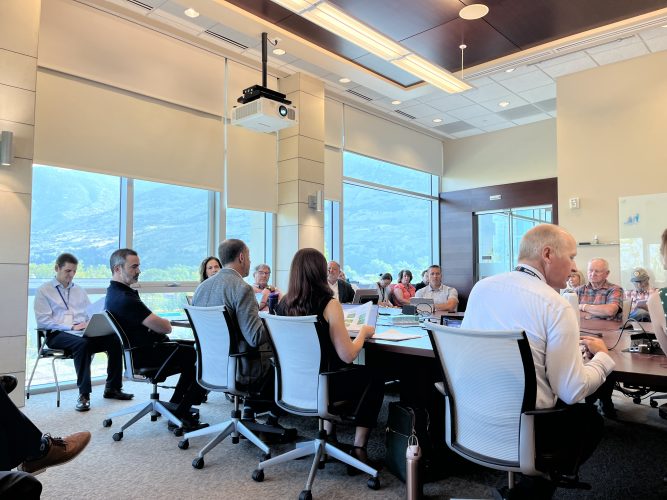
The Davis County Commission meets during a work session Tuesday, Aug. 4, 2026, to hear a proposal on and discuss a potential fifth fifth local option sales tax at the Davis County Administration Building in Farmington.Editor’s Note: The following is the first in a series of stories on the Davis County Commission’s work session Tuesday, which included a presentation and reaction to the possible imposition of a fifth fifth local option sales tax. The following story focuses on the presentation.
FARMINGTON – The Davis County Commission received input on the potential imposition of a fifth fifth local option sales tax during its work session Tuesday.
Andrew Gruber, executive director of the Wasatch Front Regional Council, and Miranda Jones Cox, government affairs manager for the council, presented an overview to the commissioners as well as mayors, city officials and county commission candidates.
“The work that we do in this space, in revenue and taxation, is to help think through with you all, with community members, with members of the Legislature, to think through what are the right mechanisms to generate the revenues that are needed for public investment,” Gruber said. “But, ultimately, it is up to the elected officials to make the decisions about what revenues to actually put in place.”
Understanding local option sales taxes
Gruber said local options are referred to sometimes as quarters because they are typically a quarter of a percent.
“Several years ago, the Legislature authorized at the county level the imposition of these local option sales taxes,” he said. “When I say that, I mean that it’s not a mandate. The Legislature or the state doesn’t say to the county or the local governments, ‘You must do this.’ But under the structure of our Utah Constitution, in order for a local government to impose a tax to raise revenue, you have to be granted that authority by the state.”
Gruber explained that it’s called a fifth because it’s 0.2%.
“But what does that mean? On a $10 purchase, it’s two cents,” he said.
In a follow-up comment to the Standard-Examiner, Gruber said local options do not apply to groceries.
It’s also the fifth local option.
Gruber said the first local option for transportation was authorized and imposed back in the 1970s and was 0.25%.
“All told, right now in Davis County, you have in place four local options for transportation – 1.05% local option transportation sales taxes,” he said. “That’s where things stand right now, and those funds, again, are going for cities, for counties, for roadway projects, for trail projects, for maintenance, for improvements and then also for UTA to use in Davis County.”
Gruber said local governments are authorized by the state to impose local option sales taxes for “locally directed purposes – generated by, controlled by local governments to use for local purposes.”
Progression of the tax
Explaining the progression of the tax, Gruber said it was originally directed entirely toward transit.
Changes were just made in the last legislative session, he said, in response to requests from counties.
“Davis County and others said, ‘Transportation is very important. We believe transportation is very important. We’re a transportation planning agency. But there are also other priorities at the local level, public safety being one of those critical priorities.’
“So, the request was made and granted by the Legislature that the county could use … a portion of the funding for public safety or for transportation. That flexibility was given. And there was even more flexibility given with the transit portion for a short period of time, for a few years, could also be used for public safety. This was the sort of legislative progression. So the point here is as you think about it now, the fifth fifth – 0.20 if imposed – could be used … basically, for transportation or for public safety, so it’s more flexible.”
Uses and impositions of the tax
According to Gruber, the uses for both transportation and public safety are broad.
“The transportation uses are very broad – very, very broad. Road, transit, trail, operation, maintenance, new construction – so, very broadly construed for transportation purposes.” He said. “The way to think about it is that right now, the fourth quarter, where a slice of that goes to the cities – 0.1 goes to the cities, 0.05 goes to the counties – these transportation dollars could be used for exactly the same things as the fourth quarter can be used for right now. So, same approach, very flexible.
“And the public safety funds, the legislation simply says public safety. So, broadly construed public safety.”
Gruber said the fifth fifth has been imposed and is in place in Utah, Salt Lake, Summit and Weber counties and noted that the Weber County Commission recently voted unanimously to put it in place. He said it will take effect Oct. 1 in Weber County.
“So Davis County is the only one of the Wasatch front counties that has not taken this option, has not utilized this option,” he said.
Tax breakdown
A chart displayed broke down how the 0.2% would be divvied up. 0.05% would go to cities for transportation, 0.1% would be “for a purpose determined by the county legislative body” and 0.05% would go to the county for transportation and public safety.
Of the 0.1%, 0.05% would go to transit, as determined by the county legislative body, and 0.05% would go to a Transit Transportation Investment Fund, or TTIF, commuter rail subaccount.
According to Cox, that subaccount was “created several years ago for uses of investing in the FrontRunner system – notably, double tracking the FrontRunner.”
Cox said the 0.2% equates to about $16 million in annual revenue, “so the 0.05 directly to the county for transportation or public safety purposes would be about $4 million annually.”
An incentive for urgency
According to Cox, during about the first three years after imposed, the 0.1% portion can be used for any purpose the county legislative body decides.
“Maximum flexibility,” she said. “Doesn’t have to be transportation. Doesn’t have to be public safety. The commission can use that for whatever purpose they see fit.”
Gruber said if Davis County chose to impose the fifth fifth and did so before Oct. 1, the earliest it would take effect is Jan. 1, 2027. He said if that happened, from then through Sept. 30, 2029, the 0.1% would generate about $22 million to be used for any purpose.
“If that doesn’t happen on that timeframe, if it goes a year after that, then the $22 million maximum flexibility would be then $14 million,” he said. “There’d be a year less of that maximum flexibility revenue. So that’s sort of one of the things to keep in mind.”
Cox said that three-year clock has started because Weber County already imposed the tax.
“There is … approximately a three-year timeline, a three-year clock that once a certain amount of second-class counties have imposed the fifth fifth, it starts that three-year clock,” she said. “So, since Weber just recently imposed, that clock has already started.”
According to utahcounties.org, there are three second-class counties in Utah: Davis, Utah and Weber. Second-class counties, according to the website, have a population range of 260,000 to 1,149,999.
Putting tax to a vote
Gruber noted that sometimes local options have been required by law to go to a vote but that was changed a few years ago.
“It’s an action of the county commission or county council, depending on the county structure,” he said.
Gruber pointed out that they could go to a vote.
“That has not been the norm over the past half a dozen years, but they could,” he said.
Davis County Clerk Brian McKenzie told the Standard-Examiner that “from just strictly speaking the election perspective, state statute requires the ballot question to be provided to the election officers 65 days prior to the election.”
That deadline, McKenzie said, is Aug. 31.
“So if they wanted to put it on the ballot, and there’s not some other statute that regulates this particular type of question, then the default is Aug. 31,” he said.
Contact Standard-Examiner editor Ryan Comer at rcomer@standard.net.
Local News

Harvest Moon Celebration to usher in autumn this weekend

UTA announces zero-fare weekend on all services while upgrades are made to fare collection system