WSU guest opinion: The wisdom women pass down to protect one another

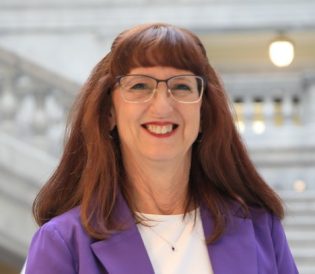
Photo supplied, Weber State University
Leah MurrayWhen I was in high school, a boy I had dated for a long time and I broke up, the way that high school relationships end. He decided to tell people we had sex, which we had not. A mutual friend told me what she had heard, and I responded that was not what happened. I remember vividly, as though 1989 was yesterday, her face when she said, “Well, he said it happened.” I learned at that moment it is never, “He said, she said,” it is always, “He said, end of story.”
I attended Syracuse University and was assigned to a first year experience cohort. At one of those meetings, a peer mentor told us girls that she had decided not to join a sorority she had pledged because of sexual abuse at the hands of a fraternity. She had not been abused, she had been told she would be expected to have sex with the brothers whenever they wanted, so she decided to quit. Sitting there listening to her in 1992, I decided to never rush a social sorority and to never attend a fraternity party at Syracuse University. I also never drank unless friends I knew well agreed to make sure I got home safely.
After undergraduate, I attended the University at Albany for my Ph.D. During orientation for that program, I was told there was a professor who liked to grab women and that I should never walk down a certain hallway in the building. During my first year, a young man in the program wrote me nasty notes and left them in my mailbox. I asked the department chair to intervene, and I was told to ask my other male friend to beat the guy up. In the third year of my program, another teaching assistant announced to a group of students that the only reason anyone worked with me was because they wanted to have sex with me. Another friend told me what he had said. I asked the department chair to intervene and was told I had to accept the teaching assistant’s apology. I was advised by another person that unless I wanted to be “that woman” and ruin my career, I should just go along to get along. So I did. I never walked down that hallway, and I accepted the apologies of the two men who were harassing me.
When I arrived at Weber State University, I taught the statistics course for political science students my first semester. Let me be clear, no one likes that class. The students hated it, they hated me for teaching it, and we all hated math for being math. My first set of students lit me up in my course evaluations, but the only comment that sticks out all these years later was that my ankles were cute and they were so glad I wore skirts. I immediately got rid of my skirts and made pants my professional uniform.
I understand fully, and have since I was 14 years old, that it is necessary to take precautionary measures. Because if something happens and you go to an authority for intervention, you will not be listened to. You will be told, “Go find a boy to fight your fight” or you will be told, “If you make this an issue, we will make your life an issue.” In New York, if you are intoxicated, it will not matter how much evidence you have on Snapchat of what happened, you will be blamed. My last weekend at Syracuse University, my roommates and I threw a huge party and I drank more than was wise. But it was my house and my graduation, and I should have been safe. I woke up the next morning with a boy I didn’t know in my bed. Later, I heard he told people we hadn’t hooked up because every time he made a move I threw up. But had we hooked up, when I didn’t know who he was and I clearly would not have given consent because I was blackout intoxicated, it would have been my fault. In my bedroom, in my house, it would have been my fault.
Cornell University has banned all fraternity parties, as though that will solve it. It will not. Women in institutions of higher education are not taken seriously, period. When I was teaching statistics, for heaven’s sake, a student commented on my ankles. When I sought help at my graduate school, I was dismissed. The only thing women can do is what my peer mentor did at Syracuse University — look other women straight in the eye and tell them the real deal about this world we live in.
As a woman, I have a moral obligation to tell other women: Don’t go to those parties, don’t get drunk, don’t wear skirts. It is absolutely true that I shouldn’t have to do that, but that is a normative ideal that has not been achieved in my lifetime. So it is my obligation to share the truth I have learned. It will always be, “He said, end of story.” Act accordingly.
Leah Murray is a Brady Presidential Distinguished Professor of Political Science and the director of the Olene S. Walker Institute of Politics & Public Service at Weber State University. This commentary is provided through a partnership with Weber State. The views expressed by the author do not necessarily represent the institutional values or positions of the university.