Weber State basketball looks to margins as players learn how to manage larger roles
-
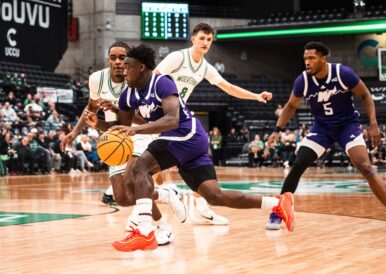
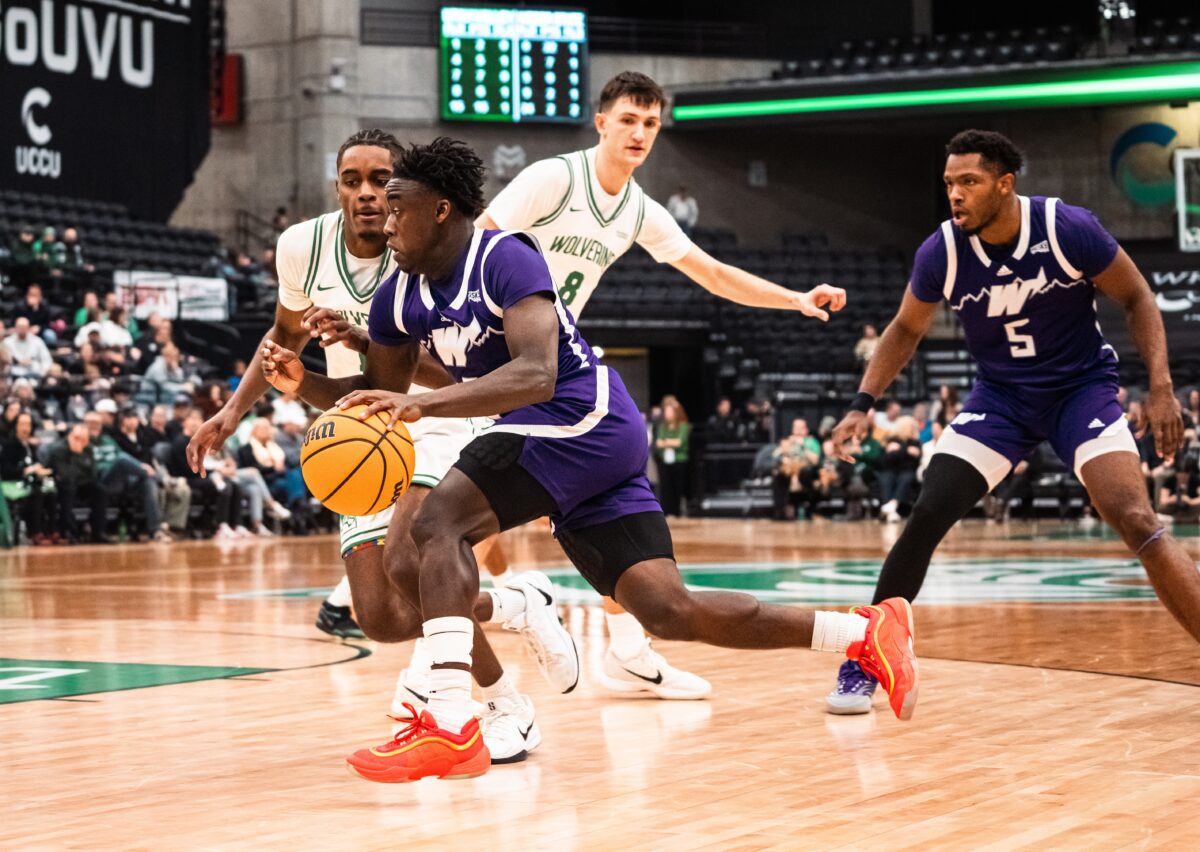
- Weber State guard Tijan Saine Jr., front, drives against Utah Valley on Wednesday, Dec. 17, 2025, at the UCCU Center in Orem.
-
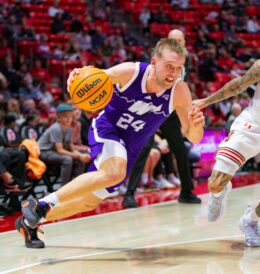
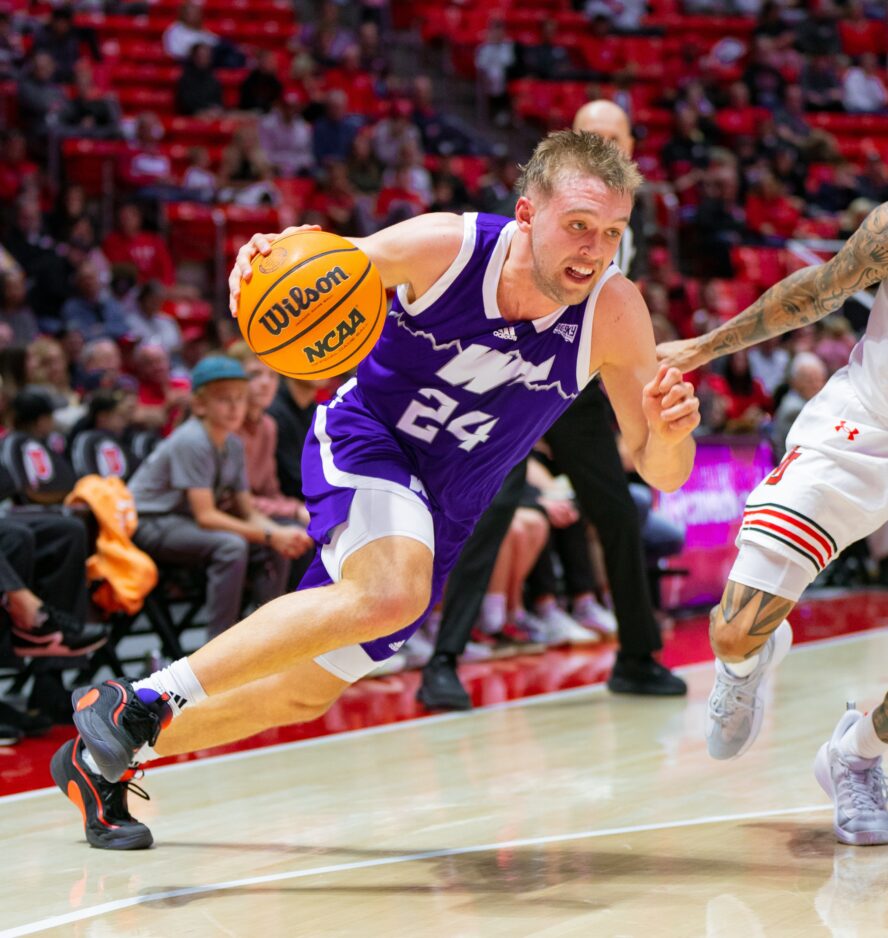
- Weber State guard Jace Whiting drives against Utah on Saturday, Nov. 8, 2025, at the Huntsman Center in Salt Lake City.
-
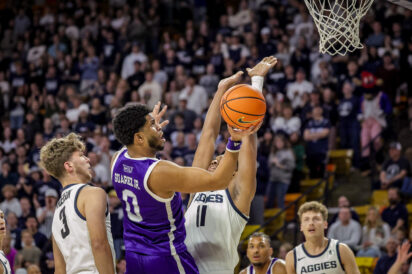
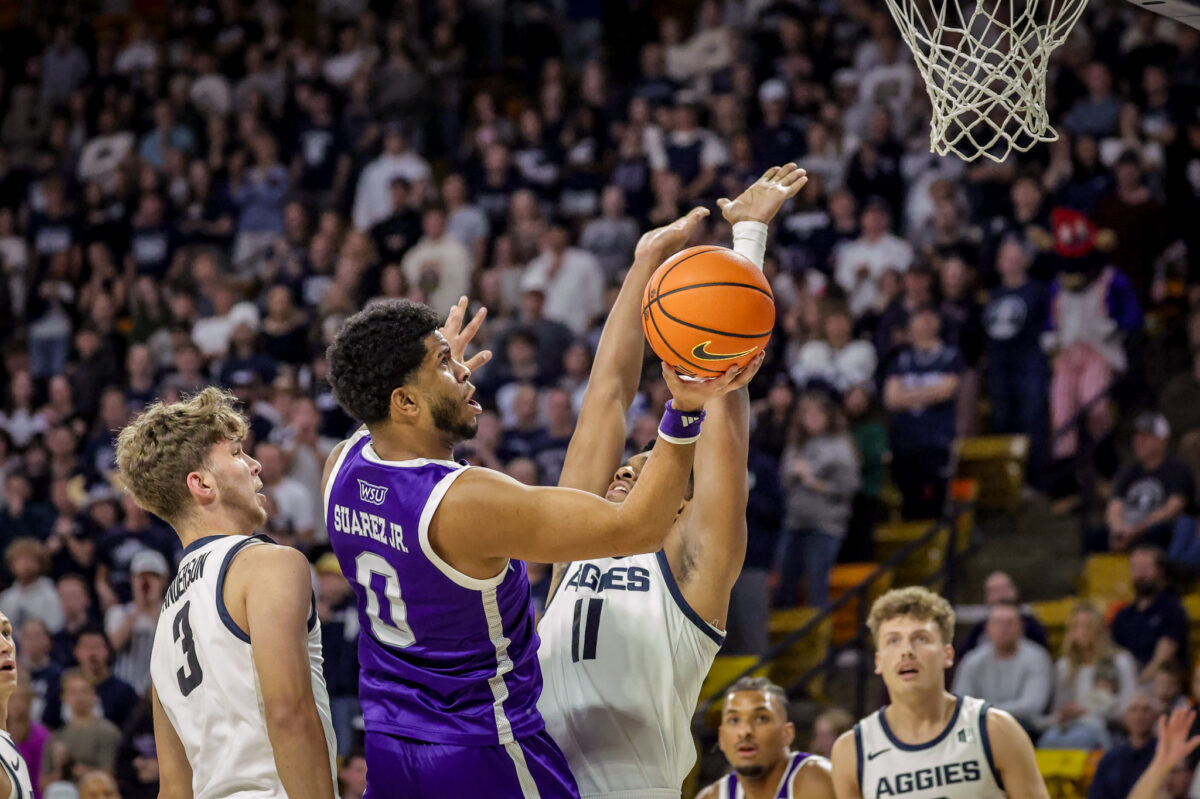
- Weber State forward Edwin Suarez Jr. (0) tries to score between Utah State defenders Tucker Anderson (3) and Garry Clark (11) on Wednesday, Nov. 12, 2025, in Logan.
-
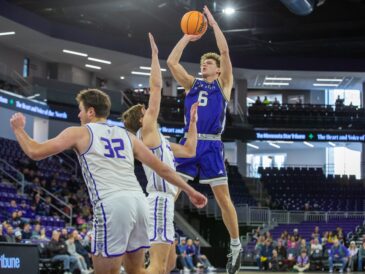
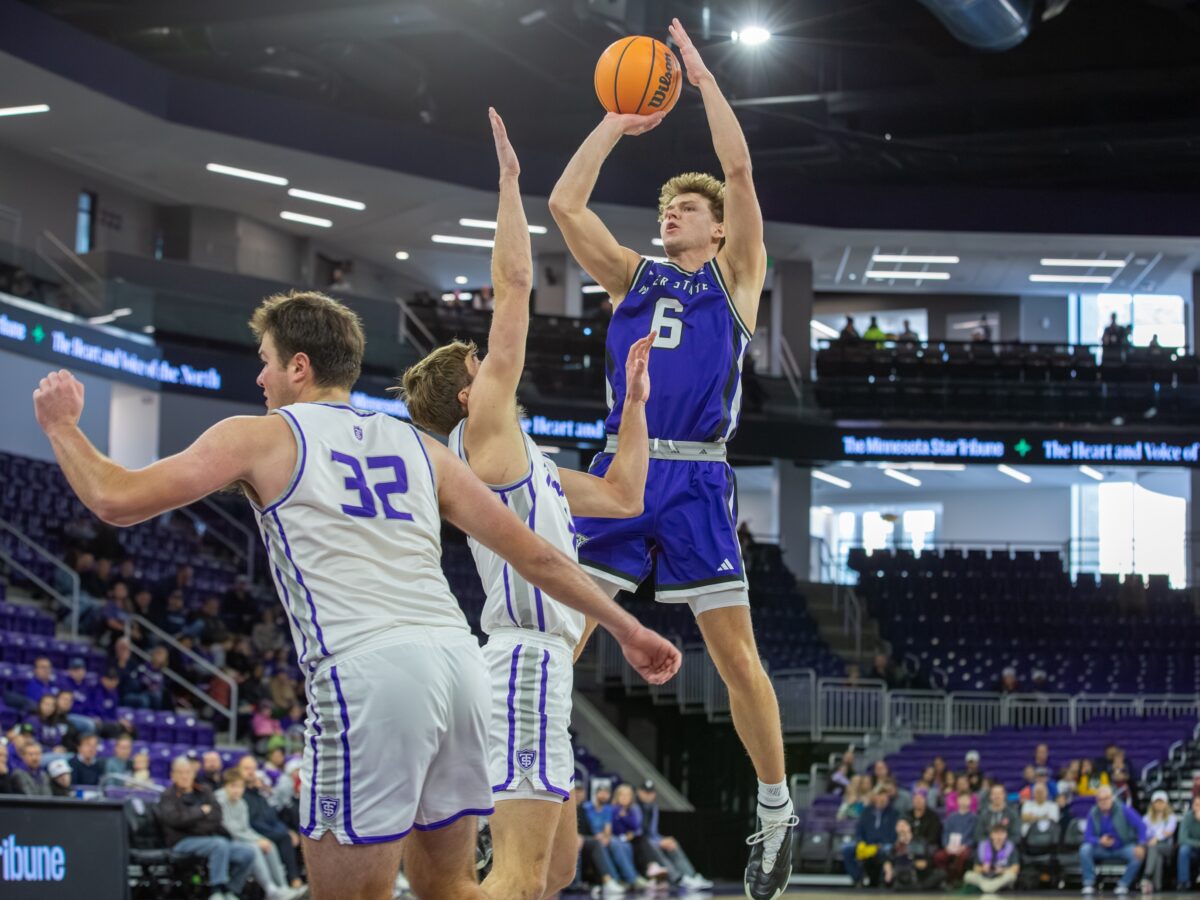
- Weber State guard Trevor Hennig (6) rises to shoot against St. Thomas defenders on Sunday, Dec. 7, 2025, in St. Paul, Minn.
OGDEN — Weber State men’s basketball enters nonconference play largely unproven and unsettled.
The Wildcats opened the season with unexpectedly competitive games against Utah State and Utah, and spent long stretches in games running Kansas City, Campbell and Oral Roberts off the court. However, WSU was also decidedly not competitive in road losses at St. Thomas and Utah Valley, and couldn’t make enough winning plays in close home losses to UT Arlington (74-73) and Utah Tech (82-80).
Overall, the Wildcats are 6-7 entering conference play, with a 4-7 mark against Division I opponents. WSU is 216th nationally, according to Ken Pomeroy — up 87 spots from the start of the season, but still seventh in a Big Sky that rates the strongest it’s been in the last three seasons.
Weber State played without junior wing Viljami Vartiainen for the second half of nonconference play, sidelined on Nov. 29 with a knee injury; Vartiainen was netting career-high averages of 11.4 points, 3.0 rebounds, 1.9 assists and 1.1 steals per game before a Kansas City player put forth a physical challenge during a screen handoff that sent him to the court.
Still, WSU has averaged 79.7 points per game in the absence of a player head coach Eric Duft called “our best executor on both ends of the court.” Several things work, but what the Wildcats might have been building early in nonconference play has seemed less solid in recent weeks.
Junior point guard Tijan Saine Jr. summed it up after the loss to Utah Tech.
“That game was lost in the margins,” Saine said. “The little things, the ticky tack fouls, staying in front of your man; just getting out of our principles, really. We just let that one slip away from us.
“We’ve just got to keep stacking because we made significant strides … we have a lot more to prove, a lot more to show.”
One example: the Wildcats totaled 17 offensive rebounds against Utah and 13 against Utah State. But against Utah Tech, WSU grabbed a season-low six.
“I think our team has gotten better in a lot of areas, but we’re losing the margins a little bit right now, which we weren’t earlier,” Duft explained. “We’re not quite as good a rebounding team as we’ve been. We’ve got to win closeouts better, do some of those little things, secure the ball better when we rebound it, execute just a little bit better.”
Duft said his staff is constantly trying to get his players to lock in on one side of the floor to help the other, as one way of winning the margins; that’s in defense leading to offense. Sophomore guard Trevor Hennig is a good example, he said. Hennig had struggled over a long stretch before finishing nonconference by scoring 31 points on 12-of-14 shooting in the final two games.
“We talk relentlessly around here about, you’re going to play bad on offense if that’s all you think about,” Duft said. “When you play well on offense is when you are diving into the defensive end, you’re diving into just winning the game, being a great teammate — then the game will come to you, and you will play better offensively. And we preach that relentlessly here.”
Duft said he thought the holiday break came at a good time for his team to refresh mentally.
One of the ways his players are learning has less to do with skill or Xs and Os, but with managing their roles and rising up to them. One trend this season has been glaring: if one player plays well one night, chances are he’s going to disappear the next.
For example: in a road loss at St. Thomas, Jace Whiting scored 17 points, Hennig 15 and Saine 12, while Malek Gomma and Edwin Suarez combined for 13 points and 14 rebounds.
In the next game at Kansas City, Gomma totaled 19 points and 13 rebounds and Nigel Burris knocked down three 3s for 14 points, but Hennig shot 0 of 5 from distance and committed six turnovers. But the next time out, at Utah Valley, Gomma had only four points and six rebounds while Suarez exploded for 26 points and 10 rebounds.
But yet again, moving to the home loss to Utah Tech, Suarez and Gomma combined for only 13 points and 13 rebounds; Saine, meanwhile, scored a season-high 28 points.
WSU currently has five players averaging double-digit scoring, with Burris at 9.4 and Gomma at 8.0.
Saine explained that it’s a struggle that he thinks will become a strength.
“It’s a strength that any given night, someone on our team can get going because a lot of teams don’t have that … six-deep 20-point scorers on a certain team, I feel like,” Saine said. “It’s a weakness the way we’re using it because … as a team, we’re taking the next game off.
“The only way to get better is capitalize on the next outing because you’re only as good as your newest game. You’re only as good as the performance you put in right there, right then. The past don’t matter.
“We’ve got a lot of new guys who haven’t had a chance to be leaders at this level. I feel like we’re getting better at it. In the long term, I feel like it will be a plus but right now, we’ve just got to hammer down and realize one game (doesn’t mean anything).”
That last part is where Duft sees the most room for growth.
Gomma, for example, is coming from a two-year backup role at Seattle; Whiting is similar, with having also not played most of last season due to injury; Suarez is a junior college transfer; and Saine is now leading a DI program for the first time as a point guard.
“These guys, their roles have expanded way more than they’ve ever had in their careers. So they have to learn and get a routine,” Duft said. “They have to understand mentally, emotionally, physically what it takes to be good each and every night. That’s what the real players do. They’re going through that process right now.
“We can’t just snap our fingers and they play great every night. It’s not going to be like that. They’re going to have to go through a process, they’re going through it. They play really hard, they’re really into it. Now they just have to find a routine that helps them play at their very best each and every night. That’s what the real guys do, and that’s what those guys are working towards.”
Duft said the coaching staff explains the routines of WSU’s past greats as examples current players can use to dial in every game.
Part of the battle, too, is knowing what to expect from night to night. One example, Duft said, was trying to help Gomma understand that Utah Valley would focus on him after he had 19 and 13 against Kansas City — and trying to understand what it takes to battle that kind of attention.
“Part of it is like, when you’re a parent, you can’t do everything for (your kids). Sometimes, you have to let them try something and then, success or failure, they’re going to learn from it,” Duft said. “We’re constantly meeting with them, watching film … they just have to go through that process.
“The great players are … very good players every night, and some nights they’re spectacular, and some nights they’re maybe a little below average. Their margins are smaller. We have to get these guys to understand what it takes at this level, and they’re great kids, they’re going to do that.”
Weber State returns to the court with a 2 p.m. tipoff on New Year’s Day in a stiff home test against Portland State, then hosts Sacramento State on Jan. 3.