VIDEO: Synthetic ice rinks the wave of the future?
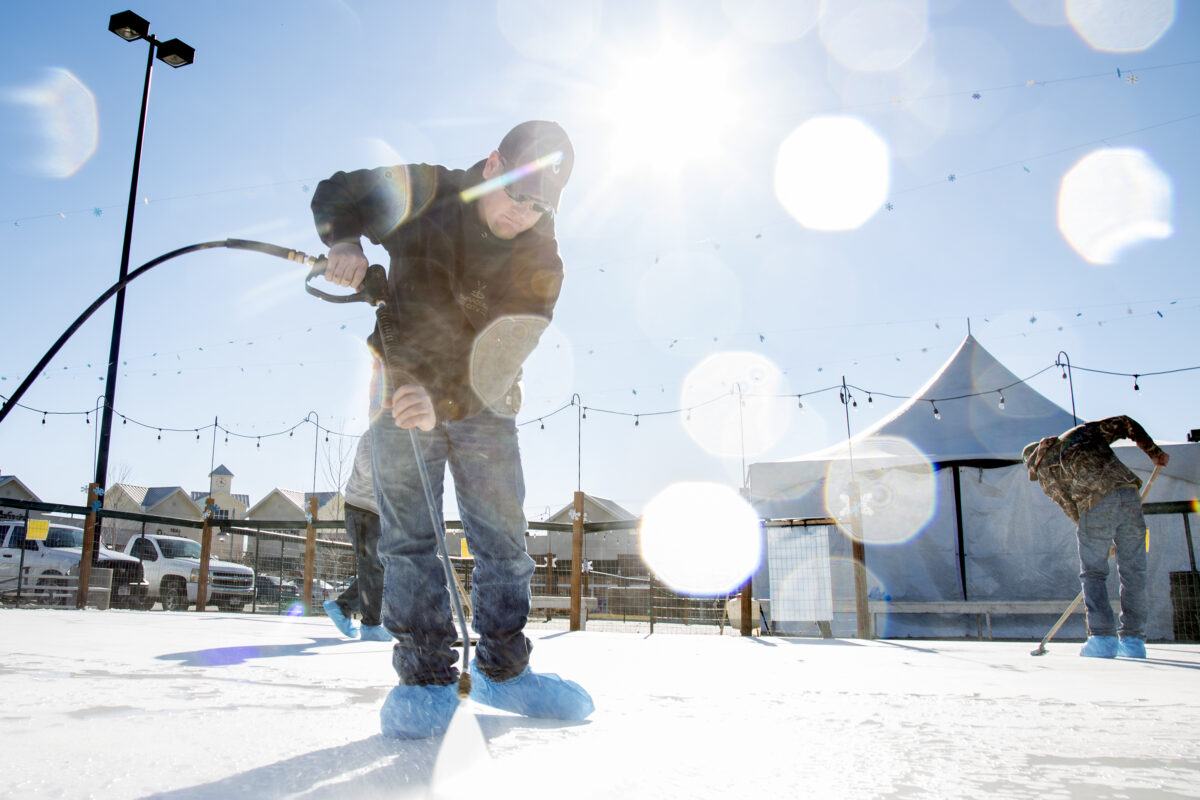
Curtis Bowers power washes the synthetic ice at the Syracuse Ice Rink on Thursday, Jan. 22, 2015. City employees come out about once a week to clean off the plastic "rink" and reapply a temporary finish.
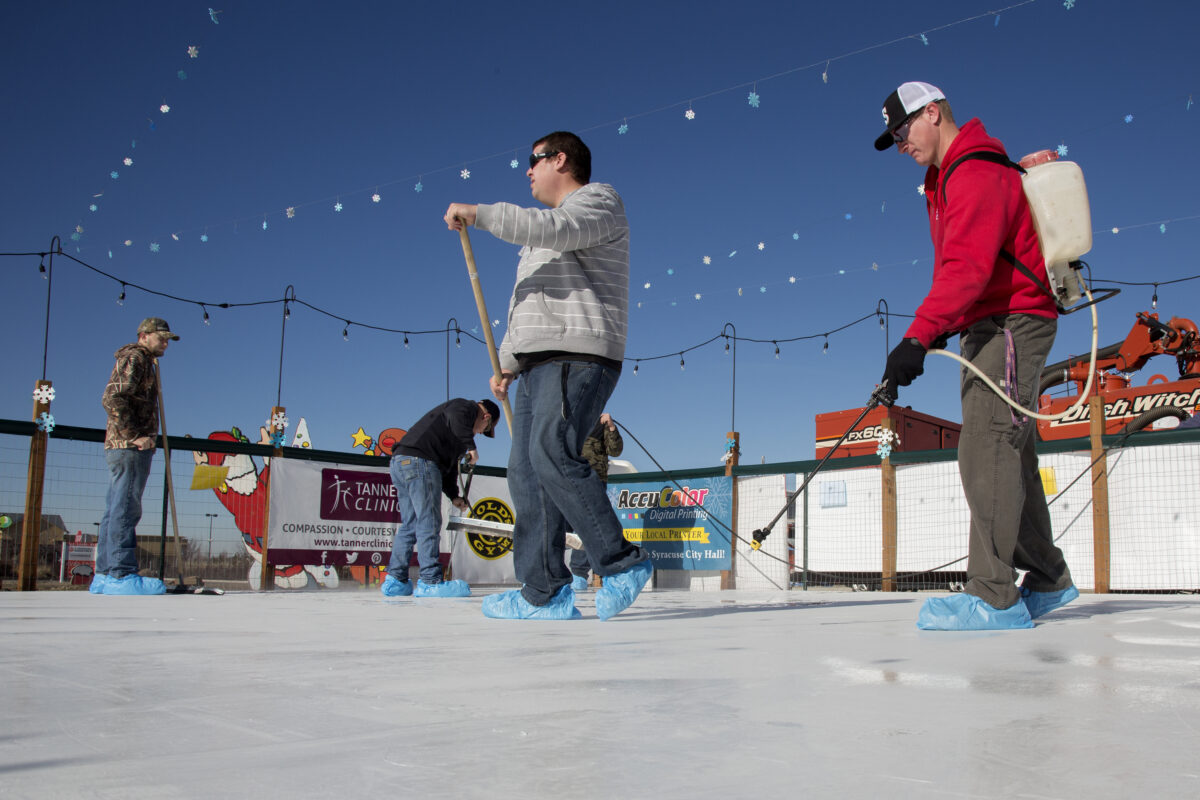
Garrett Moss, Curtis Bowers, Aaron Harris and Chad Smout (left to right) refinish the synthetic ice at the Syracuse Ice Rink on Thursday, Jan. 22, 2015. Employees from the Parks and Recreation and Public Works department clean off the old ice for an hour before Smout sprays on a new layer the enhancer.
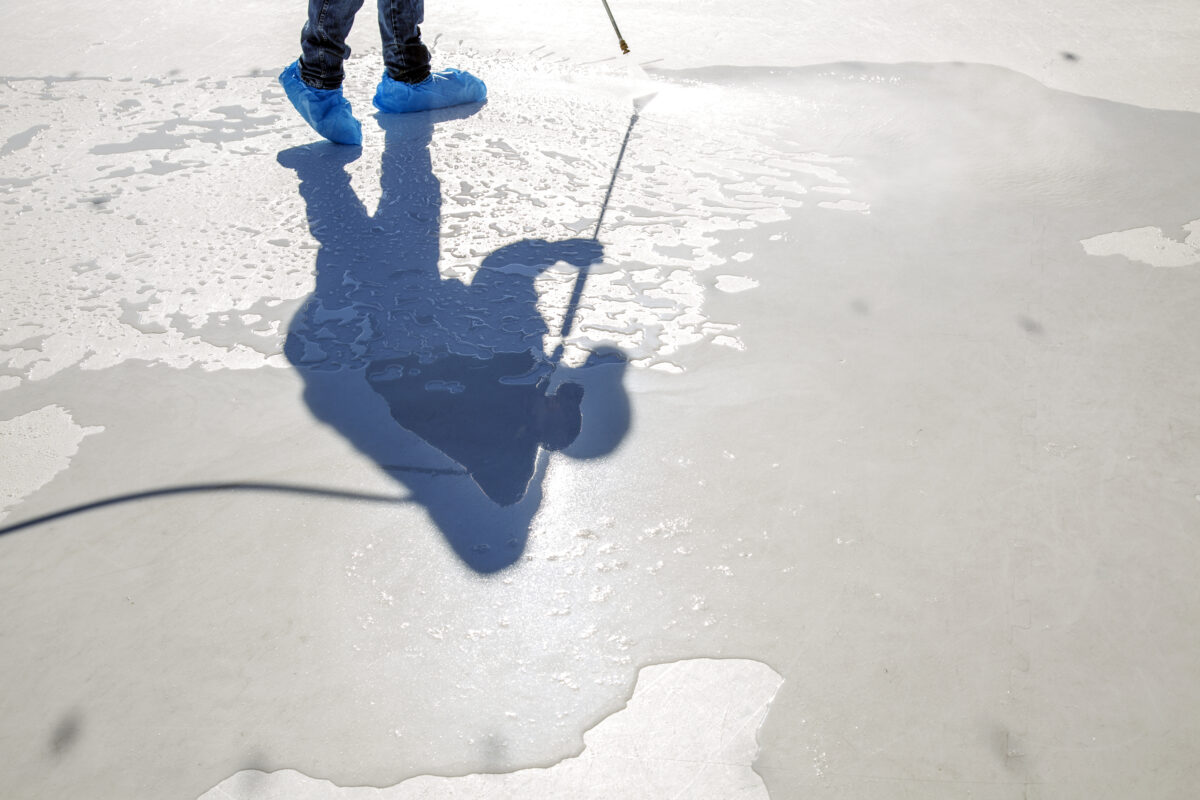
Curtis Bowers power washes the synthetic ice at the Syracuse Ice Rink on Thursday, Jan. 22, 2015. This is the first year that Syracuse has used the artificial ice rink.
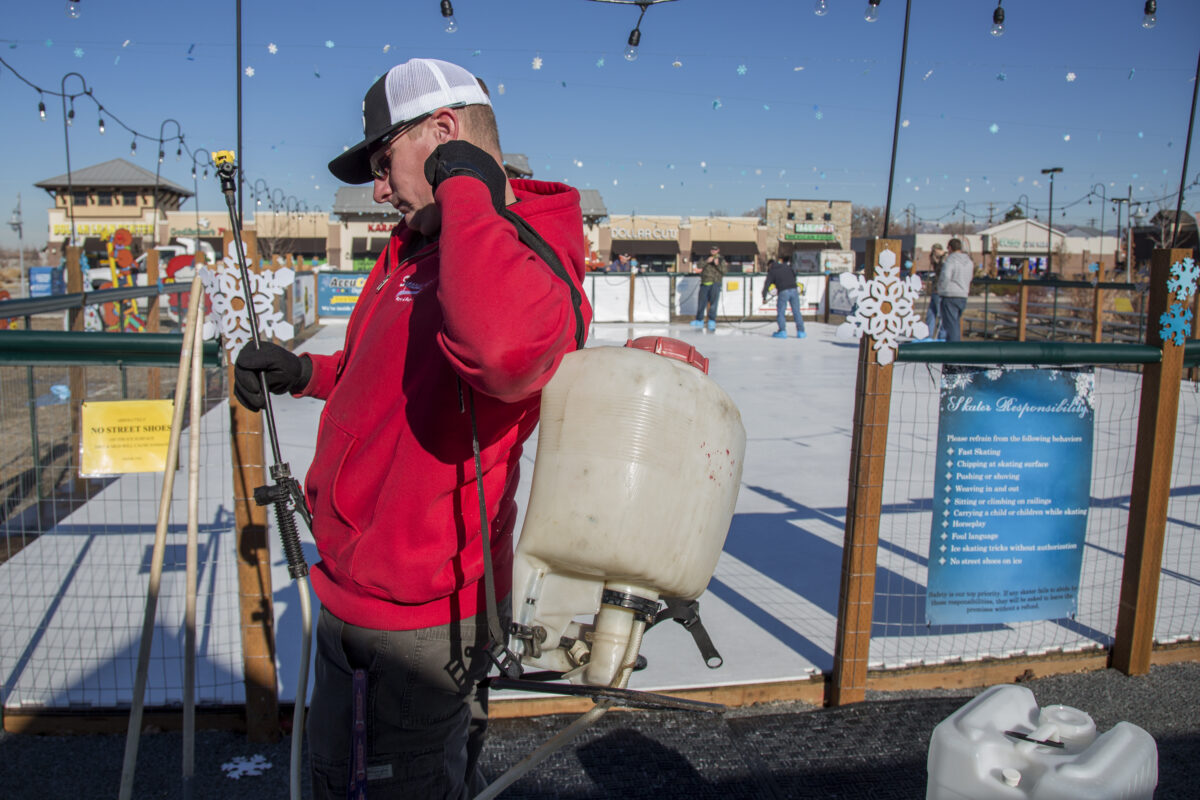
Chad Smout, the assistant director of the Parks and Recreation department in Syracuse, straps on a sprayer filled with enhancer to refinish the synthetic ice at the Syracuse Ice Rink on Thursday, Jan. 22, 2015.
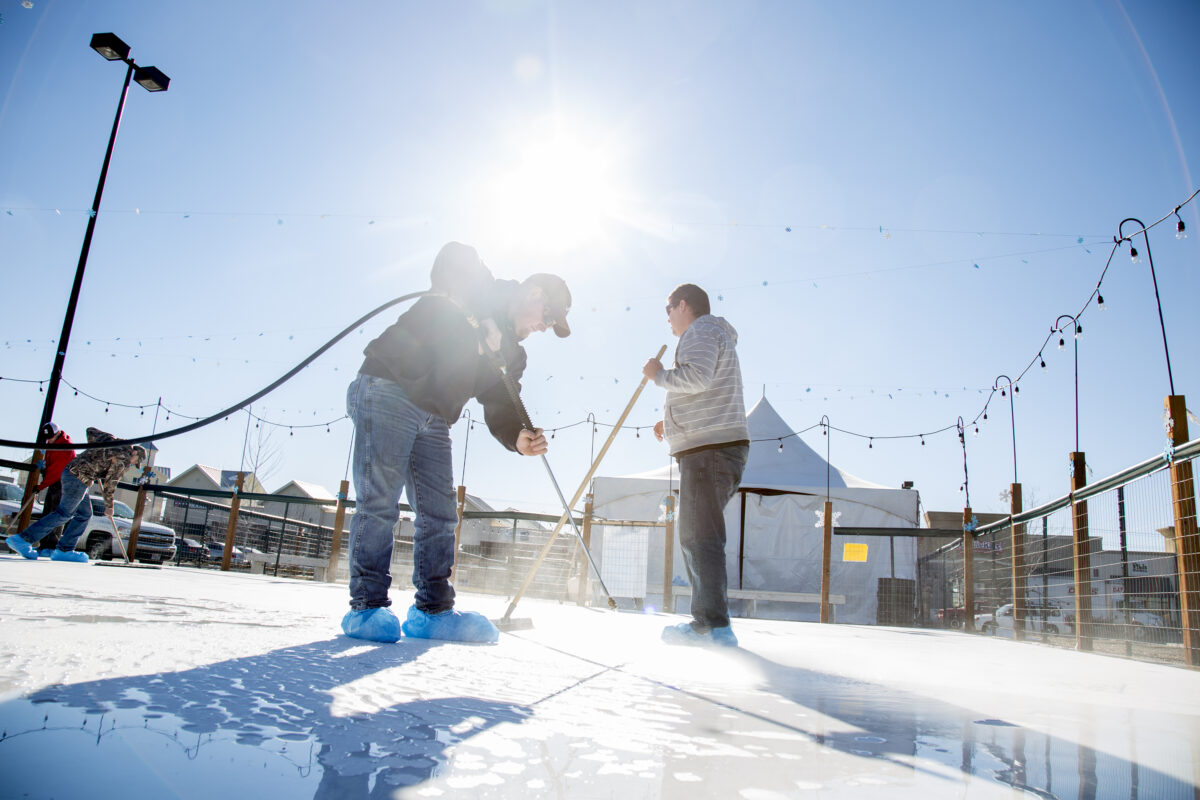
Curtis Bowers, left and Arron Harris power wash the synthetic ice at the Syracuse Ice Rink on Thursday, Jan. 22, 2015. The synthetic ice costs less than a refrigeration system and can be used above freezing, but it also has to be washed and refinished several times a month which can be difficult when temperatures are low.
SYRACUSE — It may not be as much fun as owning a Zamboni, but it is a heck of a lot cheaper.
On a recent January morning, six city workers gathered at the new Syracuse Ice Rink, at the Syracuse Towne Shopping Center at Antelope Drive and 2000 West. Donning powder-blue disposable protective booties and armed with an 800-gallon pressure washer and large squeegees, they were there for the weekly ritual of cleaning and preparing the rink’s “ice.”
We say “ice,” in quotations, to differentiate it from the ordinary, everyday frozen-water ice, without quotations. This “ice” is synthetic — dozens of half-inch-thick interlocking pieces arranged into a 40-foot-by-60-foot sheet of plastic and coated with what folks in the know say basically amounts to an extremely slippery food additive.
“It’s kind of like a big cutting board,” explains Chad Smout, assistant parks and recreation director for the city of Syracuse.
And like the one in your kitchen, Smout says it’s important this oversized cutting board stays clean. Dirt is not a friend to artificial ice — it increases the friction between skate and plastic. Hence, the protective booties.
Most Wednesday mornings, Smout and a small team of city workers spend about an hour and a half scouring the rink with a pressure washer set at 2,500 pounds per square inch. They also apply a weekly coating of something called DT-7H Extreme Enhancer, which helps give the plastic its super-slippery properties. This milky liquid — listed as non-toxic and EPA-approved — is sprayed on with a backpack pump sprayer, and a cloth is dragged around the rink to spread the enhancer uniformly.
Then, each day just before the skating rink opens, another “glide enhancer” called X-3 is applied to the rink.
The results, Syracuse City Manager Brody Bovero insists, are impressive. The synthetic ice has about 90 percent of the glide action of real ice, which makes it a pretty good imitation of real ice. Plus, the slightly less-slippery surface is more user friendly for novice ice skaters.
“It’s more attractive for a public rink because it is just a little less slippery, meaning there’s less of a chance to fall,” Bovero said. “It feels like ice when you’re skating on it, but it’s not as cold, and it’s not as hard when you fall. The only way to describe it is to experience it.”
Bovero believes Syracuse may have the first and only artificial-ice rink in the state of Utah.
“As far as we know, this is the first public synthetic ice rink,” he said. “I haven’t heard of any others.”
Skating on the rink is free, but there is a charge for skate rental. Jeremy Zaugg, of GSL Adventure Gear, in Syracuse, was asked by the city to run the skate rental concession. He’s new to the skate-rental business, but says he couldn’t pass up the opportunity.
“Let’s just say they gave me an offer I couldn’t refuse,” he said. “And winter is my slow season, so this was a perfect fit.”
Because synthetic ice offers more friction than real ice, there is a little more wear and tear on the city’s ice skates. But Zaugg says they just have to sharpen the blades a little more often.
The new synthetic ice rink has been so popular that city officials are talking about extending the season into March. They were originally going to close the rink on Feb. 14.
“A lot of people asked us, ‘Are you going to do this during the summer?’ ” Zaugg said. “We are going to extend into March, but by then people are starting to move on to soccer and other things.”
Bovero says the synthetic rink has been so popular among residents that next year they’re looking to increase its size to 40 feet by 80 feet.
“This is an experimental year for us,” Bovero said. “We decided to go with a smaller rink initially, but we do plan on expanding it next year.”
Not only that, but other cities are watching this Syracuse experiment very closely.
“We did get a phone call from Layton,” Bovero said. “They may be looking at it. At least, they asked a lot of questions.”
David Price, director of Layton Parks and Recreation, confirmed the city has made some calls to synthetic ice rink manufacturers to get some basic information, but he says it’s much too early to even be talking about a fake-ice rink in Layton.
“We have no plans to build an ice rink; we’re simply exploring different options,” Price said. “We’re not in the market for an ice rink.”
He says the city’s parks and recreation department is constantly on the lookout for new ideas — for example, they’re currently exploring the possibility of adding pickleball courts in the city.
“We’re always interested in new recreational trends; that’s what we do,” Price said.
The possibility of a synthetic rink would be only one of a number of ideas being considered, according to Price.
“An ice rink has always been in the back of our minds, and it would certainly be a nice addition to our holiday lighting display,” he said. “But we have no plans to build one.”
Bovero says the idea for the Syracuse rink came out of wanting to provide recreation for residents and boost traffic to local businesses. Officials discovered using synthetic ice was a way to accomplish both goals without breaking the bank.
“We knew a real ice rink would be way too expensive,” Bovero said, “between the refrigeration equipment and the ice-resurfacing Zamboni.”
Just how expensive? Ice Rink Engineering & Manufacturing, of Greenville, S.C., provides hundreds of new rinks each year — both of the traditional refrigerated type and synthetic variety — including the one in Syracuse. And price is a chief selling point for this faux ice, according to Jimmy Durham, the company’s CEO.
“There’s no power bill, and you don’t have an $80,000 Zamboni to buy,” he said.
For example, Durham’s company is currently working on replacing a refrigerated ice rink with a synthetic one at a ski resort back east, and he says there’s simply no comparison, cost-wise.
“They could replace the synthetic floor on that five or six times for just the cost of the refrigeration component,” he said. “It’s a fraction of the cost.”
And then, of course, you can add in the monthly power requirements to keep an ice rink from returning to a liquid state. The cost of maintaining an NHL hockey rink is between $14,000 and $21,000 per month, just in energy bills, according to Durham.
“A professional skater, given a choice, would choose a refrigerated rink over a synthetic one, every time,” he said. “That being said, for a lot of our customers, the question is not one of either refrigerated ice or synthetic ice. The question is, “Do I want synthetic ice, or nothing at all? Because I can’t afford refrigerated.”
Bovero said the rink cost the city just under $25,000. He doesn’t know how much a refrigerated rink would cost, but guesses it’s well over $100,000.
“We only know we wouldn’t have even been in the ballpark with a real ice rink,” he said.
Durham has worked in the ice skating industry since 1954. His father opened a refrigeration company back in 1937, and many family members — including Durham — have skated all over the world with the likes of Holiday on Ice and Disney.
“We’ve been there and done that in the skating industry,” he said.
Durham and his skating family and friends have been pursuing the dream of synthetic ice for decades now. Their earliest attempt?
“We put down sheets of plywood, covered with axle grease,” he said. “Believe it or not, we could move around on it, but it was as close as it gets to roller skating on gravel.”
Over the next eight to 10 years, they experimented with various plastic polymer sheets — “putting everything from axle grease to PAM on them,” Durham says.
Today, while the company offers four different synthetic ice products — including a self-lubricating one that still has a few bugs to be worked out — its No. 1 product is an “ice” surface called EZ Glide 350 DL. It’s what Syracuse officials have installed in their fair city.
Durham said one of the nice things about EZ Glide is that, even though it gets scratched and gouged, the plastic surface never has to be resurfaced.
“The more scratches it has, the faster it gets,” he said, because less of the skate blade comes into contact with a scratched surface, meaning less friction. “A floor that’s 10 years old will skate better than a brand new one. At a lot of the professional shows we do with synthetic ice, they request used panels rather than new ones.”
Durham says the synthetic ice business is booming. The company is doing eight to 10 times the business it was 10 years ago, and 2014 was the company’s most successful year to-date. Fake rinks have been particularly popular in warmer climates.
“The synthetic ice doesn’t care if it’s July or January,” Durham said. “Anything you can do on real ice, you can do on synthetic. It’s a very viable alternative.”
Bovero believes synthetic rinks may be the wave of the future.
“You’ll start to see them at shopping malls in warm-weather climates,” he said.
Another advantage: Synthetic ice stores quite nicely. The interlocking 45-inch-by-90-inch sections come apart and can be stacked neatly in the off-season.
“Your rink can just about be stored in a closet,” Durham said.
Or, Smout suggests, it’s something that could be used year-round.
“Who knows?” he said. “Maybe eventually we’ll have a little hockey league here.”
In the meantime, Smout and his crew will continue to act as a poor man’s Zamboni, pressure-washing their ice weekly — weather permitting. While washing the plastic is relatively inexpensive and easy, it can’t really be done when temperatures dip below freezing.
“We have to wait for breaks in the weather,” Bovero says. “When you’re power-washing the rink in single-digit temperatures, you’re basically spraying a sheet of ice down on your rink. Which, ironically, is not what you want here.”
Because apparently, the last thing you want on your synthetic ice sheet is a sheet of real ice.
Contact Mark Saal at 801-625-4272, or msaal@standard.net. Follow him on Twitter at @Saalman. Like him on Facebook at facebook.com/SEMarkSaal.