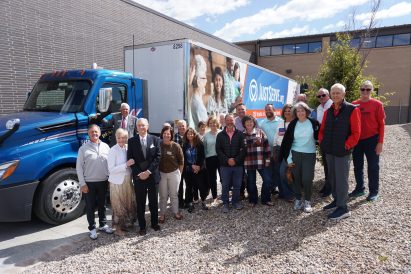
SALT LAKE CITY -- Education and business leaders gathered at the Utah State Capitol on Thursday in hopes of drawing attention and additional funding to USTAR, the Utah Science Technology and Research initiative.
USTAR's mission is to strengthen Utah's economy by supporting innovative science and technology research at Utah colleges and universities that can create new commercial businesses or can partner with existing businesses, resulting in new industries and jobs for the state.
"USTAR is an investment in higher education and in economic development," said F. Ann Millner, Weber State University president. "This initiative has made a significant impact on Weber State's campus and in our surrounding community."
"USTAR has delivered impressive results," said Dinesh Patel, chairman of the USTAR Governing Authority, "and now in the current economic climate, it is time to fulfill its full promise."
USTAR originally envisioned a program based on $25 million per year in state funding. With that, USTAR leaders said, they could deliver 422 new companies, $4.9 billion in external research funding, 123,000 new jobs and $5 billion in state tax revenues.
In USTAR's first year, 2007, lawmakers appropriated closer to $17 million, and that figure has decreased in most years since. USTAR officials are now aiming to get cuts restored, and secure additional funding to get back to a $15 million level. According to USTAR projections, $15 million per year, over 30 years, would mean 242 new Utah companies, $3.1 billion in external research funding, 73,000 new jobs and $2.9 billion in new state tax revenues.
Millner said USTAR had produced the best return on investment of any research program she had seen in 30 years.
"We can take technologies that are close to being ready for commercial use and get them to market," she said. "We are able to leverage everything going on in the institution, and leverage to create new companies that didn't exist before, or to help grow existing companies."
Among Weber State's promising projects is one involving bicycle racing tires use by elite athletes. Research and testing allowed academic and commercial partners to create tires that could handle more stress without overheating and becoming misshapen and nonfunctional.
Instead of moving overseas to cut cost, the company more than doubled its small staff.
Another WSU project found a superior technology for use in creating heat shields on aircraft, cutting down the incidents of cracks and saving money.
Professors at the University of Utah are looking for new ways to treat Down syndrome; to create "smart cap" pill bottles that communicate with patients and medical staff; to design technology that could help restore partial vision to the blind; and to create polymer-based nanoparticles to target cancer cells.
Among projects at Utah State University are the creation of spider silk proteins that could be used to create very lightweight, strong materials; programs to accurately project the paths of hurricanes and tornadoes, and to predict flood potential; and a program to forecast solar flares and geomagnetic storms that interfere with polar air travel and satellite communications.
"The businessman in me sees an expense as money gone," Jim Smith, president and CEO of the Davis Chamber of Commerce, said about potentially increased state funding for USTAR. "This is an investment, something that will pay significant dividends for years to come."


Comments