The principle mission of journalism is to convey news and information to as many people as possible.
We consider this serving our community -- producing content that attracts and appeals to an audience, which can be defined in terms of common interest or common borders.
The Standard-Examiner, like many newspapers, has a greater audience now than it has ever had. Counting print circulation, our website, mobile site, e-edition and our new tablet edition, the Standard reaches millions of people each year.
Yes, millions.
However, there is greater competition for this audience. There are now thousands of news organizations and various websites, some operated by people who consider journalism a hobby, all competing for the same audience.
This has somewhat changed the role of the reporter. Now the reporter's identity is as important as the newspaper's.
This means the reporter has a role in promoting and marketing a story to assure it is seen by as big an audience as possible. This is where social media comes in.
I used to think that social media was just a tool to help reporters do their jobs -- making contacts, developing sources and following subjects on their beats. Now, through Twitter, Facebook, YouTube and other social media outlets, reporters help spread their stories while establishing their personal brands as well as that of the newspaper.
At the Standard, no one has been better at this than Scott Schwebke.
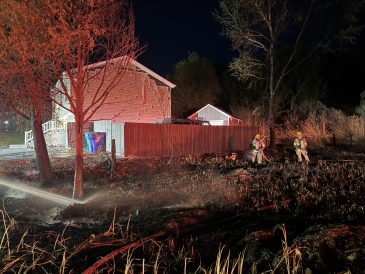
The day cops reporter has his own social media mini-network called The Chalk Outline. It includes a Twitter account, which is connected to his Facebook page; a YouTube channel; and a streaming video channel on Ustream.
On his network, he tweets and links to interesting crime news stories from all over, including those featured on Standard-Examiner sites and especially his own stories.
We encourage all staffers to have their own social media accounts, but we don't police them. We have some personal conduct rules we expect them to follow. As for the connection to their jobs, we have a policy that they aren't to "break" any news on Twitter or Facebook until the story has been posted on our website.
This can be frustrating to Scott when he is out in the field on a breaking news story.
"I would like to tweet everything from the scene," he said. "It's like knowing a secret without being able to tell anyone."
In the old print-only era, getting beat on a story was measured in days. Now it is measured in minutes.
The Chalk Outline has 2,500 followers, including competing journalists. Scott says he also follows a number of people, including sources, friends and other journalists.
He has gotten a number of news tips through social media, including the recent story of a body found in Roy. He said a woman asked him on his Facebook page why the police were digging in her Roy neighborhood.
"People feel more comfortable asking questions on social media rather than calling or emailing us," he said.
And they also have no qualms about sharing.
"People have sent us videos we have used," Scott says.
Scott is what we call a print-online journalist, or pojo. He is a multimedia reporter who takes pictures and video in addition to writing. He is well-connected, often using mobile devices to transmit news and content back to our office.
Scott grew up in Florida and graduated from Brigham Young University. He worked at newspapers in Virginia, North Carolina and Colorado before returning to Utah, where his wife grew up. Before becoming our day cops reporter, Scott covered Ogden city government.
He says social media has opened new opportunities for him in his job because it allows for immediate information from "the street."
He has followed social media coverage of the protests in Egypt and other Arab countries, collectively referred to as the Arab Spring.
He says, "I think it's fascinating to see things through their own eyes."
You can follow Scott at www.twitter.com/TheChalkOutline
Andy Howell is executive editor of the Standard-Examiner. He can be reached at 801-625-4210 or ahowell@standard.net.


Comments